Thinking about becoming a pilot car driver? Or maybe you’re already one and wondering if you’re leaving money on the table. Either way, this post cuts straight to the numbers — salaries, rates, hidden fees, and the real costs that eat into your earnings. Stick around, because the gap between what you think this job pays and what it actually pays might surprise you.
What Is a Pilot Car Driver, Exactly?
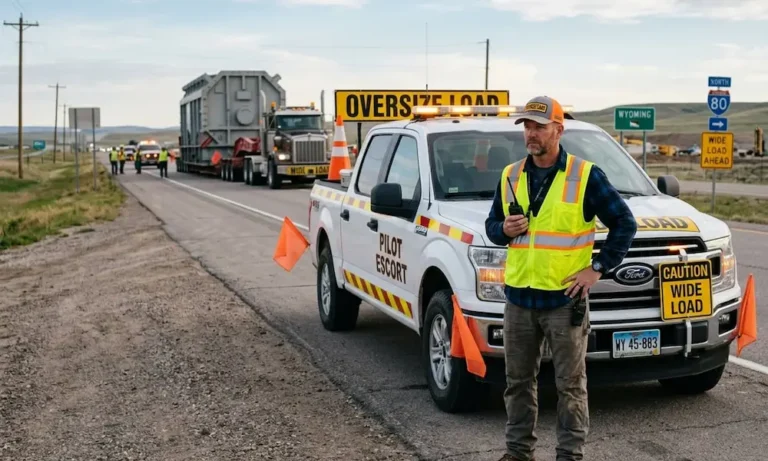
A pilot car driver — officially called a Pilot Escort Vehicle Operator (PEVO) — travels ahead of or behind massive oversize loads on public roads. Think wind turbine blades, industrial cranes, or prefab bridge sections. The job protects other drivers, prevents infrastructure damage, and keeps the convoy legally compliant.
It sounds straightforward. The pay structure? Anything but.
How Much Does a Pilot Car Driver Make as a Company Employee?
If a trucking company or logistics agency hires you as a W-2 employee, your pay looks like this:
| Compensation Tier | Annual Salary | Hourly Wage |
|---|---|---|
| 75th Percentile | $44,328 | $21.00 |
| Average | $40,293 | $19.00 |
| 25th Percentile | $35,547 | $17.00 |
The national average sits around $40,293 per year. Entry-level drivers start closer to $31,226. Experienced senior operators can push past $48,000.
The trade-off? Company jobs offer real stability. Your employer covers the truck, insurance, maintenance, and fuel. You get workers’ comp, health benefits, and consistent paychecks. But your earning ceiling is fixed. You can’t take side contracts or negotiate your own rates.
How Much Does a Pilot Car Driver Make as an Independent Contractor?
Here’s where the numbers get interesting — and complicated.
Independent pilot car operators average $130,916 per year in gross revenue, roughly $62.94 per hour. Top earners gross over $175,000 to $201,500 annually.
But read that carefully: gross revenue, not take-home pay.
Before a single dollar hits your pocket, you pay:
- Self-employment and federal taxes
- Commercial insurance premiums
- Fuel
- Vehicle maintenance and depreciation
- Permit fees
- Administrative costs
After all that overhead, your net income may land closer to an experienced company driver’s salary. The upside? No income ceiling. Operators who work the right markets and negotiate smart can genuinely out-earn almost anyone in the W-2 lane.
What Factors Change How Much a Pilot Car Driver Makes?
Experience and Skill Set
More years equal more money, but not by as much as you’d think. An entry-level operator averages $39,831 annually. An operator with eight-plus years averages $42,649. The real income jumps come from specialized skills, not just tenure. Competencies like route surveying, high-pole operation, and cargo handling can boost your base salary by 5% to 14%.
Industry Sector
The sector you serve matters. Here’s how different industries stack up:
- Energy and Utilities: $46,337/year
- Durable Goods Manufacturing: $45,128/year
- Construction: $44,322/year
- Aerospace and Defense: $43,919/year
Escorting renewable energy equipment — wind turbines especially — consistently pays more. Get used to that theme.
Geography
Where you work dramatically shifts your earning potential. Remote, industrial, or weather-extreme regions pay a premium because demand is high and competition is low.
| Location | Average Annual Revenue | Hourly Equivalent |
|---|---|---|
| Two Rivers, Wisconsin | $176,652 | $84.93 |
| Scotts Valley, California | $169,418 | $81.45 |
| Barrow, Alaska | $163,092 | $78.41 |
| Berkeley, California | $160,299 | $77.07 |
| Aspen, Colorado | $158,240 | $76.08 |
| Kilauea, Hawaii | $156,913 | $75.44 |
Texas, a massive freight state, averages $39,301 for employees and $121,969 for independent contractors — slightly below national independent averages. More competition, more pressure on rates.
How Do Pilot Car Drivers Actually Charge for Their Work?
Independent operators don’t get a set paycheck. They build income through per-mile rates, flat day rates, and a stack of accessorial fees.
Core Per-Mile Rates
| Service Type | Rate Range |
|---|---|
| Lead / Chase Car | $1.45 – $2.00/mile |
| High Pole Car | $1.55 – $2.50/mile |
| Steer Car (Tillerman) | $1.65 – $3.00/mile + ~$60/day |
| Superload Escort | $550 – $600 flat day rate |
High pole cars measure clearances ahead of the load. If the flexible pole hits a wire or bridge, the convoy stops — no catastrophic strike. The liability demands a premium rate.
Steer cars actively control the rear axles of long trailers through tight turns. It’s technical, it’s stressful, and the market pays accordingly.
Superloads — loads over 16 feet wide or 150,000 pounds — often travel 20 to 50 miles in a full shift. Per-mile pricing makes no sense here. Flat day rates of $550 to $600 protect the operator’s time investment.
Accessorial Fees That Protect Your Bottom Line
Smart operators don’t just charge per mile. They protect their margins with add-on fees:
| Fee Type | Typical Rate |
|---|---|
| Deadhead (empty travel) | $0.50 – $1.00/mile |
| Overnight | $65 – $100/night |
| Layover (full lost day) | Up to $250/day |
| Detention / Downtime | $25 – $50/hour |
| Route Survey | $1.30/mile or $400 flat |
| Night Surcharge | ~15% added to total |
| Tolls | Billed directly to carrier |
Deadhead fees deserve special attention. Driving empty to a job start point still burns fuel and puts miles on your truck. Stand firm on collecting that rate, or you’ll lose money before the job even starts.
What Does It Actually Cost to Run a Pilot Car Business?
The overhead reality is where a lot of new operators get blindsided.
Variable Costs
Fuel is your biggest enemy. Pilot cars are typically heavy pickup trucks or SUVs loaded with equipment. They’re not fuel-efficient. Every rate you negotiate needs to account for real-world fuel consumption over long distances.
Maintenance runs 10 to 15 cents per mile driven. That includes oil changes, brakes, tires, transmission service, and the inevitable surprises. Financial advisors in the transport sector recommend keeping a $4,000 emergency repair fund at all times. A breakdown means lost revenue and potential contract breaches.
Fixed Costs
These hit you every month, regardless of how many loads you run:
- Self-employment taxes — you pay both sides (employer and employee portions)
- Bookkeeping services: $300 – $500/month
- Tax preparation: $400 – $1,000/year
- Permit and inspection fees
- Factoring services: 1% – 5% of invoice value if you use them for faster payment
Insurance Is Non-Negotiable
Standard personal auto insurance doesn’t cover business operations. Period. If you cause an accident on an active escort under a personal policy, your insurer denies the claim. You’re personally exposed.
Commercial pilot car insurance runs $3,000 to $6,000 per year for solo operators. Multi-vehicle agencies can pay $20,000 or more. You need four types of coverage:
- Commercial Auto Liability — Covers injury and property damage to third parties. Minimum $1,000,000 required by most carriers.
- General Liability — Covers incidents outside the moving vehicle. Think: a civilian trips over your traffic cones. Standard limits are $1M per occurrence, $2M annual aggregate.
- Professional Liability (E&O) — Covers your professional mistakes. If you miscalculate a height pole reading and the load hits a bridge, your general liability policy won’t help. E&O insurance covers that gap.
- Inland Marine — Covers your onboard equipment: light bars, GPS systems, radios, height poles. Coverage typically ranges $1,000 to $5,000.
State Certifications You Actually Need
The pilot car industry runs on a patchwork of state rules. Fourteen states require official PEVO certification before you can legally operate:
Arizona, Colorado, Florida, Georgia, Louisiana, Minnesota, Nevada, New Mexico, New York, North Carolina, Oklahoma, Pennsylvania, Utah, Virginia, and Washington.
To get certified, you typically need to:
- Be at least 18 years old (21 in some states)
- Hold a valid driver’s license with a clean record
- Prove commercial liability insurance coverage
- Complete an 8-hour training course and pass a written exam
- Renew every 3 to 5 years
Reciprocity Isn’t Guaranteed
Most certification states recognize each other’s credentials to some degree. Colorado, Florida, Minnesota, North Carolina, Oklahoma, Utah, Virginia, and Washington share a fairly open reciprocity agreement.
Two major pitfalls to know:
- Residency rules override reciprocity. A Washington State resident can’t use a Florida certification to operate in Washington. Your home state’s card is required.
- New York accepts nobody’s credentials. NY demands its own DMV certification. No exceptions.
The WITPAC Credential
If you want to escort wind turbine components — one of the highest-paying freight categories right now — get the Wind Industry Transportation Professional Advanced Certification (WITPAC).
Requirements: Hold an existing state PEVO cert or a Class A CDL, complete an online prep module, and pass a proctored exam with 90% or higher. The training covers escorting turbine blades that can stretch past 300 feet. It’s demanding. It also opens doors to premium contracts most operators can’t touch.
What’s Driving the Industry Right Now?
The pilot car industry isn’t shrinking. National brokerages are actively raising escort rates from $1.75 to $1.85 and $1.90 per mile just to find enough qualified drivers. Three big forces are behind the surge:
- Renewable energy: Wind turbine transport has increased 66% since 2020. A single turbine installation can require over a dozen separate heavy-haul shipments, each needing front and rear escort.
- AI and data center construction: These facilities use 250,000-pound electrical transformers — a superload category that barely existed before 2020.
- Federal infrastructure investment: Texas and California alone have issued over 20% more oversize permits since 2020.
Operators near wind farm corridors, manufacturing hubs, or major ports are sitting in exactly the right place.
FAQs
Do pilot car drivers need a CDL?
Generally, no. Pilot cars fall under the 26,001-pound threshold that requires a CDL. A standard driver’s license works for most operations. That said, a CDL is a real advantage — and WITPAC certification requires you to have either a Class A CDL or an existing state PEVO certification before you can enroll.
How do independent operators find loads?
Through specialized digital load boards built for the oversize transport sector, direct relationships with heavy-haul carriers, and freight brokerages. The most successful operators bypass load boards entirely by locking down long-term contracts with recurring carriers.
Can passengers or pets ride along during an escort?
No. Standard industry practice — and most commercial insurance policies — prohibit passengers, children, or pets during an active escort. The operator needs full focus on radio traffic, clearances, and road hazards. Unauthorized passengers create liability and distraction.
What happens if a pilot car driver gets a moving violation?
It’s serious. State PEVO certifications require a clean Motor Vehicle Record. Reckless driving, speeding in work zones, or any DUI/DWI will result in certification denial or revocation. Traffic violations also spike commercial insurance premiums — sometimes to the point where maintaining the required coverage limits becomes financially impossible.
Who pays for tolls during an escort?
The carrier pays, not the pilot car operator. But the operator physically pays at the toll plaza and bills it back to the carrier as an accessorial charge on the final invoice.