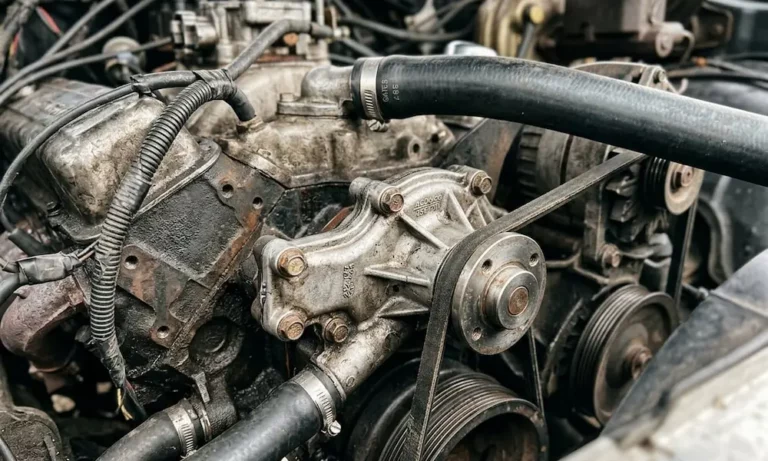
Got a puddle of green liquid under your car and a temperature gauge creeping into the red? Your water pump might be dying. Knowing how much to replace a water pump in a car before you walk into a shop puts money back in your pocket. This guide covers every cost factor — your engine type, your city, your repair shop choice — so you can stop guessing and start planning.
What’s the Average Cost to Replace a Water Pump?
The national average cost to replace a water pump runs between $857 and $1,106, all-in. That breaks down into:
- Labor: $358–$525
- Parts: $499–$581
Those numbers assume a typical import or domestic vehicle at a standard shop. Budget shops doing simple external pumps can come in as low as $240. Complex European or performance vehicles can push past $1,350.
Here’s the quick view by service tier:
| Service Tier | Parts Cost | Labor Cost | Total Cost |
|---|---|---|---|
| Budget | $40–$100 | $200–$400 | $240–$500 |
| Mid-Range | $100–$200 | $400–$700 | $500–$900 |
| Premium | $200–$350 | $700–$1,000 | $900–$1,350 |
One thing that surprises most people: shops don’t bill you by the minute. They use a flat-rate system based on labor guides from companies like Mitchell or Alldata. If the book says a repair takes two hours and the shop charges $120/hour, you pay $240 for labor — even if the tech finishes it faster. That’s why quotes vary between shops using different guides.
The Biggest Cost Factor: Where Your Water Pump Sits
This is the number that swings your bill the most. Where the pump lives inside your engine determines how many hours a tech spends getting to it.
External Belt-Driven Pumps (Cheapest)
These sit on the front of the engine, driven by the serpentine belt. A tech can usually swap one in two to four hours. Clean access, modest labor bill.
Internal Timing Belt-Driven Pumps (More Expensive)
The pump hides behind the timing belt covers, which means the tech has to pull the crankshaft pulley, timing covers, and belt tensioner just to see it. That pushes labor to four to eight hours.
Internal Timing Chain-Driven Pumps (Most Expensive)
This is where it gets brutal. Engines like the Ford 3.5L V6 EcoBoost house the pump deep inside, driven by the timing chain. Getting there requires:
- Removing timing and valve covers
- Disassembling the timing chain, guides, and tensioners
- Pulling camshaft phasers and VCT solenoids
That’s 10.8 to 12.3 hours of labor. Total repair cost: $2,500 to $3,000. A “simple” pump swap becomes a major mechanical overhaul.
| Engine Config | Drive Type | Labor Time | Estimated Labor Cost |
|---|---|---|---|
| Toyota Camry 2.5L 4-Cyl | Serpentine Belt | 1–3 hrs | $120–$360 |
| Toyota Camry 3.5L V6 | Serpentine Belt | ~4.2 hrs | $504 |
| Honda Accord V6 | Timing Belt | ~4 hrs | $480 |
| Ford 3.5L V6 (Flex/F-150) | Timing Chain | 10.8–12.3 hrs | $1,296–$1,476 |
Front-wheel-drive vehicles add another wrinkle. On a Toyota Camry 4-cylinder, the pump sits on the passenger side, blocked by the frame rail. Standard access requires removing the engine cover or lowering the block. Drop a bolt into the crankcase during this job and you’re looking at severe engine damage.
How Much Does Your Specific Car Cost?
Your vehicle’s model year matters more than most people expect. Older models aren’t always cheaper — complex engine packaging or a V6 instead of a four-cylinder can spike costs dramatically.
Toyota Pickup Example
Year-by-year pricing for the Toyota Pickup shows a sharp jump tied entirely to engine configuration:
| Model Year | Estimated Cost Range |
|---|---|
| 1995 | $519–$627 |
| 1994 | $897–$1,182 |
| 1993 | $897–$1,182 |
| 1992 | $897–$1,182 |
| 1991 | $927–$1,212 |
| 1990 | $927–$1,212 |
The 1995 model more commonly used the simpler inline-four. The 1990–1994 trucks used V6 engines that need far more disassembly to reach the pump.
Ford F-150 Example
Ford F-150 water pump replacement costs show a 200%+ jump from 2010 to 2023. The EcoBoost turbocharged V6, introduced in 2011, added coolant lines, charge air coolers, and tightly routed belts that make modern F-150 repairs far more complex.
| Model Year | Estimated Cost Range |
|---|---|
| 2024 | $1,133–$1,338 |
| 2023 | $1,340–$1,556 |
| 2021 | $1,340–$1,556 |
| 2018 | $1,134–$1,326 |
| 2015 | $965–$1,102 |
| 2010 | $455–$518 |
| 2009 | $443–$506 |
Does Your City Change the Price?
Absolutely. Labor rates across U.S. cities reflect local costs of doing business:
- Rural/lower cost-of-living areas: $115–$135/hour
- Standard metro shops: $120–$159/hour
- High-overhead cities (California, Connecticut): $150–$250+/hour
Here’s how the same repair — a water pump on a Chevy Silverado — varies by city:
| City | Silverado 1500 (2024) | Silverado 2500 HD (2023) |
|---|---|---|
| Los Angeles, CA | $1,042–$1,323 | $1,771–$2,351 |
| Houston, TX | $1,042–$1,323 | $1,771–$2,351 |
| Miami, FL | $1,036–$1,314 | $1,754–$2,326 |
| Chicago, IL | $1,030–$1,305 | $1,737–$2,302 |
| Denver, CO | $1,018–$1,287 | $1,704–$2,253 |
| Austin, TX | $1,011–$1,278 | $1,687–$2,228 |
| Seattle, WA | $1,005–$1,269 | $1,671–$2,204 |
| Phoenix, AZ | $993–$1,251 | $1,637–$2,155 |
Dealership vs. Independent Shop: Which One’s Worth It?
Dealerships charge $20–$40 more per hour than independent shops — that’s typically a 25% premium. They justify it with factory-trained techs, brand-specific diagnostic tools, and OEM parts.
For most people, the math tips toward an independent ASE-certified shop once your factory warranty expires. You get high-quality aftermarket parts at competitive prices without the markup.
When to choose a dealership:
- Your vehicle is still under the manufacturer’s warranty
- The pump failed due to a manufacturing defect (covered repairs = $0 cost to you)
- You own a German luxury vehicle that requires brand-specific diagnostic software
German brands like BMW and Mercedes use complex cooling architectures with auxiliary pumps, plastic housings, and specialized thermostats. Generic scan tools can’t fully interface with their systems, so a standard independent shop may not be able to do the job properly.
Save Money: Bundle These Repairs Together
The smartest cost-cutting move is bundling related jobs while the engine is already torn apart. You’re already paying for the disassembly — get the most out of it.
A standalone timing belt replacement runs $882–$1,285. A standalone water pump replacement runs $857–$1,106. Do both together and you spend roughly $1,200 total, saving $400 or more on labor alone.
Here’s what each add-on costs compared to a standalone service:
| Component | Standalone Cost | Add-On Parts Cost | Your Savings |
|---|---|---|---|
| Timing Belt | $882–$1,285 | $150–$400 (kit) | $400–$800 |
| Thermostat | $574–$667 | $10–$175 | $350–$450 |
| Serpentine Belt | $147–$203 | $20–$80 | $80–$120 |
| Belt Tensioner | $325–$397 | $50–$150 | $200–$250 |
| Idler Pulley | $178–$251 | $30–$100 | $100–$150 |
| Radiator Hoses | $471–$527 | $50–$150 | $300–$350 |
| Coolant Flush | $418–$487 | $20–$60 | $350–$400 |
Comprehensive timing belt kits for vehicles like the Honda Civic or Honda Pilot include the belt, water pump, tensioner bearing, crankshaft seal, camshaft seal, and valve cover gasket. Swapping these seals now prevents oil leaks from contaminating the new belt later — and a belt contaminated with oil breaks, which destroys your engine.
Warning Signs Your Pump Is Failing
Catch this early. A failing pump that causes engine overheating can warp a cylinder head or blow a head gasket — repairs that cost far more than a pump replacement.
Watch for these symptoms:
- Green coolant puddles under the car
- Temperature gauge creeping toward the red zone
- Low-pitched grinding from the front of the engine (worn bearing)
- Coolant crust or encrustations around the pump housing
For modern vehicles, a scan tool will surface diagnostic trouble codes that point directly to cooling system issues:
| Code | What It Means |
|---|---|
| P0115 | Coolant temp sensor circuit failure |
| P0116 | Sensor reading out of range — possible stuck thermostat |
| P0117 | Short circuit or extreme temp detected — boilover risk |
| P0016 | Crankshaft-camshaft timing mismatch — possible slipped belt |
| P0A01 | Hybrid cooling system performance failure |
A timing code like P0016 alongside a bad water pump means the pump may already be affecting belt tension. Don’t wait on this one.
One Thing You Absolutely Shouldn’t Do
Skip the chemical stop-leak products. These fluids get marketed as a cheap fix for weeping gaskets, but they pump particulates straight into your coolant stream. Those particles clog your radiator, heater core, and engine passages. A $15 bottle of stop-leak can turn a $900 repair into a $3,000+ cooling system overhaul. It’s not worth it.
If you’re weighing your options, get a proper diagnostic first, confirm the pump is the actual source of the failure, and then get two or three quotes. Knowing how much to replace a water pump in a car means you walk in informed — and you don’t leave overpaying.