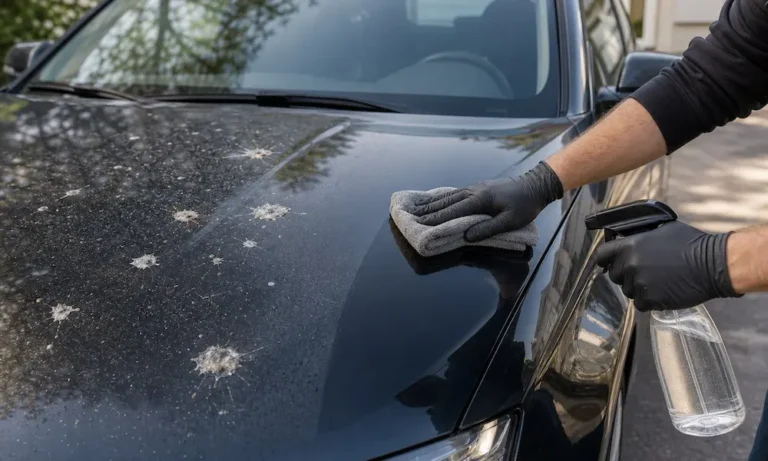
Found a fresh splat on your hood? Don’t panic — but don’t ignore it either. Bird droppings can permanently damage your car’s paint faster than you’d think. This guide covers exactly how to clean bird droppings off car surfaces safely, what household items actually help (and which ones make things worse), and how to protect your paint going forward.
Why Bird Droppings Are More Dangerous Than You Think
That white chalky blob isn’t just gross — it’s a chemical attack on your paint.
Birds excrete uric acid along with their waste. Unlike mammalian waste, bird droppings combine digestive matter and concentrated acid in one hit. The pH level can drop to something close to household vinegar — and that acid starts eating your clear coat immediately.
Here’s what makes it even worse: birds swallow small stones and grit to grind food in their gizzards. Those abrasive particles end up embedded in the droppings. So when you wipe a dry dropping with a paper towel, you’re basically dragging sandpaper across your paint.
Then there’s the heat problem. On a hot summer day, your car’s panels absorb serious solar radiation. The clear coat softens and expands, the dropping bakes on, and as temperatures drop at night, the paint contracts and molds itself around the dried waste. When you finally remove the dropping, the clear coat stays permanently deformed — dull, hazy, and wrecked.
How Long Before Bird Poop Damages Your Paint?
Act fast. Every hour counts, especially in direct sunlight.
| Time on Paint | Risk Level | Likely Damage | What You’ll Need |
|---|---|---|---|
| 0–2 hours | Low | Minimal to none | Quick detailer + microfiber towel |
| 2–12 hours | Moderate | Light etching, early thermal molding | Extended soak + possible light polish |
| 12–24 hours | High | Dull rings, clear coat deformation | Chemical neutralizers + machine polish likely |
| 24+ hours | Critical | Deep acid etching, potential cracking | Professional paint correction or panel respray |
What You Actually Need Before You Start
Skip the paper towels and dry rags. Here’s your toolkit:
- Automotive-grade microfiber towel — the deep-pile fibers trap abrasive grit away from your paint instead of dragging it across it
- Quick detailer spray — neutralizes uric acid and lubricates the surface so nothing scratches
- Waterless wash solution — a solid backup if you don’t have detailer spray
- Warm water — emergency use only, less lubrication than dedicated products
A high-quality microfiber towel isn’t optional here. It’s the difference between a clean panel and a swirl-marked mess.
How to Clean Fresh Bird Droppings Off Your Car
Fresh droppings are easier to deal with — but you still need to be careful.
Step 1: Saturate the dropping and surrounding area with quick detailer spray. Don’t be stingy.
Step 2: Let it dwell for 30–60 seconds. This lets the surfactants break down the acid and encapsulate the grit.
Step 3: Fold your microfiber towel into quarters to create a thick cushioned pad.
Step 4: Place the towel over the dropping. Use a light upward pinch and lift motion — pull the sides of the towel inward and up, taking the waste with it. Don’t wipe sideways.
Step 5: Mist the area again with detailer. Flip to a clean section of the towel and do one gentle wipe to clear residue.
That’s it. No scrubbing. No pressure.
How to Remove Dried, Hardened Bird Droppings
A sun-baked dropping that’s been sitting for hours needs a completely different approach.
Never try to scrape or wipe a hard, dry dropping. You’ll scratch the paint badly.
Instead, use the soak method:
- Soak a section of your microfiber towel with warm water, waterless wash, or quick detailer
- Lay the wet towel directly over the hardened dropping — don’t press down
- Let it sit for 5–15 minutes (longer in hot, dry conditions)
- Re-wet the towel if it starts to dry out
- Once the dropping looks swollen and softened, do the pinch and lift
The soaking approach rehydrates the waste from the outside in, so it releases cleanly without dragging grit across your paint.
Household Products: What Works and What Destroys Your Paint
You’re away from home, no detailing supplies in the car. Here’s what’s safe to use in an emergency — and what to absolutely avoid.
| Product | Safe? | How to Use It | Watch Out For |
|---|---|---|---|
| Baking soda solution | ✅ Yes (as liquid) | 2 tbsp in hot water + mild dish soap, dwell 10 minutes | Never use dry — the powder will scratch badly |
| Club soda / seltzer | ✅ Yes | Pour directly over the dropping | Must be plain and sugar-free — sugar leaves residue |
| WD-40 | ⚠️ Moderate | Spray on, dwell 60 seconds | Leaves a greasy film — wash it off afterward |
| Baby wipes | ⚠️ Moderate | Emergency blotting only | Less safe than microfiber — grit risk is higher |
| White vinegar | ❌ No | Don’t use it | Adds more acid to an already acid-damaged area |
White vinegar is commonly suggested online — but it’s a bad idea. Your clear coat is already under acid attack. Adding acetic acid accelerates the damage.
Club soda works well in a pinch because the carbonation helps lift the waste without adding more corrosive chemistry to the mix.
Cleaning Bird Droppings Off Special Surfaces
Standard gloss paint is forgiving compared to these surfaces. Get these wrong and the damage can be permanent.
Matte and Satin Paint Finishes
Matte paint gets its look from microscopic texture — peaks and valleys that scatter light. That texture is extremely fragile.
- Never use regular detailer sprays, waxes, or sealants — they fill the texture and create permanent glossy patches
- Use only a detailer specifically formulated for matte paint
- Rinse off the dropping with a gentle water stream whenever possible — touchless is best
- If you must touch it, blot only. No wiping, ever.
Windshields and Car Windows
Glass is harder than paint, but don’t use your wipers to clear a fresh dropping. The grit inside the dropping will scratch arcs across your windshield under wiper pressure — creating dangerous glare that often requires a full windshield replacement.
Instead:
- Apply automotive glass cleaner around the area first
- For hardened droppings, use carbonated water or a glass stripper on a foam pad
- Rinse thoroughly — don’t let the acidic runoff sit on painted panels
- Finish with a hydrophobic rain-repellent coating so future droppings don’t bond as strongly
Convertible Soft Tops
The woven fabric on convertible roofs absorbs liquids deeply. A topical wipe won’t fix the problem.
Rules to follow:
- No pressure washers — they destroy the weave and compromise the waterproof membrane
- No dry scrubbing — it permanently embeds grit into the fibers
- Wet the entire roof with a garden hose first
- Apply a bleach-free convertible top cleaner — no standard shampoos or dish liquid
- Agitate gently with a soft-bristle brush using overlapping lateral strokes — no circular scrubbing
- Rinse until water runs completely clear
- Once dry, reapply a fabric waterproofing reproofer — cleaning strips the protective coating
Cleaning Bird Droppings From Car Interiors
Left a window down? This requires a different approach entirely — and some safety precautions.
Dried bird droppings contain dangerous fungal spores and bacteria. In a car cabin, agitating dry waste can make those particles airborne. Wear nitrile gloves, safety goggles, and a filtration mask before you start cleaning.
Leather and vinyl: Use a pH-balanced leather cleaner applied to a cloth (not sprayed directly on the seat). Massage gently in overlapping circles. Follow up immediately with a leather conditioner — uric acid dries out leather fast, and skipping the conditioner leads to cracking.
Fabric seats: This one’s counterintuitive — let the dropping dry completely first. Wiping wet waste into fabric pushes it deeper into the foam. Once dry, flake it off with a dull plastic scraper while vacuuming up debris simultaneously. Treat the remaining stain with an enzyme-based upholstery cleaner — the enzymes digest the biological proteins at a molecular level. Pat dry and air out with windows open.
If the Damage Is Already Done: Paint Correction Options
Cleaned the dropping but still see a dull ring? Here’s how to assess and fix it.
Topical stain — the paint feels smooth but looks ghostly or discolored. A detailing clay bar can pull the bonded residue out of the paint’s pores. Lubricate heavily with detailer and glide the clay with zero downward pressure.
Light etching — the area looks dull and feels slightly rough. Clay won’t cut it here. A fine finishing polish applied by hand should level the micro-damage. Stop immediately if you see color transfer on the pad — that means you’ve broken through the clear coat.
Deep etching or cracking — if you can catch the edge of the defect with a fingernail, the damage is structural. A dual-action machine polisher with a cutting compound is needed. Most people should take this to a professional detailer.
Clear coat failure — widespread flaking, cracking, or peeling means the panel needs a full respray. No amount of polishing fixes missing paint.
How to Protect Your Car From Bird Droppings Long-Term
React faster with better protection in place.
| Protection Type | Lifespan | Acid Resistance | Impact Resistance |
|---|---|---|---|
| Carnauba wax | 1–3 months | Low | None |
| Synthetic sealant | 4–6 months | Moderate | None |
| Ceramic coating | 1–5 years | High | Low |
| Paint Protection Film (PPF) | 5–10 years | Supreme | High (self-healing) |
Ceramic coatings bond chemically with your clear coat, creating a glass-like barrier that keeps acid away from the paint itself. Droppings also struggle to bond to the hydrophobic surface, making removal much easier.
Paint Protection Film takes it further — it’s a thick physical barrier that absorbs both chemical and mechanical damage. Premium films self-heal light scratches with heat exposure.
For the best coverage, many detailers apply PPF to high-impact areas (front bumper, hood, mirrors) and ceramic coating over the rest of the vehicle.
Beyond products, a few smart habits go a long way:
- Avoid parking under trees, power lines, and architectural ledges — prime bird roosting spots
- Keep a pack of plain, unscented baby wipes and a microfiber towel in your glove box for emergencies
- Use a breathable car cover for outdoor storage
- Park in a garage or shaded structure whenever possible
The best defense against bird dropping damage isn’t a fancy chemical coating — it’s acting within the first two hours before the acid gets a chance to work.