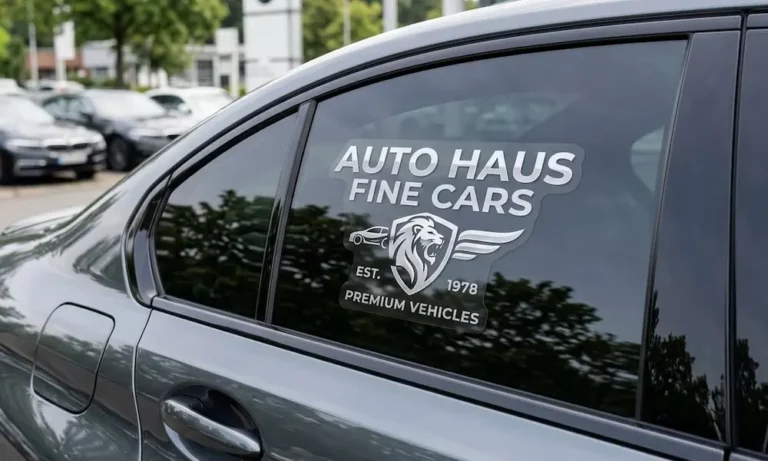
That dealership sticker on your bumper isn’t doing you any favors. It’s free advertising for them — and zero benefit for you. This guide walks you through exactly how to remove a dealership decal from your car safely, step by step, whether it’s a flat vinyl sticker or a chunky plastic badge. Stick around — the section on ghosting alone could save your paint job.
First, Know What You’re Actually Dealing With
Not all dealership markings are the same. Treating them the same way is where most people go wrong.
There are two types:
- Thin vinyl decals or stickers — flat, flexible, stuck directly to paint or glass with pressure-sensitive adhesive
- Rigid plastic badges or emblems — three-dimensional, hard plastic pieces held on with double-sided foam mounting tape
Trying to peel a rigid emblem like a flat sticker concentrates intense leverage on one spot. That can gouge, scratch, or crack your clear coat. Each type needs its own method. Don’t mix them up.
Can You Stop the Dealership From Adding Stickers in the First Place?
Yes — and it’s easier than most people realize.
Before you sign anything, write a “no dealership advertising” clause directly into the sales contract. If the dealership slaps stickers on your car anyway, you can legally refuse delivery until they remove them professionally. You can also demand financial compensation for using your car as a rolling billboard.
This one step shifts all the liability for paint damage back to their detailing team — not yours.
Set Up Your Workspace Before You Touch Anything
Jumping straight in without prep is how people end up with scratched paint and half-removed stickers.
Work in a shaded garage with temperatures between 65°F and 75°F. Direct sunlight heats up your clear coat and makes it soft and scratch-prone. High wind dries out your solvents too fast and blows chemical mist where you don’t want it.
Also — don’t skip the safety gear. Eraser wheels throw off rubber particles and hot glue dust. Chemical sprays create fine mist. Wear:
- Safety glasses
- Heavy-duty nitrile gloves
- A dust mask or respirator
- Fitted long sleeves
- Tied-back hair if you’re using a power drill
Your Tool Kit: What Works and What Destroys Paint
Picking the wrong product is a fast way to ruin your clear coat. Here’s a clear breakdown of what’s safe and what isn’t:
| Tool / Product | Where to Buy | What It Does | Safety on Paint |
|---|---|---|---|
| Hair dryer | Target, Walmart | Softens decal and badge adhesive | Very safe — can’t get hot enough to burn paint |
| Heat gun | Hardware stores | Loosens stubborn aged adhesive | Risky — can exceed 1,000°F and bubble clear coat |
| 3M Adhesive Remover | Auto parts stores | Dissolves heavy foam tape residue | High — engineered to be clear-coat safe |
| Goo Gone Automotive | General retailers | Removes light sticky residue | High — rinse it off quickly so it doesn’t attract dirt |
| WD-40 | Hardware stores | Penetrates edge adhesive | Safe — but weaker on thick foam tape |
| Acetone / nail polish remover | Pharmacies | Glass-only use | Never on paint — strips clear coat instantly |
| Nylon fishing line / dental floss | Sporting goods / pharmacies | Slices through emblem foam tape | Extremely safe — no metal touches paint |
| Eraser wheel | AutoZone, auto outlets | Mechanically removes thick foam | Effective but must stay moving — burns paint if held still |
Goof Off is popular but dangerous — it contains xylene and acetone, which can melt unpainted plastic trim and strip clear coat in seconds. Stick with Goo Gone Automotive or 3M for painted surfaces.
Interesting option if you want to go low-cost: peanut butter, vegetable oil, and WD-40 can all dissolve adhesive over a longer dwell time without any paint damage.
How to Remove a Flat Vinyl Dealership Decal
Step 1: Wash the area first.
Use a pH-balanced car shampoo and wipe in straight lines — not circles. Circular motions grind road grit into your clear coat. Let everything dry completely before you do anything else.
Step 2: Heat the decal.
Hold a hair dryer 4–6 inches from the surface. Use slow sweeping motions for 45–60 seconds. The vinyl should feel warm and slightly flexible to the touch.
Step 3: Lift a corner.
Slide a soft plastic scraper, expired credit card, or your fingernail under a heated corner at a shallow 15-degree angle. Keep it flat against the panel so you don’t scratch anything.
Step 4: Peel slowly.
Grab the lifted corner with gloved fingers and peel back at a 45-degree angle. Go slowly and steadily. A gradual, continuous pull keeps the adhesive stuck to the vinyl instead of leaving a sticky mess on your paint.
Step 5: For brittle or sun-baked decals, try this instead.
Soak a microfiber cloth in warm white vinegar and hold it against the sticker. Or apply a thick layer of peanut butter and let it sit for 20 minutes to 3 hours. The oils penetrate and break down the adhesive without any chemical risk.
How to Remove a Rigid Plastic Emblem or Badge
You can’t peel these off. You have to slice through the foam tape underneath.
Step 1: Heat the emblem.
Use a hair dryer for several minutes across the face of the badge. You’ll know it’s ready when the emblem wiggles slightly under finger pressure — that means the foam tape core has softened.
Step 2: Thread your line.
Cut a length of 10–30 lb nylon monofilament fishing line or waxed dental floss. Wrap the ends around your gloved fingers for grip. Dental floss is gentler on paint but snaps more easily. Monofilament lasts longer and cuts more cleanly.
Step 3: Saw through the foam.
Slide the line behind the emblem, flush against the paint. Use a steady back-and-forth sawing motion to cut through the foam tape. Don’t pry outward — that drives the emblem’s sharp corners into your clear coat.
Step 4: Remove the foam residue.
Saturate the remaining foam tape with 3M General Purpose Adhesive Remover and let it soak for a few minutes. Then use a thumb wrapped in a clean shop towel to gently roll the foam away. Let the solvent do the heavy lifting — don’t scrape aggressively.
Dealing With Decals on Glass — Especially the Rear Window
Glass on the outside is easy. Glass on the inside is a completely different situation.
Exterior glass: Spray glass cleaner or soapy water onto the surface as a lubricant, then scrape at a 45-degree angle with a new single-edge steel razor blade. The liquid prevents microscopic scratches on the glass.
Interior rear window — do NOT scrape. Those thin horizontal lines are defroster grid lines made from delicate conductive silver paint. One pass with a razor blade or hard scraper severs them permanently. Replacing the window typically costs around $1,000.
Instead, mix dish soap and water to a dense, sudsy consistency. Apply it to the decal and let it dry completely. Soak it again. The adhesive bonds break and the edges curl up. Then wipe gently with a soft plastic spatula or microfiber towel. A garment steamer also works well — it applies moist heat without the scraping risk.
Using an Eraser Wheel for Big Jobs
If you’re dealing with a large decal or thick foam tape across a wide area, manual scraping takes forever. A rotary eraser wheel attached to a power drill handles this much faster.
Key rules to follow:
- Max speed: 4,000 RPM. Optimal range is 1,500–3,000 RPM.
- Never hold it still. Keep the wheel moving in light, sweeping passes at all times.
- Cheap wheels disintegrate. Stick with SureBilt or 3M. Flying rubber chunks are a real hazard.
- Wear full PPE — goggles, gloves, long sleeves, and a dust respirator to block fine rubber particles.
Too much speed or a stationary wheel instantly burns through your clear coat. Don’t rush this step.
Fixing Ghosting After the Decal Is Gone
You removed everything — but there’s still a faint outline of the sticker visible on your paint. That’s called ghosting, and it’s not adhesive residue. You can’t wipe it off.
Ghosting happens because the paint under the decal was protected from UV rays for years while the surrounding clear coat faded, oxidized, and thinned. The result is a shiny silhouette against a duller background.
Here’s how to fix it:
Step 1: Clay bar the panel. A fine automotive clay bar pulls out embedded metal particles that would scratch your paint during buffing.
Step 2: Polish with a dual-action orbital polisher. Use a medium-density foam pad and a micro-abrasive cutting compound like Meguiar’s Ultimate Compound. Work in a cross-hatch pattern with light, even pressure. This shaves down the oxidized clear coat around the ghost image until both areas match.
Step 3: For severe cases, wet-sand first. Start with 3,000-grit sandpaper, then move to 2,000-grit before compounding. Deep, baked-on ghosting needs this extra step.
Step 4: Finish with a fine polish. Something like Meguiar’s M-205 on a soft finishing pad removes compounding haze and brings back mirror-like clarity.
Step 5: Seal the paint. Solvents, eraser wheels, and abrasive compounds strip all protective layers off your clear coat. Apply a high-quality carnauba wax or synthetic polymer sealant in the shade, let it haze, and buff it off with a clean microfiber cloth. This step isn’t optional — skip it and your freshly exposed clear coat is completely unprotected.
Your car, your paint, your choice — not the dealership’s billboard.