Most no-start mornings come down to three things: a safety switch doing its job, a cold engine, or a tired battery. This guide walks you through the whole routine — the two-minute walk-around, the interlock checks, the exact key sequence, cold-weather tricks, and what those dashboard lights really mean. By the end, you’ll know how to start a John Deere tractor in July heat or February sleet. Read to the end. The shutdown section saves more money than the startup one.
Do a Walk-Around First, Not a Key Turn
Give the machine two minutes on your feet before you sit down. It’s the cheapest insurance you’ll ever buy.
Look under the chassis for drips or fresh puddles. Engine oil, hydraulic fluid, and transmission fluid all leave different clues, and catching a leak now beats catching a seized pump later.
Check the wheel retaining bolts. Loose wheel hardware can shear off mid-turn and drop the tractor on its side. Tighten them to spec with the correct sequence any time they’ve been loosened, and check them often through the first hundred hours.
Then look at the iron hanging off the machine. Mower decks, loaders, and rear implements all need intact guards and PTO shields, firmly fastened. A missing shield around a spinning driveline is an entanglement hazard, and entanglement is one of the fastest ways to lose a limb or a life. Never reach under a deck, baler, or aeration head to clear a jam while the engine runs.
The Seatbelt Rule That Confuses Everyone
Here’s the part people get backwards. Your seatbelt depends on your rollover protection, not your personal preference.
If the tractor has a fixed Rollover Protective Structure (ROPS), or a foldable one locked upright, buckle up before you start the engine. The belt holds you inside the steel envelope during a rollover instead of letting you get thrown clear and crushed.
Now the flip side. If the ROPS is folded down, or the tractor doesn’t have one at all, do not wear the seatbelt. Without a frame above you, the belt traps you under the machine. That’s almost always fatal.
Tractor overturns remain the leading cause of farm deaths in the US, averaging more than 130 a year, which is why the seatbelt-and-ROPS combo gets so much attention from safety researchers.
Test Your Safety Interlocks Before You Trust Them
Modern John Deere tractors use electronic switches that block the starter unless the machine is in a safe state. They also watch the seat for a live operator. Run these checks regularly, because a failed or bypassed interlock is worse than no interlock at all.
| Interlock System | How to Test It | What Should Happen |
|---|---|---|
| Neutral start switch | Seat yourself, lock the parking brake, depress the clutch, then move the shift or reverser lever out of neutral and turn the key. | The engine must not crank. |
| PTO start switch | Transmission in neutral, engage the PTO lever or switch, then turn the key. | The engine must not crank. |
| Operator presence sensor | Start in neutral with the parking brake locked. Engage the PTO, then lift your weight off the seat without getting off. | Fuel shut-off de-energizes and the engine dies within half a second. |
| Brake interface | On models that require brake input, try starting without pressing the pedal or locking the parking brake. | The engine must not start. |
Flunk any of those? Park the machine. A technician needs to fix the circuit before it goes back to work. Running a tractor with a jumped interlock puts you and everyone around you in real danger.
The Standard Start Sequence, Step by Step
With the inspection done and the interlocks passing, here’s the actual startup.
Step 1: Set the machine up.
- Press both brake pedals and lock them together with the latch. That gives even braking on both rear wheels.
- Engage the parking brake firmly.
- Put the gear shift, range selector, or reverser lever in true neutral.
- Push every PTO control to off.
- Push the rockshaft lever and any selective control valve levers forward. This lowers attached implements to the ground. If you leave an implement raised with the valve open, the hydraulic surge at startup can make it jump or lift suddenly. That’s a crushing hazard, not a nuisance.
Step 2: Set the hand throttle to about one-third.
Fully closed throttle makes a cold diesel hard to light. Fully open throttle is worse — a cold engine racing at max rpm before oil reaches the valvetrain and turbo bearings causes irreversible metal-on-metal wear. One-third is the sweet spot.
Step 3: Turn the key to Run.
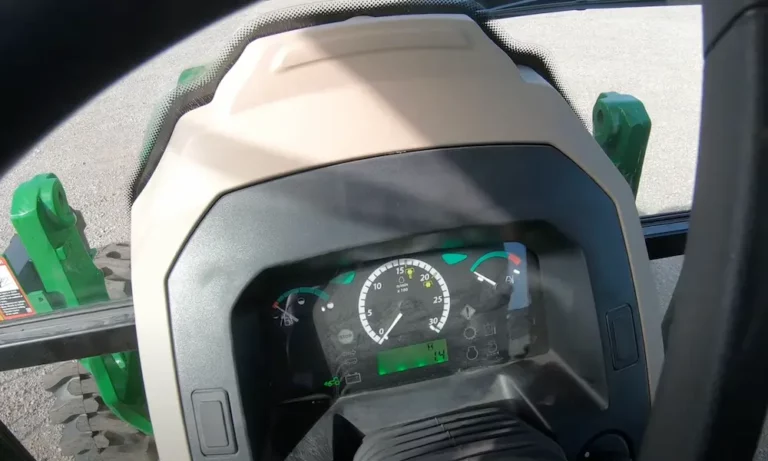
You’ll hear a click from the engine bay as the fuel shut-off solenoid opens. The dash lights up. The oil pressure light and the alternator light should both glow bright, and that’s correct — the engine isn’t turning yet, so oil pressure is zero and nothing is charging.
Step 4: Depress the clutch and turn to Start.
The clutch disconnects the transmission input so the starter spins less mass. Turning the key further sends current through the neutral safety circuit to the starter solenoid.
Step 5: Release the key when it fires.
Watch the dash for the next few seconds:
- Oil pressure light out within 5 seconds — the pump is building pressure.
- Alternator light out within 10 seconds — the charging system is working.
If either light stays on, shut the engine down immediately. You’re either starving the engine of oil or draining the battery.
Don’t Melt Your Starter
Starter motors make huge torque in short bursts and generate serious internal heat. Never crank for more than 20 to 30 seconds. If it doesn’t fire, turn the key off and let it cool at least two minutes. Overheat the windings and you’re buying a new starter.
Many newer models track crank time for you. Push too long and the control unit locks you out for a mandatory 60 seconds.
Cold Weather Starting: Making a Diesel Wake Up
Cold changes the physics. Engine oil thickens, battery chemistry slows, and frigid cylinder walls suck the heat out of compressed air before it can ignite diesel. Here’s how to fight back.
Glow Plugs and Intake Air Heaters
Smaller tractors often use glow plugs that warm the combustion chamber directly. Bigger and newer machines usually have an intake air heater — an electric grid in the manifold that superheats incoming air.
Turn the key to Run, then push it inward and hold. Above freezing, 10 to 15 seconds does it. Below 0°F, hold for 30 to 45 seconds.
If the engine starts but runs rough, misfires, or blows white smoke, that’s unburned fuel. Push the key in again while it’s running to add supplemental heat until the block warms up enough to hold a smooth idle.
Ether: Useful, and Absolutely Lethal if You Get It Wrong
Starting fluid ignites at far lower temperatures than diesel, which is why it works in extreme cold.
Never use it on a tractor with glow plugs or an intake air heater. If ether vapor crosses a glowing element in the manifold, it detonates. That explosion can blow the intake manifold clean off the engine and send shrapnel at whoever’s standing nearby. Check your manual and physically confirm there’s no heater before you touch a can.
Where starting fluid is allowed, spray it only while the engine is cranking, in short quick taps. A heavy continuous stream floods the cylinders and causes pre-ignition knock — the fuel ignites early and drives the piston down while the crank is still pushing up. That bends connecting rods and cracks heads. Hear a knock? Stop immediately.
Warm It Up Before You Work It
Once it’s running, idle at 1,000 to 1,200 rpm for several minutes with no load. The block expands evenly, cylinder head gasket stress drops, and thick oil gets time to reach the valvetrain and turbo bearings.
The hydraulics need the same courtesy. Cold fluid resists flow, and forcing it can starve the pump, create cavitation, and literally tear metal off the internal gears. You’ll notice it as sluggish steering and jumpy implements.
Cycle the loader or bucket gently while you idle, with no load. Running the PTO helps circulate fluid through the transmission and hydraulic reservoirs too. For continuous hydraulic work like air seeders or hydraulic motors, aim for roughly 122°F before you lean on it.
Jump-Starting a Dead Tractor Without the Fireworks
Lead-acid batteries vent explosive gas, and the electrolyte inside is sulfuric acid that can blind you. Wear eye protection, ventilate the area, and keep flames, sparks, and cigarettes far away.
A frozen battery must never be jumped or charged. Ice stresses the internal plates, and current will likely cause a short and an explosion. Move it somewhere warm and let it thaw to at least 60°F first.
Then follow the order below. Two or more booster batteries always connect in parallel — positive to positive, negative to negative. Series wiring doubles voltage to 24 and instantly fries the 12-volt control units and harnesses on a modern tractor.
- Red clamp to the positive terminal of the good battery.
- Other end of the red cable to the positive terminal of the dead tractor. If your machine has a remote positive jump terminal, use it — that’s what it’s there for.
- Black clamp to the negative terminal of the good battery.
- Other end of the black cable to a heavy, unpainted metal point on the dead tractor’s engine block or chassis. This final connection sparks, so keep it away from the battery, fuel lines, and belts. Never clamp it to the dead battery’s negative post.
Run the disabled machine a few minutes to stabilize voltage, then disconnect in exact reverse order, starting with the negative ground clamp.
When It Won’t Start: Read the Flash Codes
If the starter won’t engage, the diagnostic lights often flash a two-digit code that names the exact lockout.
| Flash Sequence | What It Means | What to Do |
|---|---|---|
| 1 – 2 | Brake not engaged | Firmly lock the parking brake. |
| 1 – 3 | PTO engaged | Turn the PTO switch off. |
| 2 – 1 | Neutral violation | Center all motion control levers and shifters. |
| 2 – 4 | Crank time exceeded | The starter ran 20 seconds. Cycle the key off. |
| 2 – 5 | Starter thermal protect | Wait the full 60-second cool-down. |
| 3 – 1 | Over voltage | Check the alternator regulator and battery ground cables. |
| 3 – 3 | Weak battery | Test and recharge, or look for a starter drawing too much amperage. |
| 3 – 7 | Output fault | A harness short tripped an internal fuse. Inspect wiring for chafing. |
What the Dashboard Colors Are Telling You
John Deere’s Generation 4 CommandCenter and similar displays sort problems by severity.
- Red STOP, flashing, continuous alarm: critical. Total oil pressure loss, extreme coolant temp, transmission failure. Stop and shut down now.
- Amber service alert, intermittent beeps: fix soon. Clogged air filter, low transmission pressure, charging failure. You can usually limp to the shop, but ignoring it escalates to red.
- Blue or green: information only — a status update or non-critical fault.
DPF Regeneration: The Light You Can’t Ignore
Tier 4 Final tractors run a Diesel Particulate Filter that traps soot and burns it off with heat. There are four stages:
- Passive: heavy work like plowing makes exhaust hot enough to burn soot as fast as it forms. You’ll never know it’s happening.
- Enhanced passive: light duty work lets soot build. The computer tweaks intake throttle and injection timing to raise exhaust temps on its own.
- Active: the engine injects a tiny dose of diesel late in the stroke to superheat the exhaust. A high-exhaust-temperature icon appears. The machine still works, but keep it off dry grass, hay, and spilled fuel — that muffler gets dangerously hot.
- Parked: soot has hit a critical level. Power drops, the PTO clutch disables, and you must stop and clean the filter.
For a parked regeneration, park on a non-combustible surface and lower all implements. The system checks that the transmission is in neutral with zero ground speed, the parking brake is locked, the PTO is off, coolant is at operating temperature, and the hand throttle is at low idle. Break any of those and an on-screen message tells you which one. Then hold the regen switch for five seconds.
The computer takes over the throttle and runs the engine up to about 2,200 rpm for 30 to 60 minutes. Touch the throttle, release the brake, or bump the PTO and it aborts. Only emergency shutdown stays live.
Keep ignoring parked regen requests and the soot packs so tight the tractor shuts down for good. Then you’re paying a dealer for a service regeneration, or replacing a filter that costs thousands.
Never Bypass Start. Ever.
This one kills people every year. When a tractor won’t start from the key, someone stands beside the engine and bridges the starter solenoid terminals with a wrench or pliers. Raw battery voltage goes straight to the starter, and every safety system gets skipped — the seat sensor, the clutch switch, and the neutral switch.
Now picture the common setup. The tractor’s parked in gear on a slope because the parking brake is weak. The moment that wrench bridges the terminals, the engine fires and the machine lurches forward with nobody in the seat.
You’re standing right beside the rear tire. Those tires are loaded with liquid ballast and cast iron for traction. The tractor knocks you off balance and drags you under the treads. Investigations into farm runover deaths describe exactly this sequence, and the outcome is usually fatal thoracic trauma. The unmanned tractor then keeps rolling through fences, implements, and anything else in its path.
That’s why modern tractors have shields over the starter terminals, and why you never remove them. If the key won’t start it, diagnose the fault. Check the fuse, the wiring, the neutral switch. Fix the actual problem.
The Old 4020 and Its Strange 24-Volt System
If you work on older iron, you’ll eventually meet a John Deere 4020 diesel with a factory 24-volt starting system. It exists because 1960s-era starters couldn’t crank a high-compression diesel in winter on 12 volts.
Two 12-volt batteries wired in series gave 24 volts to the starter and generator, which were fully isolated from the cast-iron frame. Then engineers grounded the cable between the two batteries to the frame, splitting the machine into two 12-volt halves — a negative-ground side and a positive-ground side. The left headlights ran off one, the right headlights off the other, so both batteries drained and recharged evenly.
It works beautifully until carbon brush dust shorts the 24-volt circuit to the frame. Then voltage spikes hit the dash and blow out headlights and fuel gauges. Plenty of owners today skip the headache entirely and convert to a modern 12-volt gear-reduction starter, alternator, and parallel batteries.
Shut It Down Right
How you park matters as much as how you start. Pick level, firm ground. Steep slopes and soft embankments invite a tip.
Disengage the PTO and let heavy attachments spin down on their own. Then lower every implement to the ground with the rockshaft levers and control valves. Leaving a loader or mower hanging in the air means rubber seals hold all that weight. If one lets go, or someone bumps a lever, several hundred pounds drop without warning.
Put the transmission in neutral or park and firmly lock the parking brake.
Then the part that saves turbos: let the engine idle with zero load for three to five minutes. Turbo shafts spin at tens of thousands of rpm on a thin film of oil, and the housing glows red under load. Kill the engine immediately after plowing and the oil pump stops while the turbo is still radiating heat. That trapped oil cooks into hard carbon, and next startup those deposits grind the bearings to dust and dump metal into your intake.
After shutdown, wait for fans and drivelines to stop completely. Pull the key so nobody untrained — especially kids — can fire it up. Then climb down facing the machine with three points of contact on the steps and handholds.
Final Thoughts
Learning how to start a John Deere tractor isn’t about finding the right spot on the key. It’s about the two minutes before and the five minutes after. Check the machine, respect the interlocks, warm it up, and let it cool down. Do that, and you’ll get thousands of hours out of it instead of a repair bill.
And if someone ever tells you to just bridge the starter with a wrench, walk away. No dead battery is worth it.