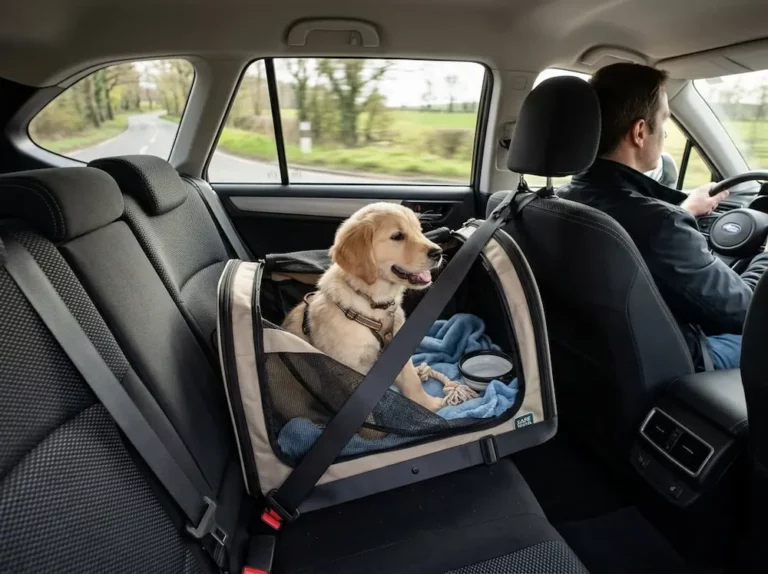
Got a new puppy and a road trip coming up? Done right, car travel with your pup is totally manageable. Done wrong, it’s dangerous for everyone in the vehicle. This guide covers everything — from restraints and motion sickness to hot car laws — so you and your puppy arrive safely.
Why Transporting a Puppy in a Car Is Riskier Than You Think
Most people know letting a puppy roam loose in the car is a bad idea. Yet over 80% of drivers admit to it. Only 16% use any kind of restraint.
Here’s the hard physics. An unrestrained 10-pound puppy in a 50 mph crash hits with roughly 500 pounds of force. An 80-pound dog at 30 mph? Over 2,400 pounds. That’s not a pet bouncing around — that’s a projectile heading straight for you or your passengers.
An unrestrained puppy also:
- Climbs into footwells and interferes with the brake and accelerator pedals
- Blocks your field of vision
- Triggers distracted driving penalties in many states
- Risks instant death if a passenger airbag deploys in the front seat
Knowing how to transport a puppy in a car correctly isn’t optional. It’s the difference between a safe trip and a fatal one.
Choose the Right Restraint System First
Before anything else, pick the right restraint. There are three main options. Which one works best depends on your puppy’s size and your vehicle’s layout.
| Restraint Type | Best For | Key Strength | Watch Out For |
|---|---|---|---|
| Safety Harness | Small to medium pups, rear bench seats | Integrates with seatbelt, limits forward movement | Must fit snugly — loose harnesses fail in crashes |
| Crash-Tested Crate | Larger breeds, SUV cargo areas | Absorbs and distributes impact energy | Needs strength-rated tie-down straps to vehicle anchor points |
| Cabin Pet Carrier | Small puppies under 20 lbs | Secured via seatbelt or LATCH anchors, reduces visual stimulation | Not suitable for growing or energetic pups |
Never use:
- Extension tethers or zip-line attachments — they build forward momentum and cause spinal injuries
- Standard wire crates — they crumple and impale in crashes
- Flimsy plastic flight kennels — they shatter on impact
The CPS Certification Standard You Can’t Ignore
Not all “crash-tested” labels are equal. For years, manufacturers sold harnesses that failed 100% of the time in independent crash tests — straps tore, hardware shattered, dummies launched forward.
The Center for Pet Safety (CPS) partnered with Subaru of America to fix that. They adopted the Federal Motor Vehicle Safety Standard 213 — the same benchmark the NHTSA uses for child car seats — and applied it to canine restraints using weighted dog dummies at a simulated 30 mph crash.
The two metrics that matter most:
- Structural integrity — does the product hold without tearing, shattering, or breaking?
- Head excursion — how far does the dog’s head travel forward? Too far, and they hit the seat ahead with lethal force.
CPS-certified products worth knowing:
- Harnesses: Sleepypod Clickit Series — one of the only harnesses to consistently pass rigorous CPS testing. It works like a three-point human seatbelt, eliminating dangerous tethers entirely.
- Crates: Gunner G1 Kennels, Lucky Duck Kennels, Rock Creek Aluminum Crate — double-walled construction with dual-locking doors and reinforced tie-down pins.
- Carriers: Sleepypod Mobile Pet Bed, Away Pet Carrier, Diggs Passenger Carrier — secured via seatbelt or LATCH anchors, designed for small breeds.
Popular harnesses like the Kurgo Tru-Fit showed catastrophic strap tearing during testing. The Ruffwear Load Up survived the crash forces structurally but failed CPS certification because the dummy pivoted too far forward, exceeding the head excursion limit. Don’t trust marketing claims. Check the CPS certification list.
Always Put Your Puppy in the Back Seat
Front-seat travel isn’t just uncomfortable for your puppy — it’s lethal. Passenger-side airbags deploy with enough explosive force to crush, suffocate, or decapitate a small dog. This applies even if the puppy is in a carrier or wearing a harness.
Automotive safety experts and veterinarians agree — all animals belong in the rear passenger seats or the cargo area of an SUV. No exceptions.
How to Handle Puppy Motion Sickness in the Car
Puppies get car sick far more often than adult dogs. Their vestibular system — the inner ear structures that control balance and spatial orientation — isn’t fully developed yet. When the car moves, their inner ear detects motion, but their eyes see a stationary interior. The brain interprets this sensory conflict as potential poisoning and triggers vomiting as a defensive response.
Spot the Early Warning Signs
Motion sickness in puppies escalates quickly. Know what to watch for:
Early signs:
- Yawning and lip smacking
- Excessive drooling
- Lethargy or sudden stillness
Escalating signs:
- Panting and pacing
- Whining or crying
- Repeated swallowing
If you see these early signs, pull over safely and let your puppy breathe fresh air outside the vehicle. This breaks the sensory conflict and stops the spiral before vomiting starts.
Simple Environmental Fixes That Work
Before reaching for medication, try these:
- Withhold food 8-12 hours before travel — an empty stomach dramatically reduces vomiting risk
- Keep the cabin cool and ventilated — heat makes nausea worse, fast
- Use a covered crate or carrier — blocking visual stimuli reduces the sensory mismatch
- Place a worn piece of your clothing inside the carrier — familiar scent lowers anxiety
- Try natural supplements — ginger, lavender, and valerian have mild anti-nausea and calming properties
When to Ask Your Vet About Medication
For severe or recurring motion sickness, your vet may recommend:
- Maropitant citrate (Cerenia) — the gold-standard antiemetic for dogs, approved for motion sickness prevention in puppies 16 weeks and older. Give it at least 2 hours before travel for 24-hour coverage.
- Dimenhydrinate or meclizine — antihistamines that suppress vestibular sensitivity, used under veterinary supervision.
- Anxiolytics like trazodone or alprazolam — for puppies with severe learned travel phobia.
Desensitize Your Puppy to the Car Early
Here’s the thing most people skip: if your puppy has bad early car experiences, they can develop a lifelong phobia — even after their vestibular system matures. Start desensitization early and do it gradually.
The step-by-step process:
- Let your puppy sit in a parked, engine-off car with the doors open. Reward with treats.
- Close the doors briefly. Reward calm behavior.
- Start the engine without moving. Let them adjust to the vibration and sound.
- Back out of the driveway and immediately return.
- Take a short loop around the block.
- Gradually extend trips — always ending at somewhere fun like a park.
Critical rule: Stop the session the moment you see any early distress signs. Pushing through it doesn’t build toughness. It reinforces the fear and undoes all your progress.
The Hot Car Danger Is Real — And Fast
Leaving your puppy in a parked car isn’t a harmless quick stop. A vehicle acts as a solar greenhouse — sunlight heats interior surfaces, and that heat can’t escape back through the glass. Here’s how fast it gets deadly:
| Time in Parked Car | Temperature Rise | What Happens to Your Puppy |
|---|---|---|
| 10 minutes | +19°F | Severe discomfort, panting, early panic |
| 20 minutes | +29°F | Hyperthermia begins, neurological confusion |
| 30 minutes | +34°F | Organ damage imminent |
| 60 minutes | +43°F | Irreversible organ failure, likely death |
On a mild 70°F day, interior temperatures exceed 110°F within an hour. Cracking a window makes almost no difference to this thermal escalation.
Puppies face additional risk because:
- Their small body mass loses and gains heat faster
- Their thermoregulatory systems are still developing
- Brachycephalic breeds (Pugs, French Bulldogs, English Bulldogs) can’t pant efficiently — they overheat in a fraction of the time
Cold weather carries the opposite risk. A puppy left in a freezing car loses body heat rapidly and can develop hypothermia quickly.
Simple rule: if you’re leaving the car, the puppy comes with you.
Know the Laws Before You Drive
Pet Restraint Laws by State
The US has no federal law requiring pet restraints in cars. It’s handled at the state level, and the rules vary widely.
- Rhode Island, New Jersey, and Hawaii have explicit laws requiring dogs to be secured in vehicles
- Hawaii specifically bans dogs on a driver’s lap or in the driving area
- Most other states enforce safety through distracted driving and careless driving statutes
If your unrestrained puppy blocks your view, interferes with the pedals, or sits on your lap while driving, you can be cited — regardless of your state’s specific pet laws.
Open Truck Beds: A Short List of Dangers
Letting a puppy ride loose in a truck bed exposes them to:
- Flying debris at highway speeds
- Sun-heated metal surfaces causing burns
- Toxic exhaust accumulation in the slipstream
- Instant ejection during any sudden turn or stop
Tethering in an open bed is equally dangerous — a dog that goes over the side gets strangled or dragged on asphalt. States including California, Connecticut, Maine, Massachusetts, New Hampshire, and Rhode Island require dogs in open cargo areas to be in a secured structural crate or properly cross-tethered to the vehicle frame.
Hot Car Rescue: What You Can Legally Do
If you see a puppy locked in a dangerously hot car, about 15-20 states give civilians explicit legal protection for breaking the window — including California, Florida, Ohio, Arizona, Tennessee, and Colorado.
But that immunity usually comes with conditions. Using California as the example, you must:
- Confirm the vehicle is locked with no other way in
- Have a genuine, reasonable belief the animal faces immediate danger
- Call 911 before breaking the window — this step is non-negotiable
- Use only the force necessary to extract the dog
- Stay on scene until authorities arrive
Skip any of these steps and you risk being liable for the window damage. In states without protection laws, only law enforcement or animal control can legally enter the vehicle. Indiana’s law uniquely requires the rescuer to cover half the window repair cost — even though the rescue is authorized.
Does Your Car Insurance Cover Your Puppy?
Legally, your dog is considered personal property in most US states. That creates some complicated insurance dynamics.
- If you hit a loose dog on the road, your comprehensive coverage handles vehicle damage (minus your deductible)
- If your puppy is injured in a crash, standard auto insurance historically covered nothing for vet bills
- Carriers like Progressive, Erie, and Chubb now offer Pet Injury Coverage bundled with collision policies — typically covering $500-$1,000 in emergency vet bills
- If another driver caused the crash, their property damage liability may cover your puppy’s vet costs
Check your current policy. Many drivers don’t realize pet injury coverage is already included or available as a low-cost add-on.
Crossing State Lines or International Borders
Domestic Interstate Travel
Most states require a Certificate of Veterinary Inspection (CVI) — commonly called a health certificate — issued within 10-30 days of your trip. You’ll also need proof of current rabies vaccination.
International Travel
International travel goes through USDA APHIS, which coordinates with destination countries. You’ll need a USDA-accredited veterinarian — a step above a standard vet license — to examine your puppy and complete the required documentation.
Quick country comparison:
- Canada: Puppies under 3 months entering as non-commercial imports may be exempt from the rabies vaccination requirement. Dogs over 8 months generally need a valid rabies vaccination certificate only.
- China: Requires a 15-digit ISO microchip, detailed vaccine records, a rabies antibody titer test from an approved lab, APHIS endorsement within 14 days of arrival, and a mandatory 30-day government quarantine upon arrival.
Build a Travel Emergency Kit
Every car trip with your puppy should include:
- Bottled water from home (unfamiliar water causes GI upset)
- Collapsible travel bowls
- Leash, waste bags, and a pet first-aid kit
- Physical copies of health certificates, rabies records, and medication instructions
- An ID tag with current contact info on the puppy’s collar
- Confirmed microchip registration with your current phone number
Microchip registration matters most during crashes or rest-stop escapes — the chaos of an accident dramatically increases the chance of permanent separation without it.
The Bottom Line on Transporting a Puppy in a Car
Knowing how to transport a puppy in a car safely comes down to four things: use a CPS-certified restraint, keep them in the back seat, never leave them in a parked car, and get their motion sickness under control before a long trip. Skip the marketing claims on pet safety products and check the certification list. Take the time to desensitize your puppy to car travel early — it pays off for every trip that follows.