Thinking about dropping $350–$450 on a scan tool? The Autel MK808 keeps popping up — but is it actually worth it, or just clever marketing? This post breaks down exactly what you get, where it shines, and where it falls flat. Stick around, because the answer might surprise you.
What Makes the Autel MK808 Different From a Basic Code Reader
Most cheap code readers only talk to your engine control module. That’s it. The Autel MK808S does something entirely different — it communicates with every module on the car.
We’re talking:
- Transmission control module
- Anti-lock braking system
- Airbag/supplemental restraint system
- Body control module
- Electronic power steering
- Climate control
- Active safety systems
It covers over 150 vehicle brands from 1996 to current model year. When you plug it in, it reads the VIN automatically and loads the right software. No manual menu hunting required.
That’s the core reason mechanics keep recommending it. It actually sees the full picture of what’s happening inside a modern vehicle.
Hardware: Is the MK808S Fast Enough for Real Shop Use?
Short answer: yes — especially the newer “S” and “Z” models.
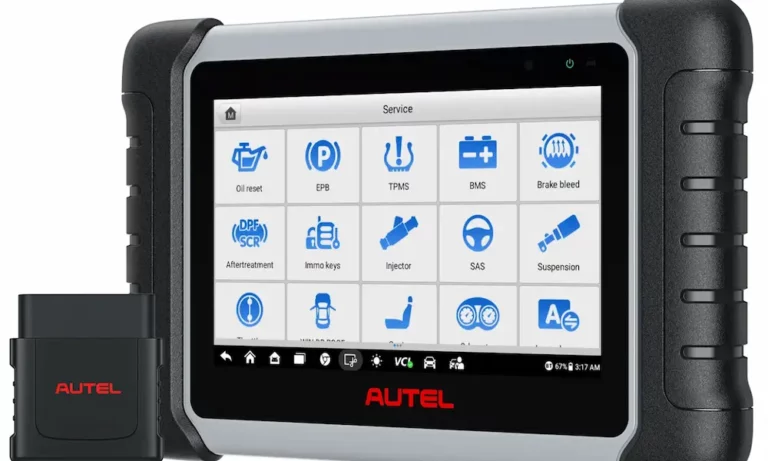
The MK808S runs on a Rockchip RK3566 Quad-Core Cortex-A55 processor clocked at 1.8 GHz with 4GB of RAM and 64GB of storage. It boots on Android 11. That’s a full generational leap over the original MK808, which ran on Android 4.4.4 with just 1GB of RAM.
The result? Up to five times faster navigation between module menus. If you’ve used an older Autel unit and hated waiting for the screen to catch up, the MK808S fixes that.
Other hardware specs worth knowing:
- 7-inch capacitive touchscreen (1024 x 600 resolution)
- Dual-band Wi-Fi (2.4GHz and 5GHz)
- 5000mAh battery — roughly 7 hours of continuous use
- Operates in temps up to 131°F
One honest caveat: the rubberized casing can degrade after years of contact with automotive fluids. It’s solid hardware, but it’s not built like a tank.
Bi-Directional Control: The Feature That Actually Sets It Apart
This is where the MK808 earns its money.
Most scanners are passive — they read data. A bi-directional tool sends commands directly to vehicle modules. You tell the car what to do. The car responds. You learn instantly whether a component works or not.
The MK808 platform includes over 3,000 active test commands. Here’s what that looks like in practice:
Engine and Fuel:
- Command the fuel pump relay on/off to check fuel pressure
- Pulse individual injectors to isolate misfires
- Open/close EGR valves and EVAP purge solenoids
Cooling and Climate:
- Cycle radiator fans through speed stages
- Engage/disengage the A/C compressor clutch
Body and Interior:
- Cycle power windows, mirrors, wipers, and lighting
- All from the tablet — no touching cabin switches
Braking and Drivetrain:
- Activate the ABS pump motor
- Modulate the electronic throttle body
A real-world example: Fluid MotorUnion used the MK808 to diagnose a persistent oxygen sensor fault on a Porsche Cayman. Instead of swapping parts, they used active tests and live data to confirm the sensors were fine — the ECM was misreading the signal. That finding saved the customer hundreds in unnecessary parts.
Without bi-directional control, that diagnosis takes hours longer. With it, it takes minutes.
28+ Service Reset Functions — What They Cover
Modern cars need software intervention, not just wrenches. The MK808S handles over 28 service reset functions. Here are the ones you’ll actually use:
Electronic Parking Brake (EPB): Retracts rear caliper motors into service mode so you can compress the piston and replace pads. Then recalibrates clamping force.
Battery Management System (BMS) Registration: Tells the ECM a new battery is installed. Skip this and the alternator overcharges the new battery. It’s a known issue.
Steering Angle Sensor (SAS) Calibration: Required after any alignment or suspension work. Resets the “straight ahead” position for stability control and ADAS systems.
DPF Regeneration: Forces a burn cycle on diesel particulate filters by commanding elevated exhaust temperatures. Clears soot buildup and restores engine performance.
Fuel Injector Coding: Writes the flow-rate code from a new injector into the ECM. Critical for diesel and direct-injection engines.
Key/Immobilizer Matching: Works well on older domestic and Asian vehicles with basic transponders. It won’t program smart keys or modern European immobilizer systems — know that going in.
FCA Secure Gateway: The Big Catch for Dodge, Jeep, Ram, and Chrysler Owners
Since 2018, Fiat Chrysler Automobiles vehicles have a Secure Gateway Module — essentially a digital firewall between the OBD-II port and the car’s internal network.
Without authentication, you’re stuck in read-only mode. You can see generic codes, but you can’t clear them, run active tests, or reset anything.
The MK808 solves this through AutoAuth, an independent authentication service. Here’s how it works:
- Create an account at the AutoAuth web portal
- Choose a subscription — $50/year for one shop, up to 5 tools and 5 users
- Register your MK808’s serial number
- Link your technician credentials with Two-Factor Authentication (Google Authenticator)
- Keep your Autel Total Care Program subscription active
That last point matters. If your Autel subscription expires, AutoAuth access dies with it. You’ll be locked out of advanced diagnostics on 2018+ FCA vehicles until you renew.
For anyone working on a lot of Rams, Jeeps, or Challengers, this setup is non-negotiable.
The CAN-FD Limitation — And How to Fix It
General Motors rolled out CAN-FD protocol starting around 2020 on vehicles like the Corvette, Cadillac CT5, and large SUVs. Ford followed on the Expedition, Explorer, and Super Duty trucks. CAN-FD moves data much faster than legacy CAN bus — and the standard MK808S can’t decode it natively.
The fix? The Autel CAN-FD Adapter, which typically runs $60–$100. It bridges the gap between the high-speed vehicle network and the tablet. It works — but it’s an extra cost to factor in.
If your shop sees a high volume of 2020+ domestic vehicles, consider the Autel MK900 or MX900, which have native CAN-FD and DoIP support built in. Otherwise, the adapter route is perfectly functional.
How the MK808S Compares to the Competition
| Diagnostic Feature | Autel MK808S | Launch CRP919E | Xtool D7 | Foxwell NT809 |
|---|---|---|---|---|
| Operating System | Android 11.0 | Android 10.0 | Android 10.0 | Android 9.0 |
| Memory / Storage | 4GB / 64GB | 4GB / 64GB | 2GB / 32GB | 1GB / 32GB |
| Bi-Directional Testing | Yes (3,000+ tests) | Yes | Yes | Yes |
| ECU Online Coding | No | Yes | No | No |
| Native CAN-FD / DoIP | No (adapter needed) | Yes | Yes (w/ adapter) | No |
| FCA AutoAuth Support | Yes | Yes | Yes | Yes |
| Free Updates Included | 1 year | 2 years | Up to 3 years | 1 year |
Launch CRP919E: Supports online ECU coding — a big deal for European vehicles. It also includes Bluetooth and native CAN-FD out of the box. However, professional techs consistently report that Autel’s software stability and live data refresh rates edge out Launch in daily shop conditions. Launch has shown occasional failures — like not disabling auto start/stop on certain Jaguars and Volvos despite claiming compatibility.
Xtool D7: Navigates menus slightly faster despite less RAM. Stronger on key programming. Offers up to 3 years of free updates. But Autel wins on software polish and fewer communication bugs.
Foxwell NT809: Easy to use and fully supports AutoAuth. But it runs old hardware and struggles with slow live data refresh — you’ll miss intermittent faults.
Which MK808 Variant Should You Actually Buy?
| Feature | MK808S / MX808S | MK808BT Pro | MX808S-TS |
|---|---|---|---|
| Vehicle Connection | Wired OBD-II cable | Wireless Bluetooth | Wireless Bluetooth |
| Bi-Directional Testing | Yes (3,000+ commands) | Yes (3,000+ commands) | Yes (3,000+ commands) |
| TPMS Programming | No | No | Yes (RF antenna built-in) |
| Battery Tester (BT506) | No | Yes | Yes |
| Videoscope Compatible | Yes | Yes | Yes |
MK808S: The sweet spot for most people. Wired connection, full bi-directional, all 28+ resets. Buy this if TPMS isn’t a priority.
MK808BT Pro: Wireless freedom via the MaxiVCI Mini Bluetooth interface — roughly 30-foot range. Adds BT506 battery tester compatibility. Great for mobile mechanics or anyone who needs to observe components while commanding them from across the car.
MX808S-TS: Built-in RF antenna for full TPMS sensor programming. Activates 98% of known sensors, reads IDs and pressures, and programs blank MX-Sensors. If you do tire service, this pays for itself fast.
One note: the MK808 (online-sold) vs. MX808 (retail stores) difference is basically just distribution channel and minor size differences. Core capabilities are identical.
What the Subscription Actually Costs You Long-Term
The MK808S runs $350–$450 upfront, including one year of software updates. After that, renewal runs $100–$130 per year.
Here’s the honest breakdown over five years: roughly $900–$1,000 total with continuous updates.
Does the tool die when your subscription lapses? No. The MK808 keeps all downloaded vehicle coverage and bi-directional functions after expiration. You just won’t get:
- New model year coverage
- Software bug fixes
- FCA AutoAuth gateway access
That last one is the real killer for US shops. If you service 2018+ Jeep, Ram, Dodge, or Chrysler vehicles regularly, keeping the subscription active isn’t optional.
For DIY hobbyists working on pre-2020 vehicles? Letting it lapse after year one is a totally reasonable choice.
The Honest Verdict: Is the Autel MK808 Good?
For 90% of what independent shops and serious DIYers actually need daily — yes, it’s very good.
Master technicians consistently report that most repair orders don’t involve ECU flashing or advanced coding. They need stable full-system scanning, fast live data, reliable active tests, and routine service resets. The MK808S handles all of that without freezing, crashing, or throwing mystery errors.
Where it won’t cut it:
- Deep ECU coding on late-model European platforms
- Key programming on complex encrypted immobilizer systems
- CAN-FD vehicles without the adapter
- Full oscilloscope diagnostics (you need a Snap-on Zeus or MaxiSys Ultra for that)
The MK808 isn’t trying to replace a $3,000 dealer tool. It’s positioned as the smart primary triage tool — the one that handles the bulk of work efficiently, so your expensive equipment stays reserved for the jobs that actually need it. At that job, it’s genuinely hard to beat.