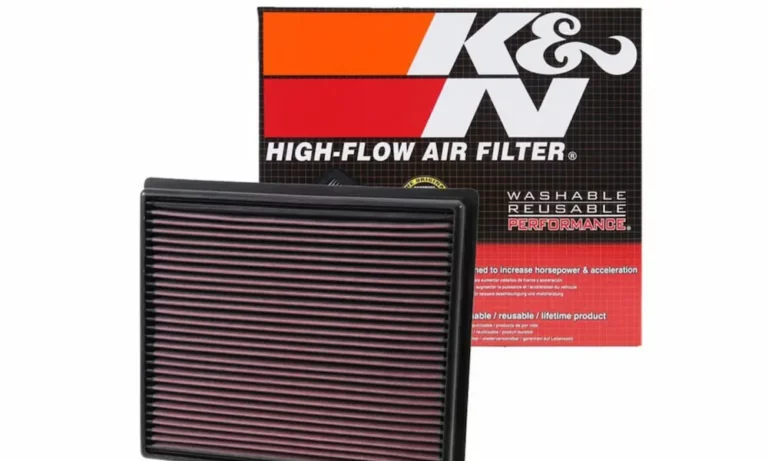
You’re staring at two air filters—one’s a washable K&N, the other’s a standard paper OEM replacement. Both promise to keep your engine running smoothly, but they couldn’t be more different. Let’s cut through the marketing hype and figure out which one makes sense for your ride.
What Makes These Filters Different?
OEM Filters Use Paper Technology
OEM filters rely on pleated paper that traps dirt throughout its entire thickness. Think of it like a sponge—particles get caught deep inside the material, not just on the surface. The paper’s treated with resin to keep it from falling apart, and manufacturers typically fold it into 75-114 pleats to maximize surface area.
The construction creates what engineers call “barrier filtration.” Dirt hits the paper and stays there, period. No oil, no fuss, no complicated cleaning rituals.
K&N Goes with Cotton Gauze
K&N filters stack 4-6 layers of cotton gauze that’s been treated with their signature red oil. The oil does the heavy lifting here—it attracts particles electrostatically while the cotton provides structure.
This setup allows bigger gaps between fibers, which means more air can flow through. But here’s the catch: that oil needs to be just right. Too much and you’ll coat your mass airflow sensor. Too little and filtration suffers.
Do K&N Filters Really Add Horsepower?
The Marketing Claims
K&N advertises 15-25 horsepower gains on average. Sounds impressive, right? But reality doesn’t always match the brochure.
What Actually Happens
Drop-in filter replacements—the ones that just swap into your stock airbox—deliver minimal results. We’re talking 0-5 horsepower on stock engines. That’s basically nothing you’ll feel in the seat of your pants.
Testing on a 2009 Lexus IS220D showed no significant difference in acceleration between K&N and OEM filters. Even more interesting? A Miata test found the aftermarket intake actually reduced power from 169hp to 156hp compared to stock.
Cold air intake systems tell a different story. When you combine a K&N filter with larger intake tubes and better routing, you can see legitimate gains of 15-24 horsepower. But that’s the whole system working together, not just the filter.
Why the Disconnect?
K&N filters flow up to 50% more air in lab testing. But your engine’s computer adjusts fuel delivery and timing based on what it sees. More airflow doesn’t automatically mean more power unless the entire intake system and engine management can capitalize on it.
Which Filter Blocks More Dirt?
Lab Testing Results
Both filters undergo standardized ISO 5011 testing, though K&N acknowledges this protocol can’t predict real-world performance. Here’s what the numbers show:
- K&N filters: 97-99% efficiency
- OEM filters: 98%+ efficiency with Ford claiming >98% dust stopping capability
Those percentages look similar, but the devil’s in the details.
The Controversial Project 200 Test
Independent testing found significant differences in what actually passes through. After 60 minutes of controlled dust exposure, an AC Delco paper filter accumulated 574 grams of dirt while letting only 0.4 grams through. The K&N filter accumulated 221 grams but allowed 7.0 grams to pass through.
That’s 17.5 times more dirt getting into your engine with the K&N.
The Particle Size Factor
K&N filters excel at catching larger particles over 10 microns. But they let more ultra-fine particles under 2.5 microns slip through compared to paper filters. Those tiny particles are exactly what you don’t want circulating in your engine oil.
What About Your Wallet?
Upfront Costs
Here’s the initial investment comparison:
| Filter Type | Cost Range |
|---|---|
| K&N drop-in | $50-70 |
| OEM replacement | $15-30 |
K&N costs 2-3 times more upfront. But the story changes when you zoom out.
Long-Term Math
K&N filters need cleaning and re-oiling every 50,000 miles. OEM filters get replaced every 15,000-30,000 miles depending on conditions.
Over 200,000 miles:
- K&N: $70 initial + $30 cleaning kit = $100 total
- OEM: 8-10 replacements × $25 average = $200-250 total
K&N breaks even around 40,000-60,000 miles. If you keep vehicles long-term or drive a lot, the savings add up.
Maintenance Reality Check
OEM Simplicity
Pop the old filter out, drop the new one in. Five minutes, done. No special tools, no waiting, no mess.
K&N Complexity
Cleaning a K&N properly takes 30-60 minutes. Here’s the process:
- Remove and inspect the filter
- Spray with K&N cleaning solution and let it soak
- Rinse thoroughly with low-pressure water
- Let it air dry completely (24+ hours recommended)
- Apply new filter oil evenly
- Let the oil cure before reinstalling
Screw this up and you’ll either starve your engine for air or contaminate sensors. Over-oiling is the most common mistake, and it can trigger check engine lights or cause rough running.
The MAF Sensor Debate
K&N’s Position
K&N insists oil migration is impossible under normal conditions. They’ve tested filters at extreme airflow rates without detecting oil contamination. Laboratory analysis of 52 “failed” sensors found zero caused by K&N oil.
The company offers a consumer protection pledge and will reimburse warranty denials they determine resulted from their products.
What Forum Members Report
Head to any car forum and you’ll find multiple reports of MAF sensor issues after K&N installation. The common thread? Over-oiling.
Even K&N acknowledges that excessive oil application can affect sensor readings. The difference between “properly oiled” and “too much oil” isn’t always obvious to DIYers.
Will K&N Void Your Warranty?
Legal Protection
The Magnuson-Moss Warranty Act requires dealers to prove aftermarket parts caused specific damage to deny warranty coverage. Simply installing a K&N filter can’t automatically void your warranty.
Practical Reality
Dealers may initially deny claims and make you fight for coverage. K&N backs their customers with a consumer protection pledge, but you’ll need to advocate for yourself.
The burden of proof stays on the dealer to establish causation. But do you want that hassle when you’re dealing with a broken engine?
When K&N Makes Sense
High-Mileage Drivers
If you’re racking up more than 20,000 miles annually, K&N’s cost savings become meaningful. The filter pays for itself faster and you’ll spend less time buying replacements.
Dusty Environments
Operating in construction zones, off-road conditions, or agricultural areas? You’d be changing OEM filters constantly. A washable K&N makes more sense when conditions are harsh.
Performance Builds
Building a turbocharged or supercharged engine with supporting modifications? Modified engines with tuning can actually capitalize on K&N’s increased airflow. But you need the whole package—intake, exhaust, tuning—to see benefits.
Sound Enhancement
Let’s be honest: one of the biggest differences you’ll notice is enhanced intake noise. If you want to hear your engine breathing, K&N delivers. Some people dig that, others find it annoying.
When OEM Is the Better Choice
Low-Mileage Drivers
Driving under 15,000 miles yearly? You won’t replace filters often enough to justify K&N’s higher upfront cost. Stick with cheap paper filters.
Warranty Protection
If your vehicle’s under warranty and you don’t want any potential complications, OEM filters eliminate questions. No dealer can point fingers at your air filter choice.
Maintenance Simplicity
Hate wrenching? Don’t want to spend an hour cleaning and oiling a filter? OEM filters require zero maintenance—just swap and forget.
Stock Configurations
Running a completely stock vehicle with no performance modifications? Independent testing consistently shows minimal power gains from K&N drop-in filters. You’re spending extra money for no real benefit.
Maximum Filtration
If engine longevity matters more than anything else, OEM paper filters demonstrate superior fine particle retention. They’re engineered specifically for your engine’s requirements.
Real-World Performance Testing
Dyno Results
Comprehensive testing using automotive-grade equipment reveals measurable differences:
| Test Parameter | K&N | OEM |
|---|---|---|
| Airflow | 15-25% more | Baseline |
| Fine particle retention | Lower | Higher |
| Initial restriction | Higher | Lower |
| Dust holding capacity | More total dirt | Less |
Field Testing Across Platforms
Testing multiple vehicles consistently shows:
- Minimal power gains from drop-in K&N filters on stock engines
- Measurable improvements with complete cold air intake systems
- No significant fuel economy changes in most applications
- Enhanced intake sound as the primary noticeable difference
The Bottom Line on K&N Air Filter vs OEM
Neither filter wins across the board. Your choice depends on how you use your vehicle and what matters most to you.
Pick K&N when you’re chasing cost savings over high mileage, don’t mind hands-on maintenance, and want that intake growl. The washable design pays off after 40,000-60,000 miles, especially in dusty conditions.
Go OEM when you want maximum engine protection, simple maintenance, and zero warranty complications. The superior fine particle filtration and drop-in convenience make paper filters the smart choice for daily drivers and stock configurations.
For most people driving stock vehicles under warranty? OEM filters offer the best balance of protection, cost, and simplicity. Performance enthusiasts with modified engines and proper maintenance skills might benefit from K&N—but only when combined with supporting modifications that can actually use the extra airflow.
The fundamental trade-off remains: K&N gives you increased airflow and long-term savings at the cost of more complex maintenance and potentially reduced fine particle filtration. OEM delivers superior filtration and maintenance simplicity while requiring more frequent replacement and higher lifetime costs.
Choose based on your priorities, not marketing hype.