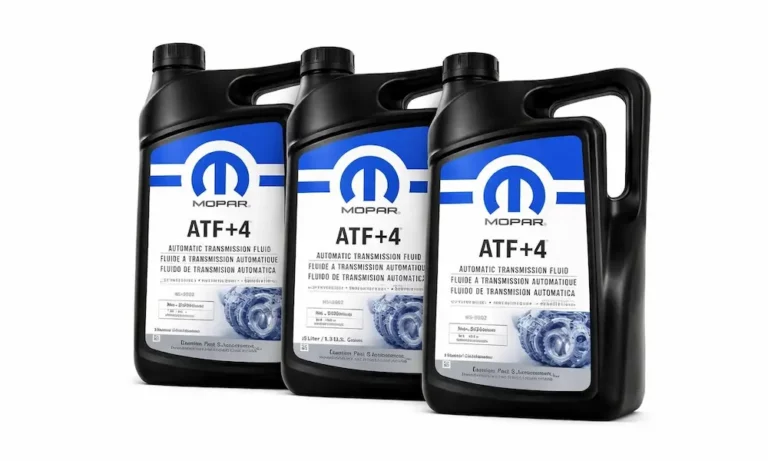
Picking the wrong transmission fluid for your Chrysler, Dodge, Jeep, or Ram can wreck a transmission that costs thousands to replace. This guide breaks down every licensed Mopar ATF+4 transmission fluid equivalent — and flags the fluids you should never use. Read to the end before you buy a single quart.
What Makes Mopar ATF+4 Different From Regular Transmission Fluid?
Mopar ATF+4 isn’t just any transmission fluid. It meets the Chrysler MS-9602 material specification — a demanding standard developed specifically because early electronically controlled Chrysler transmissions were destroying themselves with the wrong fluid.
The problem was torque converter shudder — a high-frequency vibration caused by friction modifiers breaking down under heat. Standard mineral-oil fluids couldn’t handle it. So Chrysler engineers developed a full-synthetic formula with a unique additive package matched exactly to Chrysler clutch materials.
The result? A fluid marketed as “Fill for Life” under normal driving conditions — and one that became mandatory for all Chrysler, Dodge, Jeep, and Ram service and repair work from 1998 onward.
The MS-9602 Licensing Program: Why the Label Matters
Here’s the thing that separates ATF+4 from fluids like Dexron or Mercon: it’s a licensed trademark, not a generic specification.
In 2005, Chrysler established a formal licensing program managed by the Center for Quality Assurance (CQA) — an independent body that tests and approves every brand allowed to carry the ATF+4 name.
Getting that license isn’t easy. Brands must:
- Complete over one million miles of testing in severe environments
- Pass a full chemical and physical validation process
- Submit to random market sampling (the CQA pulls products off store shelves and tests them)
If a bottle carries the ATF+4 trademark, it’s passed every single one of those tests. That’s your green light.
Using an unlicensed fluid risks lower performance, shorter transmission life, and a voided vehicle warranty. The CQA is clear about that.
ATF+4 Technical Specs: What’s Actually in the Bottle
ATF+4 uses Group II+ and Group III synthetic hydrocarbon base fluids — not the basic mineral oils from older fluid generations. These base stocks get hydro-cracked to remove impurities, giving the fluid a remarkably stable molecular structure.
Here’s what the spec sheet looks like:
| Property | Typical Value | Test Method |
|---|---|---|
| Color | Red | Visual |
| Flash Point | 410°F | ASTM D92 |
| Pour Point | -48 to -51°C | ASTM D97 |
| Kinematic Viscosity @ 40°C | 33.24–35.13 cSt | ASTM D445 |
| Kinematic Viscosity @ 100°C | 7.39–7.71 cSt | ASTM D445 |
| Viscosity Index | 194–204 | ASTM D2270 |
| Brookfield Viscosity @ -40°C | 8,380–9,300 cP | ASTM D2983 |
That viscosity index of 194–204 means the fluid maintains consistent thickness from arctic cold to desert heat. The pour point of -48°C tells you it flows freely on the coldest winter mornings. The 410°F flash point reflects just how stable the synthetic base stocks really are.
Four Things the Additive Package Must Do
Every licensed Mopar ATF+4 equivalent contains additives engineered for four specific jobs:
- Shear stability — Keeps the fluid from thinning out permanently when mechanical pressure tears apart weaker fluid molecules
- Oxidation resistance — Prevents sludge, varnish, and acid buildup at high temperatures
- Frictional modification — Delivers the exact grip profile Chrysler clutch packs need to shift smoothly and prevent shudder
- Anti-wear and anti-foam protection — Guards internal components and prevents cavitation from trapped air bubbles
Every Licensed Mopar ATF+4 Transmission Fluid Equivalent
Because the ATF+4 name is a licensed trademark, any brand displaying it has already been approved by Chrysler. Here are the major ones.
Valvoline ATF+4
Valvoline ATF+4 is the most widely available aftermarket option. It’s a full-synthetic formula officially approved for all Chrysler, Dodge, Ram, and Jeep applications. Valvoline specifically targets the three biggest failure points: leaks, wear, and shift inconsistency.
You’ll also find Valvoline’s fluid sold under the NAPA, AutoPride, and Parts Master store labels — same formula, different packaging.
Mobil ATF+4
Mobil ATF+4 is designed specifically for Chrysler-designed transmissions and also covers certain Mitsubishi and Hyundai applications that share similar transmission architecture. Mobil highlights low-temperature fluidity and dependable wear protection as its standout features.
Castrol Transmax ATF+4
Castrol Transmax ATF+4 carries license number 40630033. It’s a full-synthetic fluid certified for all Chrysler cars and trucks requiring any generation of the ATF+ standard. You can verify any license number directly with the CQA for extra peace of mind.
Petro-Canada ATF+4
Petro-Canada’s ATF+4 uses 100% Purity VHVI synthetic base fluids and is tested to exceed the 100,000-mile drain interval. Petro-Canada is also a major base stock supplier for other blenders in this space — which says a lot about their technical credibility.
Pennzoil Platinum ATF+4
Pennzoil Platinum ATF+4 is a full-synthetic fluid engineered for enhanced oxidation and shear stability. It’s fully backward-compatible with ATF+3 and covers all current Chrysler vehicles.
Store-Brand and Regional ATF+4 Equivalents
The licensing program covers dozens of retail and regional brands. These aren’t inferior products — they meet the exact same CQA standards as the premium names. Here’s the full picture:
| Brand Name | Supplier | Availability |
|---|---|---|
| AutoZone ATF+4 | AutoZone Parts, Inc. | Global |
| CITGO Transgard ATF+4 | CITGO Petroleum | North America |
| FRAM Full Synthetic ATF+4 | CQ Sourcing, Inc. | North America |
| Havoline ATF+4 | Chevron Products | North & South America |
| MAG 1 ATF+4 | Highline Warren LLC | Global |
| Motomaster ATF+4 | Motomaster Canada | Canada |
| NAPA ATF+4 | Valvoline | Global |
| O’Reilly ATF+4 | Ozark Automotive | USA/Global |
| Ravenol ATF+4 | Ravensberger | Global |
| Super Tech ATF+4 | Walmart Stores | Global |
| Amalie ATF+4 | Amalie Oil Company | Global |
| Federated Auto Parts ATF+4 | Federated Auto Parts | Global |
| Starfire ATF+4 | Highline Warren LLC | Global |
Ravenol is particularly worth noting for international owners. If you’re running a Jeep or Ram outside North America where Mopar-branded fluid is hard to find, Ravenol’s MS-9602 certified product is a solid, accessible option.
ATF+4 vs. Multi-Vehicle “Universal” ATF: Don’t Mix These Up
This is where a lot of people go wrong. Walk into any auto parts store and you’ll see shelves full of “Multi-Vehicle” or “Universal” transmission fluids. They look like a convenient one-size-fits-all solution. They’re not — at least not for your Chrysler.
Take Valvoline MaxLife Multi-Vehicle ATF. It’s a well-made product. But Valvoline’s own documentation notes that vehicle manufacturers have not endorsed or evaluated it for MS-9602 applications.
The core problem: a multi-vehicle fluid tries to balance the friction needs of GM’s Dexron-VI, Ford’s Mercon LV, and Chrysler’s MS-9602 all at once. Those specifications have fundamentally different friction profiles. Something designed to satisfy all of them will be perfectly optimized for none of them.
The CQA’s own testing shows that unlicensed products claiming compatibility regularly fail to meet the full range of FCA specifications. If your vehicle is under factory warranty, this matters a lot. If your transmission is already showing shift quality issues, it matters even more.
Stick with a licensed brand. It’s not worth the risk.
ATF+4 Works in More Than Just the Automatic Transmission
Most people associate ATF+4 with automatic transmissions, but Chrysler actually uses it in several other systems on post-1998 vehicles:
- Power steering systems — ATF+4 replaced dedicated power steering fluid across the FCA lineup. Its low-temperature performance prevents the heavy steering and hydraulic noise you’d otherwise get during cold starts.
- Certain manual transmissions and transfer cases — The high shear stability is especially useful in transfer cases during four-wheel-drive engagement. Check your owner’s manual to confirm, but most modern Jeep and Ram manual units call for ATF+4.
Also worth noting: ATF+4 is fully backward-compatible with ATF+, ATF+2, and ATF+3. If you’re maintaining an older vehicle originally filled with ATF+3, switching to ATF+4 is not only fine — it’s recommended.
Critical Warning: ATF+4 Does NOT Work in 8-Speed or 9-Speed Transmissions
This is the most important section in this entire post. Read it carefully.
Many newer Chrysler, Jeep, and Ram vehicles — particularly 2014 and later models — use ZF-designed 8HP or 9HP transmissions. These units require a completely different fluid: Mopar 8&9 Speed ATF or ZF LifeGuard 8.
ATF+4 is not compatible with these transmissions. Not even close.
| Transmission Type | Required Fluid | Compatible Brands |
|---|---|---|
| Chrysler 3/4/6-Speed | MS-9602 (ATF+4) | Mopar, Valvoline, Mobil, Castrol, Pennzoil |
| Chrysler/ZF 8/9-Speed | 8&9 Speed ATF | Mopar 8&9 Speed, ZF LifeGuard 8, Pentosin ATF 8 |
The 8/9-speed fluids are thinner, engineered to reduce parasitic drag and improve fuel economy. The clutch materials in those units are co-developed with those specific fluids. Dealership technicians are blunt about it: using ATF+4 in a ZF 8-speed will damage the transmission.
Before you buy anything, check your owner’s manual or the transmission tag to confirm exactly which unit you have.
How to Pick the Right ATF+4 Equivalent: A Quick Checklist
You don’t need to overthink this. Follow these four steps:
- ✅ Check your transmission type first. 2014+ model? Verify whether you have a ZF 8/9-speed before buying ATF+4.
- ✅ Look for the ATF+4 trademark on the bottle. That name is your guarantee of CQA approval.
- ✅ Verify the license number if you want extra certainty. Castrol’s is 40630033 — licensed brands list here.
- ✅ Skip unlicensed universal fluids if your vehicle is under warranty or showing any shift quality issues.
Any licensed brand on the tables above will protect your transmission just as well as Mopar’s own bottle — at a fraction of the dealership price.