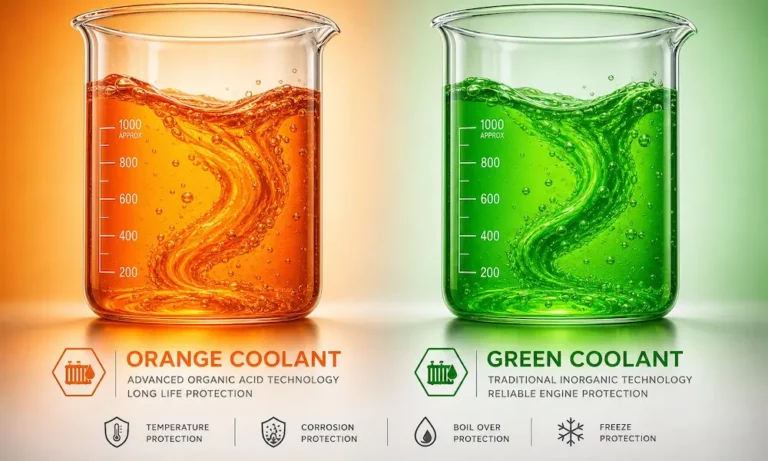
Grabbed the wrong coolant at the auto parts store? You might be one accidental mix away from a very expensive repair. The difference between orange and green coolant isn’t just color — it’s chemistry. Get it wrong and you could turn your cooling system into a gel-filled disaster. Here’s everything you need to know before you pop that radiator cap.
They’re Chemically Different — Not Just Different Colors
Green coolant uses Inorganic Additive Technology (IAT). It relies on silicates and phosphates to protect your engine. Orange coolant uses Organic Acid Technology (OAT). It relies on organic carboxylates instead.
These two formulas don’t just work differently — they protect different metals.
Green coolant was built for older engines made of cast iron, steel, copper, and brass. Orange coolant was designed for modern engines packed with aluminum alloys and nylon polymers. As car manufacturers swapped heavy metals for lightweight materials, green coolant simply couldn’t keep up.
Here’s a quick side-by-side breakdown:
| Feature | Green (IAT) | Orange (OAT) |
|---|---|---|
| Inhibitor type | Silicates & phosphates | Organic carboxylates |
| Best for | Cast iron, steel, copper | Aluminum, nylon polymers |
| How it protects | Coats all metal surfaces | Targets only active corrosion sites |
| Service life | 2–3 years / 24K–36K miles | 5 years / 100K–150K miles |
| Heat transfer | Slightly reduced | Better efficiency |
Green coolant forms a physical protective layer over every metal surface inside your engine. That sounds great — until you realize that blanket coating slightly reduces heat transfer efficiency. It also depletes fast because those silicates constantly sacrifice themselves to maintain the coating.
Orange OAT coolant skips the blanket approach. Its organic acids stay in suspension and only react where corrosion actually starts. That means better heat transfer and a much longer service life.
What Happens When You Mix Orange and Green Coolant
Here’s where things get ugly. Mixing orange and green coolant doesn’t just dilute one formula — it triggers a chemical reaction that destroys your cooling system.
When silicates from green coolant hit the organic carboxylates in orange coolant, the silicates destabilize and fall out of suspension. The result? A thick, jelly-like sludge that clogs your cooling passages.
This isn’t a theoretical risk. It’s a real mechanical failure sequence:
| Stage | What Happens | Damage |
|---|---|---|
| 1. Destabilization | Silicates react with organic acids | Inhibitors destroyed, fluid thickens |
| 2. Gelation | Sludge forms and blocks narrow passages | Clogged heater cores, radiator tubes |
| 3. Fluid starvation | Water pump loses flow and lubrication | Pump seizure, seal failure |
| 4. Thermal overload | Heat can’t reach the radiator | Blown head gaskets, warped cylinder heads |
Mixing these coolants even once can start this chain reaction. If you’ve accidentally mixed them — or you don’t know your vehicle’s coolant history — a complete system flush is your only safe move. Drain everything, use a chemical cleaner to dissolve silicate deposits, flush with distilled water, and refill with the correct formula.
The Dex-Cool Story: When Orange Coolant Made History
In 1995, General Motors introduced Dex-Cool — the first widespread orange OAT coolant in the U.S. market. It promised five years or 150,000 miles of protection. That was a huge deal compared to green coolant’s two-to-three-year replacement schedule.
But early Dex-Cool had a serious problem. It used 2-ethylhexanoic acid as its primary inhibitor. That compound acts as a plasticizer — it softens certain plastics and rubber seals. In GM’s 3.1L, 3.4L, and 3.8L V6 engines from 1995 to 2004, the coolant attacked the composite intake manifold gaskets. Coolant leaked into the oil. Engines sludged up. Radiators and heater cores clogged with rusty brown gunk — especially when fluid levels dropped low and oxygen entered the system.
The fallout was massive. GM settled a class-action lawsuit in 2008, paying affected owners between $50 and $800 per vehicle. When GM filed for bankruptcy in 2009, remaining claimants received roughly 30 cents on the dollar. Modern orange formulations have since been reformulated, and newer GM vehicles don’t suffer the same gasket degradation issues.
How Ford and Chrysler Handle Coolant (It Gets Complicated)
Ford took a different path. Concerned about 2-ethylhexanoic acid damaging plastic gaskets, Ford skipped Dex-Cool entirely. In the early 2000s, Ford adopted G-05 — a Hybrid Organic Acid Technology (HOAT) formula. It combines low-silicate content with organic acids. Ford dyed it yellow.
In 2011, Ford switched to a true OAT orange coolant for most passenger vehicles and light trucks through 2018. Then Ford switched again to a bright yellow OAT formula (Motorcraft Yellow, meeting WSS-M97B57-A1/A2 specs). The good news? The new yellow formula is compatible with the older orange fluid, so topping off an older Ford with the newer yellow coolant won’t cause problems.
Chrysler’s story is even messier. In the 2000s, Chrysler also used G-05 HOAT — but dyed it orange instead of yellow. Then around 2013, Chrysler switched to a true OAT formula dyed purple (Mopar MS.90032). Two different chemistries, both orange or close to it, from the same manufacturer.
Technicians frequently mix these up, topping a newer purple-spec Chrysler with an older orange HOAT formula. Those inhibitors aren’t compatible, and mixing them shortens the coolant’s protective life. To make things worse, the purple Mopar coolant often turns pinkish-orange or brown from heat cycling — making owners think the wrong coolant was already installed.
Stop Trusting Color to Pick Your Coolant
This is the biggest mistake DIYers and even some shop techs make. Color no longer tells you what chemistry is inside the bottle. There’s no federal regulation governing coolant color in the U.S. Manufacturers add dye for branding and leak detection — not chemistry identification.
The same OAT formula can show up in orange, red, pink, purple, blue, or green depending on the brand and target vehicle market. Honda uses blue dye across all its proprietary coolants regardless of the formula type.
Regional chemistry differences make this even trickier:
- North American vehicles: Typically need silicate-free, phosphate-free OAT formulas to protect aluminum while avoiding mineral scaling.
- Asian vehicles (Toyota, Honda, Nissan): Usually require phosphate-rich OAT formulas for fast aluminum passivation, but strictly prohibit silicates to protect water pump seals from abrasion.
- European vehicles: Use low-silicate, phosphate-free hybrid formulas because European tap water contains high levels of calcium and magnesium that cause deposits.
Pouring a generic orange “universal” coolant into a Toyota or BMW can deplete inhibitors fast, cause chemical drop-out, or accelerate internal corrosion.
Here’s how popular aftermarket coolants break down:
| Product | Color | Technology | Best For |
|---|---|---|---|
| Prestone Dex-Cool | Orange | OAT | GM 1995+, Ford 2011–2018, Chrysler 2013+ |
| Prestone Max Stellantis | Purple | OAT | Jeep, Dodge, Ram, Chrysler 2000+ |
| Prestone Max Asian (Toyota) | Red | POAT | Toyota, Lexus, Scion |
| Prestone Max Asian (Honda) | Blue | POAT | Honda, Acura, Nissan, Subaru 2009+ |
| Valvoline Zerex G-05 | Yellow | HOAT | Older Ford, Chrysler, Mercedes-Benz |
Always Check Your Owner’s Manual First
Your owner’s manual or the label on the coolant reservoir tells you exactly which specification your vehicle needs. Look for a spec number — like GM 6277M, Ford WSS-M97B44-D, or Mopar MS.90032 — and match it to the coolant container label.
Don’t top off with tap water, either. Tap water introduces minerals that cause scaling and speed up galvanic corrosion inside your engine. Always use pre-mixed 50/50 distilled water formulas or mix concentrate with deionized water only.
If your vehicle’s coolant history is unknown, skip the guessing game. Do a full flush, use a chemical cleaner to clear out any silicate deposits or sludge, rinse with distilled water, and start fresh with the correct manufacturer-approved formula. It’s a two-hour job that beats a $3,000 head gasket repair every single time.