Your steering wheel feels heavy, you hear a whine every time you turn, or there’s a puddle of red fluid under your car. Sound familiar? These are classic signs your power steering pump is giving up. This guide covers everything — symptoms, costs, DIY steps, and the mistakes that kill new pumps fast. Read to the end before you buy a single part.
What Does a Power Steering Pump Actually Do?
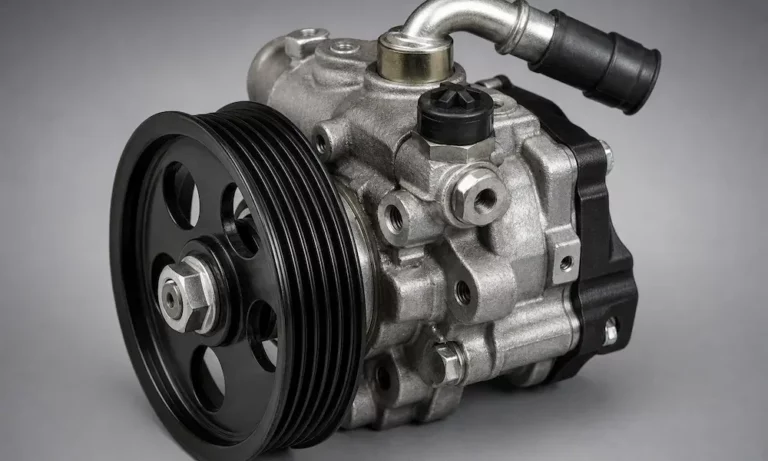
The power steering pump is the heart of your hydraulic steering system. It bolts to your engine, runs off the serpentine belt, and pushes fluid through your steering rack at high pressure. That pressure is what makes turning the wheel feel effortless — especially when you’re parking or doing slow maneuvers.
Most pumps use a rotary vane design: a spinning rotor with vanes that slide in and out, creating pressure as they rotate inside an elliptical cam ring. It’s a simple concept that works well — until it doesn’t.
Warning Signs Your Power Steering Pump Is Failing
Don’t ignore these. A bad pump that runs dry can destroy itself in minutes.
Noises That Tell the Real Story
The sounds coming from your engine bay are your first clue. Here’s what each one means:
| Sound | What’s Happening |
|---|---|
| Whining or groaning | Air in the fluid (cavitation) or worn internal vanes |
| Squealing at startup | Belt slipping on the pump pulley |
| Grinding or chirping | Worn bearings — pump seizure is close |
| Hissing | Fluid leaking through a high-pressure fitting |
Cavitation is the sneaky killer here. Air bubbles in the fluid implode under pressure, creating tiny shock waves that erode the pump’s internal surfaces. Low fluid or a leaking return line usually causes it.
Steering That Feels Wrong
Your hands tell the story too. Watch for:
- Heavy or stiff steering, especially at low speeds or when parked
- Choppy or jerky wheel movement — assistance cuts in and out
- Vibrations through the wheel — damaged rotors or vanes causing pressure spikes
A failing pump struggles most at idle, because it can’t build enough pressure when the engine spins slowly.
What Your Fluid Is Telling You
Pull the reservoir cap and look at the fluid. Fresh fluid is bright red or clear. Here’s what color changes signal:
| Fluid Appearance | What It Means |
|---|---|
| Foamy or bubbly | Air entering the system through a loose hose |
| Milky or tan | Water contamination |
| Grey with metallic flecks | Internal parts are shedding metal — pump is dying |
| Dark brown or black | Oxidized fluid, needs a full system flush |
A reddish puddle under the front of your car? That’s a leak at the pump shaft seal, a hose fitting, or the reservoir itself. Don’t top it off and ignore it — fluid starvation destroys a pump fast.
Don’t Replace the Pump Until You Check These First
Here’s a money-saving step most people skip: ruling out cheaper problems that mimic pump failure.
Check the Serpentine Belt First
A worn or slipping belt causes stiff steering and a loud squeal — exactly like a dying pump. Look for glazing (shiny surface), fraying, or cracks. Also check the belt tensioner. A weak tensioner lets the belt slip under load without showing obvious wear.
Check for Mechanical Steering Issues
Seized strut mounts, worn ball joints, or a binding steering column coupler all create resistance that feels like low power assist. Here’s a quick test: raise the front wheels off the ground and try turning the wheel with the engine off. If it’s still hard to turn, the problem is mechanical — not hydraulic.
Check the Reservoir Screen
This is the hidden culprit nobody talks about. Many vehicles — especially imports — have a fine mesh screen inside the power steering reservoir. If it clogs with oxidized fluid or metal debris, it starves the pump of fluid. The pump whines, steering gets stiff, and everyone assumes the pump is bad. Sometimes cleaning or replacing the reservoir fixes the whole problem.
What You Need to Replace a Power Steering Pump
Specialty Tools You Can’t Skip
- Pulley puller and installer kit — Most modern pumps have a press-fit pulley. Using a standard gear puller will crack it. You need a proper clamshell-style kit that grips the hub and uses a jackscrew to pull or press the pulley cleanly.
- Line wrenches (flare nut wrenches) — These grip five sides of the hydraulic fitting hex. Use a regular open-end wrench and you’ll round off soft brass fittings instantly.
- Vacuum bleeder kit — A Mityvac or similar hand-pump vacuum tool makes air bleeding dramatically faster and more effective than doing it by hand.
General Tools
- Socket and ratchet set
- Torque wrench (don’t skip this — over-tightened fittings leak, under-tightened bolts cause vibration)
- Jack and jack stands
- Drain pan and plenty of shop towels
- Penetrating oil for corroded bolts
How to Replace a Power Steering Pump: Step-by-Step
Step 1: Safety First
Park on flat ground, set the parking brake, and disconnect the negative battery cable. The pump often sits near the alternator. Let the engine cool completely before you touch anything.
Step 2: Drain the System
Use a turkey baster or suction pump to pull fluid from the reservoir — it keeps the mess manageable. Place a drain pan under the car, then disconnect the low-pressure return hose at its lowest point to drain the rest.
Step 3: Remove the Drive Belt
Release belt tension with a socket on the automatic tensioner, then slip the belt off the pump pulley. Inspect the belt now. If it shows any wear at all, replace it while you’re in there.
Step 4: Disconnect the Hydraulic Lines
Use your line wrenches to disconnect the high-pressure and return lines. Wrap shop towels around the alternator and AC compressor before you do — power steering fluid damages electrical components if it soaks in.
Step 5: Remove the Pump and Transfer the Pulley
Unbolt the pump from its bracket and pull it out. If your new pump doesn’t include a pulley, use the specialty puller to remove the old one. A thin layer of wheel bearing grease on the installer tool threads helps prevent shaft damage when pressing the pulley onto the new pump.
Step 6: Install the New Pump
Position the new pump, torque all mounting bolts to spec, and reconnect the hydraulic lines. Always use new O-rings or copper crush washers on high-pressure fittings. Old seals are the number one cause of post-repair leaks.
Step 7: Reinstall the Belt and Check Alignment
Route the belt according to the diagram in your engine bay or owner’s manual. Then check that the pump pulley lines up perfectly with the rest of the drive system. A misaligned pulley causes chirping noise and kills the belt in weeks.
Bleeding the System: Don’t Skip This
Air trapped in the system after a power steering pump replacement will cause cavitation — and cavitation will ruin a brand new pump. You must bleed it properly.
Manual method:
- Fill the reservoir to the “Full Cold” mark and leave the cap off
- Raise the front wheels off the ground
- With the engine off, turn the wheel slowly lock-to-lock 20–40 times
- Keep topping off the fluid as the level drops
- Start the engine and repeat, watching for foam or whining
Vacuum method (faster and more thorough):
- Fit a vacuum adapter to the reservoir
- Apply 15–25 inches of mercury with your hand pump
- Hold the vacuum for several minutes
- Start the engine and cycle the steering wheel
- Once the fluid runs clear and quiet, you’re done
The vacuum method pulls out micro-bubbles that manual cycling misses. If your new pump whines after installation, improper bleeding is almost always the reason.
Use the Right Fluid — This Really Matters
Using the wrong power steering fluid is one of the fastest ways to destroy your system. Wrong fluid wrecks seals and causes sludge buildup that clogs the entire steering circuit.
| Vehicle | Required Fluid |
|---|---|
| Chrysler/FCA | ATF+4 |
| Ford | Mercon V or Type F (check your model year) |
| Honda/Acura | Honda Genuine PSF only — generic fluid destroys seals |
| BMW, VW, European | Pentosin CHF 11S or CHF 202 |
| Toyota/Lexus | Dexron II/III or specified PSF |
Always check your reservoir cap or owner’s manual. Never mix fluid types — the chemical reaction creates sludge that clogs the steering rack valves.
How Much Does Power Steering Pump Replacement Cost?
Here’s what you’re looking at in 2025–2026:
| Item | Cost (USD) |
|---|---|
| New pump (aftermarket) | $400–$700 |
| Remanufactured pump | $150–$400 |
| Labor (1.5–4 hours) | $200–$600 |
| Power steering fluid | $10–$40 |
| Shop supplies | $20–$50 |
Total professional cost: $700–$1,000 for most vehicles. Some models cost significantly more.
Cost by popular model, according to RepairPal:
- Ford F-150: $494–$612
- Chevrolet Silverado: $638–$758
- Toyota Camry: $565–$900
- Honda Civic: $300–$1,080
- Nissan Altima: $895–$1,604
- BMW 3 Series: $550–$1,400
Labor hours vary a lot depending on how buried the pump is in your engine bay. Some modern engines require removing multiple components just to reach it.
Always Flush the System When You Replace the Pump
When a pump fails mechanically, it sheds metal particles throughout the entire hydraulic circuit. If you don’t flush the system completely before installing the new pump, those particles act like sandpaper on the new vanes and seals. Your brand new pump fails in weeks.
A full system flush means pushing fresh fluid through the entire circuit until it runs clean — not just topping off the reservoir. This step is non-negotiable.
Dispose of Used Fluid the Right Way
Power steering fluid is classified as used oil under EPA regulations. It contains toxic heavy metals including lead, cadmium, and chromium. You can’t dump it down the drain, toss it in the trash, or pour it on the ground.
Here’s what to do:
- Store used fluid in a sealed, labeled plastic container
- Drop it off at any AutoZone, O’Reilly, or local municipal recycling center — it’s free
- Never mix it with brake fluid, antifreeze, or gasoline — contaminated oil can’t be recycled and becomes hazardous waste
Use Earth911’s recycling finder or your state’s EPA website to locate the nearest drop-off point. California has additional certification requirements for collection centers — check CalRecycle if you’re in the state.
What About Electric Power Steering?
If your car was built in the last several years, it might already have Electric Power Steering (EPS). EPS uses an electric motor instead of a hydraulic pump — no fluid, no hoses, no pump to replace. It’s more fuel-efficient because it only draws power when you actually turn the wheel.
EPS failures show up as a warning light on the dash and a sudden loss of assist — usually caused by a blown fuse, a bad sensor, or a failed motor. Diagnosis shifts from hydraulic troubleshooting to electrical diagnostics.
That said, millions of hydraulic-equipped vehicles are still on the road. Power steering pump replacement isn’t going anywhere as a DIY or shop repair anytime soon.