Found a mystery black box wired under your dashboard? It’s probably a Spireon GPS tracker — and no, it’s not as sinister as it sounds. Whether it’s active, dormant, or tied to your loan, what you do next depends entirely on your situation. Read to the end before you touch anything.
What Is Spireon and Why Is It in Your Car?
Spireon is one of North America’s largest vehicle telematics companies, operating under a corporation called Solera. It doesn’t make consumer gadgets. Instead, it sells GPS tracking systems to car dealerships, subprime auto lenders, and commercial fleet operators.
The company processes billions of location messages monthly across millions of active vehicles. If you found a Spireon GPS in your car, it almost always traces back to one of three scenarios:
- The car was financed through a subprime or Buy-Here-Pay-Here lender
- It was sold through a franchise dealership that used LoJack for lot management
- The car previously served as a commercial fleet vehicle
It’s rarely there for anything nefarious. It’s nearly always about money and asset protection.
The Four Spireon Products You Might Find
Spireon doesn’t use one universal device. It deploys four distinct product lines, each targeting a different part of the auto industry.
| Product | Who Uses It | Main Purpose |
|---|---|---|
| GoldStar | Subprime lenders & Buy-Here-Pay-Here dealers | Real-time tracking, payment enforcement, remote starter disable |
| LoJack by Spireon | Franchise dealerships & consumers | Lot management, stolen vehicle recovery, aftermarket upsell |
| FleetLocate | Commercial fleets & logistics companies | Driver monitoring, route optimization, federal compliance |
| Kahu | Independent dealers (now rebranded into LoJack) | Test drive tracking, loaner vehicle management |
Knowing which device you’re looking at tells you exactly why it’s there.
GoldStar: The Subprime Lender’s Tool
GoldStar is the most invasive product in Spireon’s lineup. It’s built specifically for Buy-Here-Pay-Here dealerships and high-risk auto lenders.
Here’s how it works. When a borrower with poor credit needs a car loan, lenders take on serious risk. To offset that risk, they require a GoldStar device as a non-negotiable condition of financing. The device tracks the car’s location in real time. It can also include a starter interrupt module — commonly called a kill switch.
If you miss a payment, the lender sends a cellular signal to the device, which cuts power to the ignition circuit. The car won’t start. You’re forced to call your lender and sort it out. It’s a technological substitute for a repo truck.
LoJack by Spireon: The Dealership Upsell
LoJack started as a standalone stolen vehicle recovery brand. After Spireon acquired it, LoJack became a dual-purpose dealership tool.
For the dealer, it’s a lot management system. Dealerships tracking hundreds of cars use it to find specific vehicles instantly, monitor battery voltage, and streamline monthly inventory audits. At the point of sale, the dealer pitches LoJack to the buyer as an aftermarket product, often adding several hundred dollars to the finance package.
For the consumer, it offers stolen vehicle recovery through a mobile app. Spireon claims an average recovery time of 26 minutes using cellular technology — compared to the national average of 28 days.
If you declined the LoJack purchase at the dealership but still found the device in your car? It’s probably dormant hardware the dealer never removed. That’s extremely common.
FleetLocate: The Commercial Leftover
If your car was previously a delivery vehicle, rental unit, or company car, it may have a FleetLocate device. These track driver behavior, fuel usage, route efficiency, and federal logging compliance.
They’re usually plug-in OBD-II devices, making them easy to spot and easy to remove. They rarely include starter interrupt capability on light-duty passenger vehicles.
What Does a Spireon Device Look Like?
Spireon deploys two main hardware categories: plug-in modules and hardwired units.
Plug-in modules connect directly to the OBD-II diagnostic port under your steering column. They’re roughly the size of a deck of cards, have a barcode and serial number on the casing, and pull power directly from the port. No tools needed to remove them — just unplug.
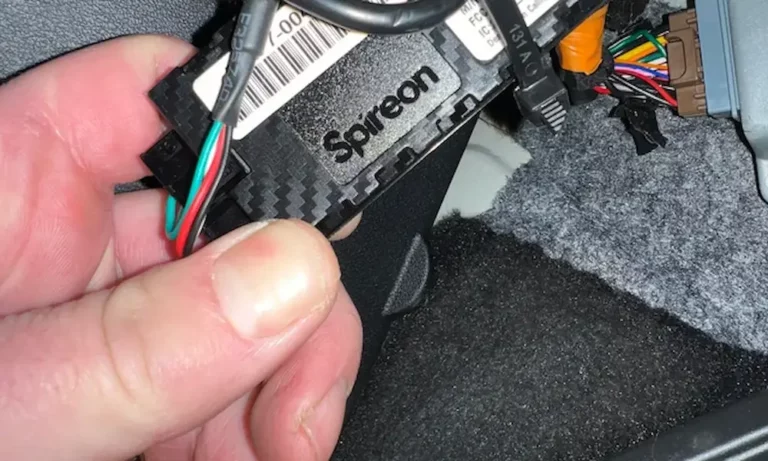
Hardwired units (like the GoldStar Edge, Talon, and Rocket) are designed to stay hidden. Installers tuck them behind dashboard panels, above the glove box, inside A-pillars, or near the instrument cluster. They must face skyward to receive satellite signals, but they penetrate plastic and glass easily.
The LED lights on these devices tell you a lot:
| LED Color | What It Means |
|---|---|
| Solid green | Active GPS satellite lock — it knows exactly where you are |
| Flashing green | Scanning for satellite signal |
| Slow blue/yellow flash | Connected to cellular network and transmitting data |
| Rapid blue/yellow flash | Searching for a cell signal |
| Solid red | Powered on and operational |
A solid green light plus a slow blue flash means the device is actively tracking your location and sending it to a remote server.
The Wiring Setup (And Why the Kill Switch Matters)
Hardwired Spireon devices tap into your car’s electrical system using color-coded wires. Understanding these is critical before you touch anything:
| Wire Color | Function |
|---|---|
| Red | Constant 12V power — always on, even with the key out |
| Black | Chassis ground |
| White | Ignition sense — only powered when the car runs |
| Green | Starter disable signal — controls the kill switch relay |
| Yellow/Brown | Optional door lock control |
The starter interrupt relay is spliced directly into the factory wire running from your ignition switch to the starter motor. If you remove the Spireon unit without dealing with this relay first, your car won’t start. The relay stays open with no device telling it to close.
Is the Tracker Killing Your Battery?
This is one of the most common concerns people have when they find a Spireon GPS in their car. The short answer: a properly functioning device probably isn’t the culprit.
Modern telematics units enter a deep sleep mode after detecting the ignition switch off via the white wire. In sleep mode, consumption drops to around 5 milliamperes — well within normal vehicle parasitic draw ranges. Your car’s factory systems (alarm, clock, keyless entry) already draw 50–85 milliamperes. Daily driving replenishes this easily.
Battery drain usually comes down to three real causes:
- Long-term parking — cumulative drain from both the car and device over weeks
- Failed internal backup battery — the device pulls high amperage trying to recharge a dead cell
- Improper installation — the worst case: if an installer tapped into a CAN bus circuit, it can prevent your car’s own computers from sleeping, killing the battery in days
Electric vehicle owners face an extra risk here. Disrupting the 12V auxiliary system on an EV can disable the entire vehicle, which is a much bigger headache than a dead battery in a gas car.
Is It Legal to Remove a Spireon GPS From Your Car?
This depends entirely on one thing: do you own the car outright, or is it financed?
If the Car Is Financed
The finance agreement you signed almost certainly contains a clause authorizing GPS tracking and, if applicable, starter interrupt technology. By signing, you granted the lender the legal right to monitor the vehicle as collateral.
Removing the device while the loan is active constitutes a material breach of contract. The lender can immediately declare default and repossess the car. Don’t do it.
If You Own the Car Outright
If the loan is paid off, or you bought the car used with a clean title, the previous owner’s consent to tracking expired the moment that loan closed. Any active tracking on a vehicle you own free and clear is unauthorized electronic surveillance on your private property.
You have every right to remove it.
This “abandoned device” situation is extremely common. Lenders managing thousands of accounts rarely establish protocols to physically remove trackers after loans mature. The hardware stays in the car, sometimes still transmitting location data to a third-party server — with neither party knowing it.
State Laws on GPS Tracking and Starter Interrupts
The federal government hasn’t passed a single national statute governing private automotive telematics. That leaves a patchwork of state laws protecting consumers:
| State | Key Rule |
|---|---|
| California | Civil Code 2983.37 requires written disclosure before using trackers or kill switches. Lenders must warn borrowers before disabling a vehicle and must provide a 24-hour emergency override. |
| New York | Senate Bill 2484 requires written notice mailed at least 10 days before remote disabling. Violations are a misdemeanor. |
| Pennsylvania | Title 18 Subchapter D prohibits placing trackers on vehicles without explicit owner consent. |
| Florida | Title 934.425 bans unauthorized tracking, with exceptions for legally collateralized vehicles. |
| New Jersey | Requires strict prior written notice before tracking employees in commercial fleet vehicles. |
If you’re unsure about your state’s specific rules, a quick consultation with a consumer protection attorney costs far less than accidentally breaching your loan agreement.
How to Remove a Spireon GPS Tracker (Step-by-Step)
Important: disconnect your negative battery terminal before touching any wiring. Skipping this step risks blown fuses, short circuits, or damage to your engine control module.
Step 1: Confirm You Have the Legal Right
Check your title. Verify your loan status. If the vehicle is free and clear, proceed. If not, stop here.
Step 2: Find the Device
- Check the OBD-II port under the driver’s side dash first. If something’s plugged in that wasn’t there from the factory, unplug it and you’re done.
- Use a flashlight and plastic trim tools to inspect behind the dashboard paneling, above the glove box, and along the A-pillars.
- Look for non-factory wires — brightly colored wires spliced into the existing harness and wrapped in loose electrical tape.
Step 3: Determine If There’s a Starter Interrupt
This is the critical fork in the road.
No starter interrupt (tracking only):
- Trace the black ground wire and disconnect it from the chassis
- Cut the red and white wires where they splice into the factory harness
- Wrap all exposed factory wires tightly with quality electrical tape
- Remove the unit
Starter interrupt installed:
- Locate the external relay module connected to the device via the green wire
- Find the two cut ends of the factory starter wire connected to the relay
- Remove the relay entirely
- Strip and reconnect the two factory starter wire ends using crimp connectors or solder, then seal with heat-shrink tubing
- Remove the remaining device wiring
- Reconnect the battery and test the ignition
If you’re not confident with automotive wiring, a certified auto electrician can handle this safely. Incorrectly splicing ignition wires can trigger factory immobilizer systems or generate persistent engine codes that cost more to fix than the removal itself.
Your Rights When It Comes to Surveillance
Placing a tracker on someone’s vehicle without consent is broadly illegal under stalking and unlawful surveillance statutes across most states. The Supreme Court’s ruling in United States v. Jones protects against government tracking — but offers no protection against corporate entities.
For lenders and dealers, the legal cover comes entirely from the paperwork you signed. That’s why reading finance agreements carefully matters so much. A clause buried in page 8 of a subprime loan agreement can legally authorize a company to track your every movement until the loan is paid in full.
The CFPB and FTC have both launched investigations into whether remotely disabling a consumer’s vehicle constitutes an unfair or abusive practice. Class-action lawsuits in Illinois have challenged lenders who disable vehicles and abandon them on public streets without proper repossession procedures — arguing this violates the “commercially reasonable” standard required under the Uniform Commercial Code.
The legal landscape is evolving fast. If a lender disabled your car improperly or you discovered an active tracker on a vehicle you own outright, document everything and speak to a consumer protection attorney before taking action.