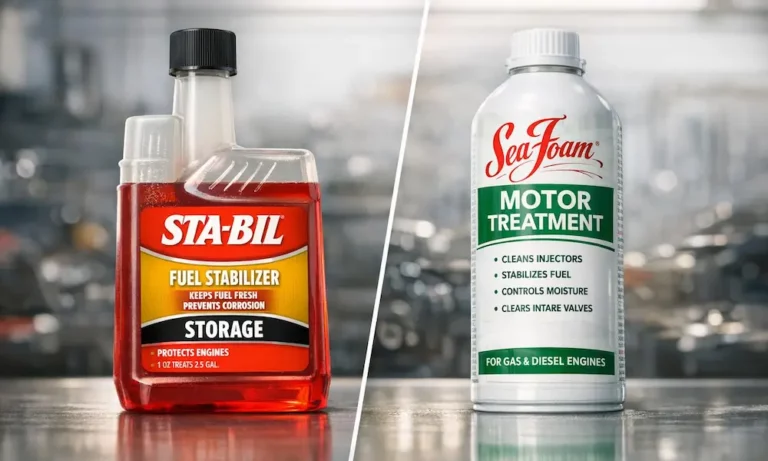
Got a lawn mower, boat, or small engine that won’t start after winter? The answer might be in a bottle. STA-BIL and Sea Foam both promise to keep your engine happy, but they do it in completely different ways. Pick the wrong one, and you’ll either spend too much money or end up with a gummed-up carburetor. Read on to find out which one fits your situation.
They’re Not the Same Product — Not Even Close
Most people treat STA-BIL vs Sea Foam like they’re interchangeable. They’re not.
STA-BIL is a fuel stabilizer. It stops gasoline from going bad during storage. It was designed in 1958 specifically for seasonal equipment owners who found their engines dead every spring.
Sea Foam is a cleaner and lubricant. It dates back to 1942 and started in the marine industry. Its job is to dissolve gunk that’s already built up inside your engine.
Here’s the short version:
- STA-BIL prevents the problem
- Sea Foam fixes the problem after it happens
Both products work with petroleum-based fuels. But their chemistry, their purpose, and their ideal use cases are completely different.
How STA-BIL Actually Works
Gasoline starts breaking down within 30 days of sitting untreated. Oxygen attacks the fuel and turns light hydrocarbons into thick, sticky resins — the kind that clog carburetor jets and fuel injectors.
STA-BIL’s antioxidants interrupt that chain reaction before it starts. Think of it as a chemical bodyguard for your fuel. It also bonds with tiny water droplets so they pass harmlessly through combustion instead of causing rust or phase separation.
The STA-BIL Product Lineup
STA-BIL isn’t just one product. Gold Eagle makes several formulas for different situations:
| Product | Best For | Treat Rate |
|---|---|---|
| STA-BIL Storage (Red) | Long-term storage (up to 24 months) | 1 oz per 2.5 gallons |
| STA-BIL 360 Protection (Amber) | Daily drivers, ethanol protection | 1 oz per 5 gallons |
| STA-BIL 360 Marine (Blue) | Boats, coastal equipment, salt air | 1 oz per 10 gallons |
| STA-BIL Diesel | Diesel trucks, tractors, generators | 1 oz per 5 gallons |
| STA-BIL Fast Fix (Green) | Gummed-up or rough-running engines | Varies |
The 360 Marine and 360 Protection formulas include something called vapor-phase corrosion inhibitor. It evaporates off the fuel and coats the metal walls above the fuel line — the bare metal where condensation forms. That’s a detail most people miss entirely.
How Sea Foam Actually Works
Sea Foam takes a completely different approach. Its three main ingredients are a refined pale oil lubricant, a naphtha-based solvent, and isopropyl alcohol. Because it’s 100% petroleum-based, Sea Foam claims it’s “engine-identical” — meaning its chemistry won’t harm engine components even at higher concentrations.
Its standout feature is reliquefaction. Sea Foam doesn’t just break deposits apart (which can send chunks into injector nozzles). It dissolves hardened varnish and gum back into a liquid state so they burn off or filter out cleanly.
Sea Foam Works in Three Places
Unlike STA-BIL, Sea Foam isn’t limited to the fuel tank. You can use it three ways:
- In the fuel tank — cleans injectors and carburetors, lubricates upper cylinders, stabilizes fuel for up to two years
- In the engine oil — add it 100–300 miles before an oil change to dissolve crankcase sludge and quiet noisy lifters
- Through the air intake — Sea Foam Spray can reach the backs of intake valves, which is critical for GDI engines where fuel-based cleaners never touch the intake tract
That multi-system versatility is where Sea Foam earns its reputation among mechanics.
STA-BIL vs Sea Foam: Head-to-Head Comparison
Here’s a direct comparison of both products across the features that actually matter:
| Feature | STA-BIL Storage | Sea Foam Motor Treatment |
|---|---|---|
| Primary job | Prevent fuel decay | Clean fuel residues |
| Max storage claim | 24 months | 24 months |
| Treat rate | 1 oz per 2.5 gallons | 1 oz per 1 gallon |
| Vapor protection | Yes (360/Marine formulas) | No |
| Crankcase cleaning | No | Yes |
| Intake valve cleaning | No | Yes (with Sea Foam Spray) |
| Lubricity addition | Minimal | Significant |
| Works on already-gummed engines | Limited | Yes |
The Cost Difference Is Massive
This is where STA-BIL wins by a landslide for anyone storing large fuel quantities.
| Factor | STA-BIL Storage | Sea Foam Motor Treatment |
|---|---|---|
| Treat rate per gallon | 0.4 oz | 1.0 oz |
| Cost per gallon treated | ~$0.17 | ~$1.87 |
| Gallons treated per 16 oz | 40 gallons | 16 gallons |
Storing 100 gallons of fuel? STA-BIL costs around $17. Sea Foam costs around $187. That’s an 1,100% difference. For emergency fuel prep, bulk storage, or fleet management, STA-BIL is the only practical choice.
Sea Foam’s higher price makes sense for targeted cleaning jobs on small, high-value engines where the cleaning and lubrication benefits justify the cost.
Who Endorses Each Product
Briggs & Stratton officially names STA-BIL as its “Official Fuel Treatment” for all small engines. Honda Power Equipment also uses a stabilizer formula built on STA-BIL technology. These OEM endorsements are based on actual warranty data — gummed carburetors are one of the most common causes of non-warranty failures.
Sea Foam doesn’t carry the same official OEM endorsements, but it’s the go-to recommendation from independent small engine mechanics. When a customer walks in with a machine that won’t run after sitting, Sea Foam is what most shops reach for first.
The split is simple: manufacturers recommend STA-BIL for prevention, mechanics recommend Sea Foam for the cure.
Ethanol Is the Real Enemy
Modern gasoline with ethanol (E10, E15) creates two problems. Ethanol attracts water from the air — a process called phase separation — where water and ethanol sink to the bottom of the tank leaving low-octane gas on top. It also dries out rubber fuel lines and causes micro-pitting in aluminum carburetors.
STA-BIL 360 Protection was built specifically to fight these ethanol-related issues. It manages moisture and coats tank surfaces where ethanol-induced corrosion usually starts.
Sea Foam handles ethanol differently. Its isopropyl alcohol component solubilizes water droplets so they mix into the fuel instead of pooling. It also adds lubricity that helps protect components dried out by high-alcohol blends. However, if the tank already has significant standing water, physical draining may still be necessary.
The Right Winterization Protocol
Getting storage right requires more than just pouring something in the tank. Follow these steps:
- Use fresh fuel only. Stabilizers can’t reverse fuel that’s already gone stale
- Measure your dose accurately. For STA-BIL Storage, that’s 1 oz per 2.5 gallons
- Fill the tank to 95%. Less air space means less condensation. Briggs & Stratton recommends this approach
- Run the engine for 5–10 minutes after adding the stabilizer. This is the step most people skip. The treated fuel has to reach the carburetor bowl and fuel injectors. Without this, the untreated fuel already in the system will still degrade over winter
The Rescue Protocol for Gummed-Up Engines
If the engine won’t start and the old gas smells like varnish, Sea Foam is your tool:
- Drain as much old gasoline as possible
- Add 1 gallon of fresh fuel and 4–8 oz of Sea Foam (a high concentration dose)
- Use the primer bulb to draw the mixture into the carburetor, then let it soak overnight
- Start the engine — expect white smoke as the dissolved deposits burn off. That’s normal. It means the cleaning is working
Are They Safe for Rubber Seals and Gaskets?
Both products use petroleum distillates as their base, which are generally compatible with modern Viton seals and synthetic rubber components. Sea Foam specifically states it won’t harm seals or gaskets and may actually prevent them from drying out.
STA-BIL is safe for all gasoline engines, including those with oxygen sensors and catalytic converters. Some mechanics note that extremely old rubber components in vintage equipment could react to any concentrated solvent — but at recommended treat rates, both products are considered safe across the industry.
Can You Use Both Together?
You can — and a lot of serious equipment owners do exactly that.
Here’s a simple integrated approach:
- Every fill-up: STA-BIL 360 Protection in every gas can for constant ethanol defense
- Winterization: STA-BIL Storage (Red) for any machine sitting more than 30 days, followed by a 5-minute run
- Twice a year: A tank treated with a higher concentration of Sea Foam to dissolve minor carbon buildup and clean injectors
- Emergency: Sea Foam soak method if an engine fails to start after storage
Using both isn’t redundant — it’s actually the complete picture. STA-BIL keeps the fuel clean going in. Sea Foam cleans what inevitably builds up over time.
The Final Verdict
Choose STA-BIL if:
- You’re storing equipment for 30 days or more
- You manage bulk fuel storage or a fleet
- You want OEM-backed, cost-effective prevention
- You’re dealing with ethanol blends and moisture
Choose Sea Foam if:
- The engine already runs rough or won’t start
- You want to clean the crankcase or intake valves
- You’re maintaining a high-value small engine regularly
- You need one product that works in fuel, oil, and the air intake
The debate around STA-BIL vs Sea Foam usually comes down to timing. Use STA-BIL before fuel goes bad. Use Sea Foam after it already has. Get that distinction right, and your engines will start every single time.