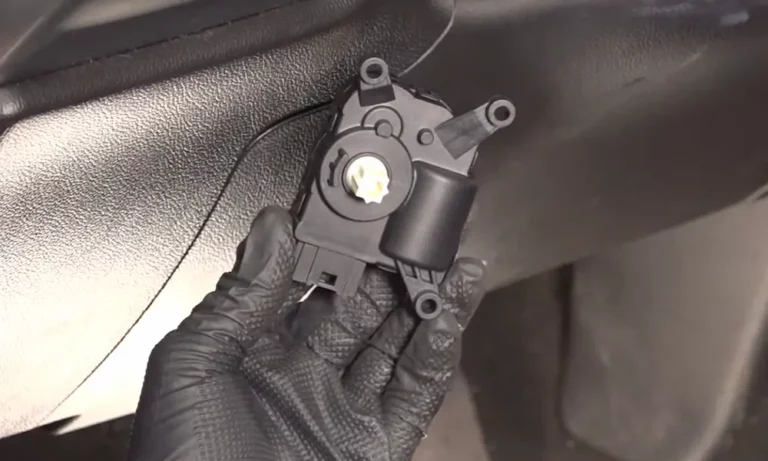
Your car’s AC blows cold on one side and hot on the other. Or maybe there’s a mysterious clicking behind your dashboard every time you start the engine. Sound familiar? These are classic symptoms of a bad blend door actuator — and ignoring them can turn a cheap fix into a very expensive one. Read to the end to know exactly what’s wrong and what to do about it.
What Is a Blend Door Actuator, Anyway?
Before jumping into symptoms, it helps to know what this thing actually does.
Deep inside your dashboard sits a plastic housing called the heater box. Inside it, a small flap called the blend door controls the mix of hot and cold air before it reaches your vents. The blend door actuator is the small electric motor that moves that flap.
It takes a signal from your climate control module and translates it into precise mechanical movement. Do that thousands of times over several years, in temperature extremes, and eventually something breaks.
Here’s how the blend door actuator differs from other actuators in your HVAC system:
| Actuator Type | What It Controls | What Fails When It Goes Bad |
|---|---|---|
| Blend Door Actuator | Temperature mixing flap | Hot or cold air stuck, no temp control |
| Mode Door Actuator | Floor/vent/defroster routing | Air blows from the wrong vents |
| Recirculation Actuator | Fresh vs. recirculated air | Car smells or AC feels weak |
| Rear Blend Actuator | Rear passenger temp zone | Back seat stays hot or cold |
The #1 Symptom: That Clicking Noise Behind the Dashboard
The most reported symptom of a bad blend door actuator is a repetitive clicking or ticking noise coming from behind the glove box or center dash area. People describe it as a plastic machine gun, rapid tapping, or rhythmic knocking.
Here’s why it happens: the actuator uses a small plastic gear train to move the blend door. When those gears strip or lose teeth from wear, the motor keeps spinning — but the gears slip instead of turning the door. Every slip creates that signature click.
You’ll usually hear it most during startup. Many climate control systems run an initialization sweep, moving the blend door from one end to the other. If the gears are damaged, that sweep produces nonstop clicking.
Quick test: Turn your temperature from max cold to max heat slowly. If the clicking starts, stops, or changes rhythm as you adjust, the blend door actuator is almost certainly the culprit.
Other Sounds a Bad Actuator Makes
Clicking isn’t the only noise a failing actuator produces. Here’s what each sound tells you:
| Sound | What’s Happening Inside | When You Hear It |
|---|---|---|
| Rapid clicking/ticking | Stripped gear teeth slipping | Startup or during temp adjustments |
| Heavy knocking | Broken internal stops or jammed door | At max hot or max cold settings |
| High-pitched whirring/droning | Motor spinning freely with no connection | Continuously, with zero temp change |
| Grinding or squeaking | Friction in the linkage | During slow temperature adjustments |
| Brief buzzing | Motor fighting resistance | Right when you change a setting |
Temperature Problems That Point to a Bad Blend Door Actuator
Sound symptoms aside, temperature control issues are the clearest sign something’s wrong.
Stuck on Hot or Stuck on Cold
When a blend door actuator dies completely, the door freezes in its last position. If it was blocking the heater core, you get nothing but cold air — even with the heat cranked all the way up. If it failed while the heater core was fully exposed, you’re getting blasted with hot air even on max AC.
This “perma-hot” or “perma-cold” state is a dead giveaway. Your climate controls feel completely disconnected from what the vents are doing.
Some actuators fail in the middle, leaving the door stuck halfway. The result? Lukewarm air you can’t adjust in either direction — which is especially problematic in winter when you need the defroster to actually work.
One Side Hot, One Side Cold (Dual-Zone Systems)
If your car has dual-zone climate control, each side of the cabin has its own blend door actuator. When one fails, you get a temperature mismatch — driver’s side cool, passenger’s side blowing heat, or vice versa.
This is one of the most diagnostic symptoms out there. Low refrigerant can cause mild side-to-side differences, but a total lack of temperature response on one side almost always means a zone-specific actuator has failed.
Random Temperature Swings
Does your car’s temperature change on its own without you touching anything? That’s called “hunting,” and it happens when the actuator’s internal position sensor (called a potentiometer) starts failing.
The sensor feeds voltage back to the climate control module to report the door’s position. When that sensor develops worn spots or “dead zones,” the module gets confused and keeps trying to correct the door position — swinging the temperature from hot to cold and back again. It also destroys the actuator faster by forcing constant movement.
Temperature Symptom Summary
| What You’re Experiencing | What It Likely Means |
|---|---|
| Only cold air, no heat | Actuator failed blocking the heater core |
| Only hot air, no AC effect | Actuator failed exposing the heater core |
| One side hot, one side cold | Zone-specific actuator failed (dual-zone system) |
| Temp changes randomly | Failing position sensor causing system hunting |
| Lukewarm air at all settings | Actuator stuck in a mid-range position |
Electronic Failures and Error Codes
The blend door actuator isn’t just a mechanical part — it’s also an electronic one. And electronic failures have their own set of symptoms.
When the Position Sensor Goes Bad
Most actuators use a three-wire setup: power, ground, and a signal wire. That signal wire sends a feedback voltage (usually 0.5V to 4.5V) back to the control module to report door position. When the internal sensor wears out, the voltage signal becomes erratic.
A common result: the system works briefly after a battery reset, then goes unresponsive again once the module detects the faulty signal. If your climate control seems to “reset” after disconnecting the battery but fails again shortly after, that’s a classic sign.
Dashboard Warning Codes
When the system detects an electronic fault, it logs diagnostic trouble codes (DTCs). A scan tool can pull these codes and point you directly at the problem. Common ones include:
- B1080 — Blend door actuator motor circuit failure
- B1081 — Position sensor signal out of range
- B1021 — Individual zone actuator failure (dual-zone systems)
- B1090 — System failed to complete actuator calibration
- LIN Bus errors — Communication lost between HVAC module and smart actuator
If your climate control display is flashing or showing error symbols, a scan tool is your next step.
How to Test a Blend Door Actuator at Home
You don’t always need a shop to confirm what’s wrong. Here are two solid diagnostic methods.
The Startup Listen Test
Turn the ignition to “on” without starting the engine. The car’s quiet, so you can hear exactly what’s happening behind the dash. Slowly move the temperature from cold to hot and listen:
- Smooth whirring = healthy motor and gears
- Repeated clicking = stripped gear teeth confirmed
- Complete silence = dead motor, blown fuse, or broken wire
In many cars, you can also see the actuator by removing the glove box or looking under the dash. Watch the actuator arm as you adjust the temperature. If the motor moves but the door doesn’t, the mechanical connection has failed.
The Multimeter Test
For electrical issues, a multimeter gives you definitive answers:
| Test | Healthy Reading | Sign of Failure |
|---|---|---|
| Supply voltage pin | Steady 12V (or 5V ref) with ignition on | No voltage = blown fuse or broken wire |
| Ground pin | Near 0V relative to battery negative | High voltage = corroded or broken ground |
| Feedback pin (static) | Steady 0.5V–4.5V | Erratic jumping = worn sensor track |
| Feedback pin (moving) | Smooth transition as door moves | Dead spots or frozen signal = failed sensor |
| Motor continuity | Low resistance (ohms) | Infinite resistance = burnt-out motor winding |
Vehicle-Specific Quirks You Should Know
Symptoms of a bad blend door actuator don’t always look the same across different vehicles.
Ford F-150 (2009–2020): Loud, rapid clicking the moment the key is turned is extremely common. Ford’s high-torque calibration sweep eventually shears the main drive gear teeth. Dual-zone models have four separate actuators in the dash — you may need to unplug them one by one to find the culprit, or use a scan tool to actuate them individually.
Nissan Rogue: The actuator itself may test perfectly, but the plastic spline on the blend door shaft can strip out. The actuator moves, the multimeter reads normal — but the door doesn’t. Many owners replace the actuator and are confused when the problem persists.
Jeep Grand Cherokee / Chrysler vehicles: These systems are prone to the blend door itself snapping under actuator pressure. You’ll hear a “pop” instead of a “click,” followed by complete temperature loss. Replacing just the actuator won’t fix it — the entire HVAC housing often needs to come apart.
Honda Accord and Civic: Honda has a built-in self-diagnostic mode. Holding specific buttons while turning the ignition triggers a system self-test that displays a code identifying the failed component. A faint chirping or squeaking behind the radio area is a common early warning sign.
Is It Actually the Actuator? How to Tell the Difference
Other problems can look like symptoms of a bad blend door actuator. Here’s how to separate them:
| Symptom | Most Likely Cause | How to Tell Apart |
|---|---|---|
| No heat on one side | Blend door actuator | Actuator usually clicks; a clogged heater core doesn’t |
| No AC on one side | Blend door actuator | Low refrigerant produces weak cooling, not zero response |
| Air from wrong vents | Mode door actuator | Temperature is correct, location is wrong |
| Weak airflow volume | Cabin filter or blower motor | Temp is fine, air just doesn’t blow hard |
| Constant clicking | Blend door actuator | Clicking changes when temperature setting is moved |
Blower motor vs. actuator: A failing blower motor affects how much air comes out. A failing actuator affects the temperature of that air. If your fan speed feels normal but the temperature is wrong, the actuator is the primary suspect.
Heater control valve vs. actuator: Older vehicles sometimes use a heater control valve to regulate hot coolant flow. A stuck valve causes a loss of heat — but it won’t make any clicking noise, and it’ll affect the whole cabin, not just one side.
Why You Shouldn’t Ignore It
A broken blend door actuator isn’t just a comfort problem.
Visibility and safety: A stuck-cold blend door means your defroster can’t generate the warm, dry air needed to clear a fogged or iced windshield quickly. In winter conditions, that’s a genuine safety risk.
Damage to the control module: If your actuator motor stalls against a jammed door, it draws excess current. That can damage the HVAC control module or blow fuses that power other dash components.
Much bigger repair bills: Replacing a blend door actuator often takes under an hour and costs well under $200 in parts. But a clicking actuator that’s left alone can eventually break the blend door hinge inside the HVAC housing. Fixing a broken blend door means removing the entire dashboard and disassembling the heater box — a repair that can run into the thousands.
Fuel economy: A stuck-open blend door forces your AC compressor to run at full capacity trying to compensate for unwanted heat. That extra load burns more fuel and wears out your compressor, serpentine belt, and cooling fans faster.
Three things to do right now if you suspect a bad actuator:
- Replace your cabin air filter if it’s overdue — debris inside the HVAC housing can jam the blend door and burn out the actuator
- Don’t force temperature adjustments from full cold to full hot rapidly — that puts sudden stress on the plastic gears
- Address any clicking sound immediately — the longer you wait, the more expensive the repair gets