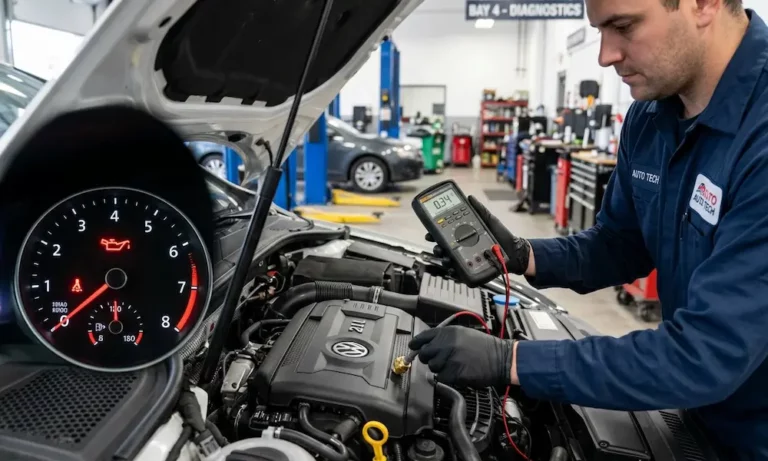
That oil pressure warning light just lit up your dashboard. Before you panic and call a tow truck, it might just be a $20 sensor lying to you. This guide breaks down every symptom of a bad oil pressure sensor, explains what’s actually happening inside your car, and shows you how to tell the difference between a faulty sensor and a real engine emergency. Read to the end — that distinction could save you thousands.
What Does an Oil Pressure Sensor Actually Do?
Your engine’s oil pressure sensor sits directly in the engine block or oil filter housing. It reads the hydraulic pressure of your oil and sends that data to your car’s computer — the powertrain control module (PCM). The PCM uses this data for everything from controlling variable valve timing to deciding whether to put your car in limp mode.
There are three types of sensors you’ll find in modern vehicles:
| System Type | How It Works | Common Failure Mode |
|---|---|---|
| Pressure Switch | Spring-loaded contacts open/close a circuit | Spring fatigue or diaphragm rupture |
| Analog Transducer | Sends variable voltage (0.5V–4.5V) based on pressure | Signal drift or internal short-to-voltage |
| Smart Digital Sensor | Sends data over CAN/LIN bus | Data corruption or bus communication failure |
When any of these fail to send accurate data, the symptoms ripple across your entire vehicle — not just the warning light.
The 6 Most Common Symptoms of a Bad Oil Pressure Sensor
1. The Oil Warning Light Flickers or Blinks
This is the classic tell. If your oil pressure light blinks rhythmically with engine vibration — especially at idle — the binary pressure switch inside is likely worn out. Its internal spring loses tension after millions of cycles. The diaphragm can also develop micro-tears.
The result? The switch can’t maintain a clean open or closed circuit. It flickers. It stutters. It annoys you at every red light.
If it only blinks at idle and disappears at higher RPMs, that’s a strong indicator of a dying pressure switch rather than a mechanical problem.
2. Erratic Gauge Needle That Bounces Wildly
A healthy gauge rises when you accelerate and drops slightly at idle. It moves smoothly. It makes physical sense.
If your needle is jumping from zero to 80 PSI and back again in a split second, that’s electrically impossible to explain with real fluid behavior. Oil is a non-compressible fluid — it can’t change pressure that fast. The physics simply don’t work.
That violent, spasmodic movement points to an internal short or a failing transducer diaphragm losing contact intermittently.
3. The Gauge Is Stuck at Maximum or Zero
Pegged at max: If your oil pressure gauge reads maximum the moment you turn the key — before the engine even starts — you’ve got a short to voltage. The sensor is feeding the PCM a constant 5-volt signal, and it’s interpreting that as maximum pressure.
Stuck at zero while running: This is the one that scares people most. It can mean a catastrophic oil failure, but it can also mean a completely dead sensor or an open circuit in the signal wire.
Here’s the key test: listen to the engine. A real zero-pressure condition triggers loud clattering and knocking almost immediately as bearings and lifters run dry. If your engine sounds perfectly normal while the gauge reads zero, the sensor is almost certainly the culprit.
4. A Check Engine Light With P0520–P0524 Codes
Modern PCMs don’t wait for you to notice a gauge problem. They constantly monitor the sensor’s signal and flag anything suspicious. When you plug in an OBD-II scanner and see these codes, here’s what they actually mean:
| DTC Code | What It Means | Likely Cause |
|---|---|---|
| P0520 | General circuit malfunction | Broken wire, dead sensor, corroded connector |
| P0521 | Signal is implausible for current conditions | Sensor signal drift or contaminated sensor port |
| P0522 | Signal voltage too low | Short to ground or open signal path |
| P0523 | Signal voltage too high | Internal open circuit or short to 5V reference |
| P0524 | Reported oil pressure dangerously low | Sensor failure or real mechanical problem — verify immediately |
A P0521 code is the most common for a partially failed sensor. It means the pressure reading doesn’t match what the engine should be doing at that RPM and temperature. Think of it as the computer saying, “I don’t believe you.”
P0524 is the dangerous one. Don’t assume it’s a bad sensor until you’ve verified actual hydraulic pressure mechanically.
5. Oil Leaking From the Sensor and Wicking Into the Wiring
Not every symptom of a bad oil pressure sensor shows up on the dashboard. Sometimes it shows up as a greasy drip under your hood.
The sensor screws directly into the engine block, where it’s exposed to full system pressure. Over time, the seal between the metal base and the plastic connector fails. Oil begins weeping from around the sensor body.
That leak does two things:
- It slowly drops your oil level, which can create the real low-pressure condition you’ve been falsely diagnosing
- It corrupts the electrical signal by creating a high-resistance path in the connector
The worse scenario is oil wicking. When the sensor’s internal seal ruptures, pressurized oil forces itself into the copper wire insulation through capillary action. It travels through the wiring harness — sometimes several feet — until it reaches sensitive electronics. Mercedes-Benz and BMW owners have faced $3,000+ repair bills because a $50 sensor leak saturated the wiring harness and destroyed the engine control unit.
If you see oil inside the sensor’s connector boot, replace the sensor immediately. Don’t wait.
6. Sluggish Performance, Engine Rattle, or Limp Mode
This symptom catches people off guard because it doesn’t seem related to a sensor at all.
Your engine uses pressurized oil as hydraulic fluid to run the variable valve timing (VVT) system. Solenoids direct oil into camshaft actuators that adjust timing for power or efficiency. The PCM uses your oil pressure sensor data to decide if there’s enough hydraulic force to run VVT.
If the sensor reports inaccurate or low pressure, the computer may disable the VVT system entirely as a precaution. You’ll feel:
- Sluggish acceleration, especially when merging or overtaking
- Rough idle — the engine stumbles or shakes at a stop
- Rattling or ticking from the top of the engine — camshaft phasers not locking properly
- Stalling at low speeds, particularly at traffic lights
In GM and Ford vehicles especially, a bad sensor signal can trigger Limp Mode. The PCM caps your RPMs, limits your speed to 35–45 mph, and displays a “Reduced Engine Power” message. This gets misdiagnosed as a transmission problem constantly, leading to expensive and unnecessary repairs.
Is It the Sensor or Is Your Engine Actually Failing?
This is the question that matters. Getting it wrong in either direction is expensive.
The acoustic test: Listen carefully when the warning light comes on. A true oil pressure failure is loud. Hydraulic lifters, bearings, and cam followers all start metal-to-metal contact almost immediately. You’ll hear ticking, tapping, or knocking that gets faster as RPMs rise. Silence means the oil is probably still flowing — and the sensor is lying.
The mechanical gauge test: This is what professional technicians do. Remove the electronic sensor and thread a manual mechanical gauge directly into the oil gallery. This gauge bypasses every computer and wire in the vehicle — it reads pure hydraulic pressure.
- Mechanical gauge reads 60 PSI, dashboard reads zero → sensor is bad, replace it
- Both read zero or near zero → you have a mechanical failure (failed pump, clogged pickup screen, excessive bearing wear)
This test takes 20 minutes and costs nothing if you own the gauge. It’s the only way to be certain.
What Causes Oil Pressure Sensors to Fail?
Sludge buildup: Skipping oil changes leads to sludge — a thick carbon-and-moisture residue. It clogs the tiny sensor port (often the size of a pin head), blinding the sensor to real pressure. Your readings come back consistently low or delayed.
Thermal stress and vibration: Sensors endure temperature swings from winter cold starts to full-load highway heat. That constant expansion and contraction fatigues the internal sensing element over time. High-frequency engine vibration also loosens the delicate electrical pins inside the connector, causing those erratic gauge readings.
Age and cycles: A binary pressure switch opens and closes thousands of times per engine hour. Eventually, the spring loses its calibrated tension. It’s a wear item, not a lifetime part.
How to Diagnose a Bad Oil Pressure Sensor Step by Step
Work through this in order before spending money on parts:
- Stop driving immediately if the oil light comes on. Pull over safely and shut the engine off. Check the oil level with the dipstick before doing anything else.
- Inspect the sensor visually. Look for oil weeping from around the sensor body. Open the connector and check for oil inside the boot — that’s wicking in progress.
- Listen to the engine. Restart briefly and listen. Ticking or knocking means a potential mechanical crisis. Smooth and quiet means the sensor is likely at fault.
- Scan for codes. Use an OBD-II scanner and look specifically for P0520 through P0524. Live data mode lets you watch the pressure reading change (or not change) with RPM in real time. If it stays static at all engine speeds, the sensor has failed its range performance test.
- Run a mechanical pressure test. If you’re still unsure, thread in a manual gauge to confirm actual hydraulic pressure. This one step eliminates all doubt.
| Diagnostic Goal | Method | What Confirms a Bad Sensor |
|---|---|---|
| Confirm actual hydraulic pressure | Mechanical gauge test | Gauge reads normal PSI while dash reads abnormal |
| Find electrical fault | Multimeter voltage test | Signal stuck at 0V or 5V constantly |
| Check for oil wicking | Visual inspection of connector | Oil present inside the harness boot |
| Verify sensor range | OBD-II live data | Pressure reading doesn’t change with RPM |
A bad oil pressure sensor is one of those rare cases where a cheap part — often $15 to $60 — causes symptoms that mimic a dying engine. The symptoms of a bad oil pressure sensor are real and varied, but they follow a clear pattern once you know what to look for. Check the oil level first, listen to the engine second, and verify with a mechanical gauge when in doubt. That sequence protects your engine and your wallet.