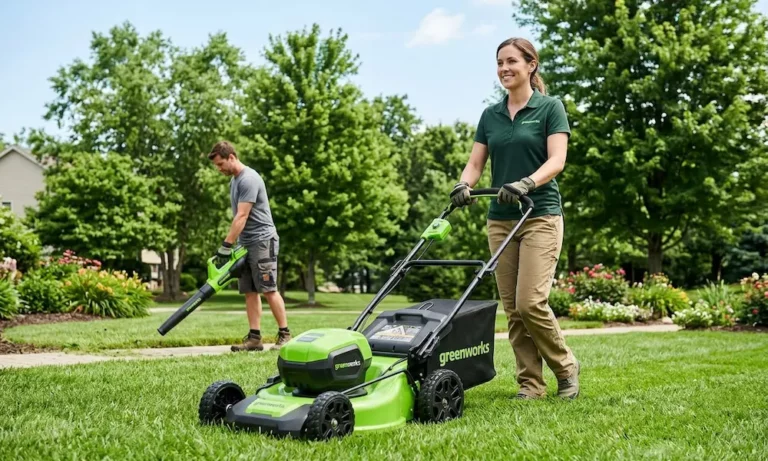
Thinking about going electric for your yard work? Greenworks keeps coming up. But before you spend hundreds — or thousands — of dollars, you deserve a straight answer. This post breaks down the real strengths, the real weaknesses, and exactly who Greenworks is right for. Stick around — the customer service section alone might save you a headache.
What Is Greenworks, Exactly?
Greenworks launched in 2007 as a purely electric outdoor power equipment brand. It’s owned by the Globe Tool Group, with headquarters in Mooresville, North Carolina, and Holland Landing, Ontario.
Unlike traditional brands that had to ditch gas engines and pivot to batteries, Greenworks was built electric from day one. That focus paid off. The company now pulls in over $1.6 billion in annual revenue and sells through Lowe’s, Costco, Walmart, Amazon, and Best Buy.
That’s not a niche brand. That’s a major player.
| Corporate Detail | Info |
|---|---|
| Founded | 2007 |
| Parent Company | Globe Tool Group |
| Annual Revenue | ~$1.6 Billion |
| Key Retailers | Lowe’s, Walmart, Costco, Best Buy |
| US HQ | Mooresville, NC |
The Voltage System — Which One Do You Actually Need?
Greenworks runs multiple voltage platforms: 24V, 40V, 48V, 60V, 80V, and 82V. Each targets a different type of user.
Here’s how to think about it:
- 24V — Small patios, light trimming, urban yards. Lightweight and easy to handle.
- 40V — The entry point for suburban lawns. Good balance of price and power.
- 60V — The most popular tier. Great for larger yards, snow removal, and heavy leaf clearing.
- 80V Pro — Serious acreage, thick grass, demanding terrain. This is residential max power.
- 82V — Built for professional landscapers. Note: 80V and 82V batteries aren’t interchangeable — they’re physically keyed differently to prevent cross-use.
If you have a typical suburban lot, the 60V platform hits the sweet spot. If you’ve got acreage or tackle tough overgrowth regularly, the 80V Pro is worth the extra cost.
| Platform | Best For | Main Benefit |
|---|---|---|
| 24V | Urban/small spaces | Lightweight, maneuverable |
| 40V | Small to medium lawns | Affordable entry point |
| 60V | Most homeowners | Universal balance |
| 80V | Large lots, heavy tasks | Maximum residential power |
| 82V | Professional use | Rugged, commercial-grade |
How Does Greenworks Actually Perform?
SmartCut Technology Makes a Real Difference
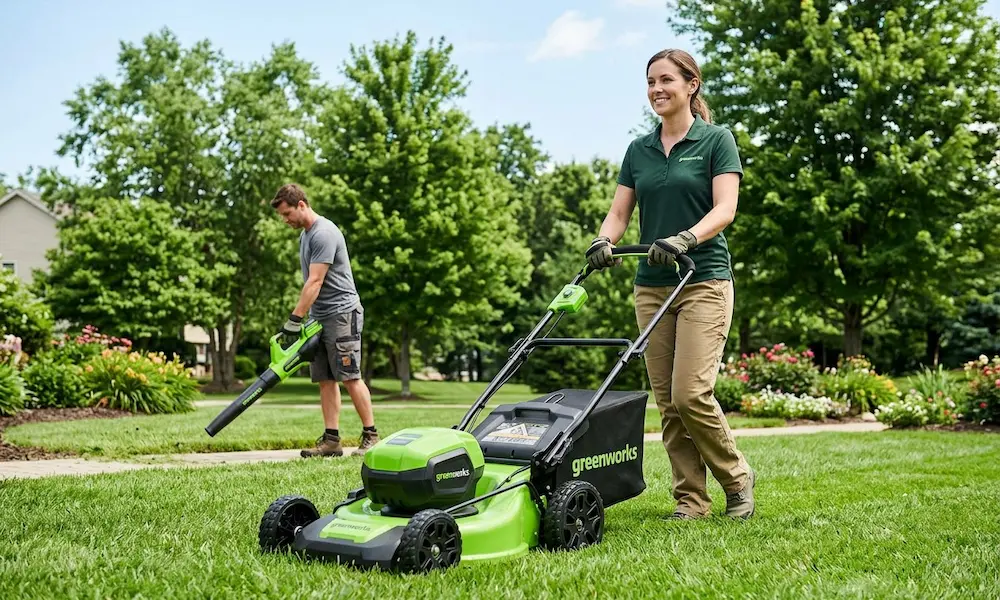
Greenworks uses something called SmartCut technology on their mowers. It’s not just a marketing term. The system monitors blade resistance in real time and automatically bumps motor speed when it hits thick grass — then dials it back when the turf is lighter. The result? Better battery life without sacrificing cut quality.
You also get fade-free power with modern lithium-ion cells. The tool runs at full power until the battery hits its minimum threshold. No gradual slowdown on the last pass.
Higher Voltage = Smarter Engineering
There’s a real electrical reason why higher voltage systems outperform lower ones in demanding applications. Higher voltage means less current draw to produce the same power. Less current means less heat, lighter wiring, and smaller motors. The tools end up being both more efficient and easier to handle. That’s why the 80V 21-inch brushless self-propelled mower feels less fatiguing than its gas equivalent, even with a steel deck.
Greenworks vs. The Competition
Greenworks vs. EGO
EGO uses a single 56V platform with a clever Arc Lithium battery design that focuses on heat management. It’s premium-priced and genuinely impressive.
Greenworks counters with raw voltage. In dense vegetation, the 80V systems consistently show stronger torque. And on price? Greenworks wins — sometimes by nearly half the cost on comparable tools like chainsaws.
Greenworks vs. Ryobi
Ryobi’s 40V HP line is easy to use and reliable for small to medium yards. It’s a fair competitor.
Greenworks pulls ahead with better warranty terms on Pro tools (4 years vs. Ryobi’s 3) and small but useful extras — like USB ports built into the batteries so you can charge your phone while you mow.
Greenworks vs. DeWalt
DeWalt’s OPE tools are rugged and built for job sites. But their outdoor catalog is narrower. Greenworks offers a much wider range of specialized yard tools — earth augers, dedicated snow blowers, and more — that DeWalt simply doesn’t prioritize.
| Feature | Greenworks 80V | EGO 56V | Ryobi 40V | DeWalt 60V |
|---|---|---|---|---|
| Peak Voltage | 80V | 56V | 40V | 60V |
| Tool Warranty | 4 Years | 5 Years | 3 Years | 3 Years |
| Battery Warranty | 4 Years | 3 Years | 3 Years | 3 Years |
| Price Position | Mid-Range | Premium | Value | Professional |
The Customer Service Problem — Don’t Ignore This
Here’s where things get uncomfortable. Greenworks makes solid hardware. Their customer service, however, is a genuine problem.
Trustpilot data shows an overall score of 1.8 out of 5 stars, with 75% of reviews sitting at one star. The complaints cluster around the same themes:
- Phone wait times averaging 90 minutes — often followed by sudden disconnections
- AI chatbots that can’t handle real technical issues
- Warranty claims that get ignored or denied on products from authorized retailers
- 30-day returns blocked by hidden restocking fees
About 14% of customers report positive experiences, usually around fast shipping or surprise goodwill parts replacements. But that’s a small minority.
The honest takeaway: Greenworks grew its sales faster than it built its support infrastructure. If something breaks and you need help, be prepared for a frustrating experience.
The smart move? Buy through a retailer with a strong return policy — Costco and Lowe’s both provide an important buffer against Greenworks’ internal service issues.
Maintenance: Way Simpler Than Gas
This is one of Greenworks’ strongest arguments. Compare the maintenance schedules:
| Task | Gas Mower | Greenworks Electric |
|---|---|---|
| Oil Changes | Every season | Not required |
| Spark Plugs | Annual | Not required |
| Air Filter | Monthly/Seasonal | Not required |
| Fuel Stabilizer | Before winter storage | Not required |
| Blade Sharpening | Annual | Annual |
| Battery Storage | N/A | Bring indoors for winter |
You skip the oil changes, the spark plugs, the carburetor cleanings. The main tasks are keeping the deck clean and sharpening the blade once a year. Clean the underside after every use to prevent grass clumping and motor strain.
The one thing you must do: bring batteries inside during winter. Lithium-ion cells lose capacity permanently if stored in freezing temperatures. A garage that dips below 32°F can quietly kill your battery over one winter.
The Electronic Repair Problem Is Real
Simpler maintenance doesn’t mean simpler repairs. When something does break electronically, it can get complicated fast. Common issues include:
- Safety switch failures — mechanical switches that prevent startup when stuck
- Thermal sensor errors — riding mowers throwing overheating codes like MR23 even when cold, often from loose wiring connectors
- PCB failures — some control boards have been discontinued for tools only a few years old, leaving the tool unrepairable
Also worth knowing: many authorized service centers can’t actually repair common tools like string trimmers, blowers, or pressure washers. They redirect you back to customer service — the same bottleneck we just talked about.
Does It Actually Save You Money?
The upfront cost is higher. A Greenworks 80V mower kit runs around $899. A comparable gas mower costs $400–$600.
But factor in the ongoing costs:
| Cost Factor | Gas | Greenworks 80V |
|---|---|---|
| Initial Price | $400–$600 | ~$899 |
| Annual Fuel | $50–$100+ | Nearly zero |
| Annual Maintenance | $50–$100 | $0 (blades aside) |
| Battery Replacement (after 5+ years) | N/A | $150–$300 |
The math favors electric over 5–7 years — but only if you take care of the battery. A dead 80V battery that you have to replace at year three because you left it in a frozen garage can erase those savings quickly.
The Noise and Environmental Upside
Gas mowers run at 85–95 decibels. That’s loud enough to cause hearing damage with regular exposure. Greenworks electric mowers run at 55–65 decibels — roughly the volume of a normal conversation.
Because the decibel scale is logarithmic, a 30-decibel drop means the Greenworks mower sounds about 8 times quieter to your ears. You can mow early on a Saturday without getting glared at by your neighbors.
Beyond noise, the benefits stack up:
- Zero exhaust fumes at the point of use — no carbon monoxide, no particulates
- No spark risk — critical in dry regions where gas-powered equipment can ignite vegetation
- Push-button start — no pull cord, no fuel priming, no crossed fingers
So, Is Greenworks a Good Brand?
Here’s the honest answer: it depends on what you’re buying and where you’re buying it.
Greenworks is a good brand if:
- You want genuine gas-equivalent power without the gas
- You’re shopping the 60V or 80V platform for a medium to large yard
- You buy through Costco or Lowe’s for retailer-level return protection
- You’re committed to proper battery care (especially winter storage)
Greenworks might frustrate you if:
- You expect responsive customer support when something breaks
- You’re buying a complex tool like a riding mower and would need electronic repairs
- You rely on the company’s warranty process without a retailer safety net
The hardware is genuinely good. The support infrastructure hasn’t kept up with the company’s growth. That gap is the real risk. Go in with eyes open, buy smart, and Greenworks delivers solid results for the electric-first yard.