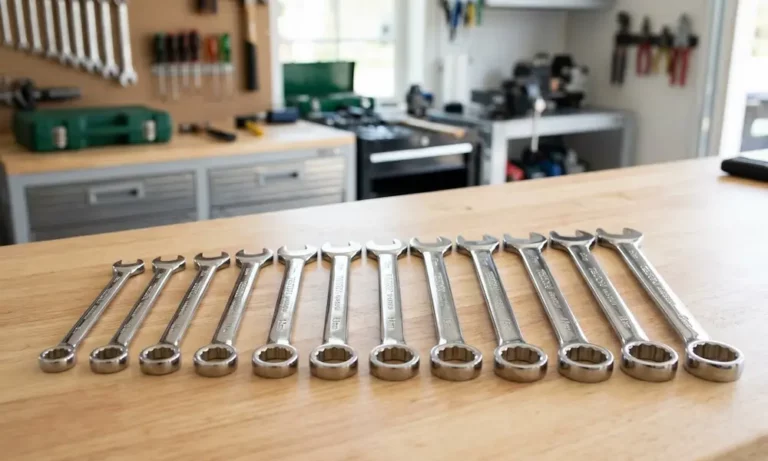
Thinking about Tekton wrenches but not sure if they’re worth your money? You’ve probably seen them pop up everywhere, and you’re right to wonder if they’re legit or just cheap tools with good marketing. This post breaks down the steel, the specs, the warranty, and how they stack up against the big names. Stick around — the answer might surprise you.
What Is Tekton, Anyway?
Tekton isn’t some faceless corporation slapping a logo on random tools. It’s a family-owned company based in Grand Rapids, Michigan, run by the sons of its founder, Attallah Amash. The company started as a hardware distributor in the 1960s, but in the late 2000s, it flipped its entire business model.
Instead of selling through retailers and “tool truck” middlemen, Tekton went direct-to-consumer. That means you’re not paying for a franchise markup, a salesman’s commission, or a truck to drive to your shop once a week. You order online, it ships fast, and the price reflects that.
The name “Tekton” comes from ancient Greek, meaning a skilled craftsman or technician. That’s not just branding fluff — it shapes how the company approaches every product decision, from which sizes go in each set to how they handle a broken wrench claim.
Where Are Tekton Wrenches Made?
This is where Tekton does something most tool brands refuse to do: they tell you exactly where each tool comes from.
| Country | Share of Product Line | What’s Made There |
|---|---|---|
| Taiwan | 81% | Ratcheting wrenches, sockets, combination wrenches |
| United States | 12.5–22% | Angle wrenches, pry bars, modular organizers |
| Germany | 4% | High-performance pliers and screwdrivers |
| Canada | 2% | Specialized mechanical tools |
| Poland / Sweden / Slovakia | <0.5% | Niche industrial components |
Taiwan isn’t a red flag here. It’s actually the global hub for high-quality hand tool forging. Taiwanese manufacturing often beats traditional Chinese factories on material consistency and tolerances. That’s why brands like Snap-on source from Taiwan too.
Their Grand Rapids facility handles CNC machining, broaching, laser engraving, and vibratory polishing. For all steel tools made in-house, they use American-sourced steel exclusively. That’s a detail worth noting.
What Steel Are Tekton Wrenches Made From?
Tekton wrenches use 6140 Chrome Vanadium steel. That’s the industry-standard alloy for professional hand tools, and for good reason.
- Chromium resists corrosion and oxidation
- Vanadium toughens the metal grain structure
Heat treatment brings hardness to 42–49 on the Rockwell C scale. That range matters more than it sounds:
- Below 42 HRC: The jaws spread under torque. Bolts get rounded.
- Above 49 HRC: The steel turns brittle. In a high-torque moment, it can shatter instead of flex.
- 42–49 HRC: The sweet spot. Tough enough to hold, ductile enough not to snap.
This isn’t marketing copy. It’s measurable metallurgy that places Tekton in the same material tier as tools costing three times the price.
How’s the Finish? Will It Hold Up in a Shop?
Three finishes, each with a purpose:
Mirror Chrome — On most standard combination wrenches. Easy to wipe clean, keeps grime from building up and corroding the steel.
Satin Chrome — On ratcheting wrenches. Abrasive-blasted before plating with Trivalent Chromium. Non-reflective, hides scratches, grips better with oily hands.
Electroless Nickel Plating — On specialty tools like crowfoot and service wrenches. Uniform coating that resists wear and chemical exposure.
Worth noting: Tekton uses Trivalent Chromium, not the older Hexavalent version. It’s more environmentally sound and provides equivalent or better protection.
Long-term users report that the high-polish finish holds up even after repeated exposure to harsh degreasers and shop grit.
What’s the Box End Design Like?
Tekton uses a 12-point box end with off-corner loading geometry. Here’s why that combination works well together.
A 12-point design doubles your access angles — useful when your swing arc is tight. The downside of standard 12-point designs is that they press on the corners of a bolt head, which is the weakest point. Tekton’s off-corner loading shifts contact to the flat sides of the fastener.
What that means in practice:
- Less bolt rounding, even on soft or already-damaged hardware
- Higher torque capacity before slipping
- Works on 6-point, 12-point, and square fasteners
| Design Feature | Spec | Why It Matters |
|---|---|---|
| Box end offset | 15 degrees | Clears your fingers and nearby obstructions |
| Open end angle | 15 degrees | Flip the wrench to double your usable positions |
| 45-degree offset option | Available | Reaches over large obstructions standard wrenches can’t |
How Good Is the Ratcheting Mechanism?
The ratchet head uses a 72-tooth mechanism, which gives you a 5-degree swing arc. Some competitors push to 90 or 120 teeth (4 or 3-degree arcs), but there’s a trade-off: thinner teeth break under high torque.
Tekton’s 72-tooth design keeps each tooth robust while still giving you enough precision for tight engine bays. Reviews of disassembled units note a spring-loaded pin under the direction selector that creates a positive, tactile click when changing directions — no accidental gear wandering mid-use.
Smaller sizes (1/4″ to 11/32″ and 6mm–9mm) get a 60-tooth mechanism. Everything else runs 72 teeth.
Ratcheting wrench styles available:
- Reversible ratcheting combination — Standard 15-degree offset box end with drive switch
- Flex-head ratcheting — Head pivots up to 180 degrees for off-angle fasteners
- Long flex box end — Combines pivot head with a longer beam for maximum reach and leverage
How Accurate Are Tekton Torque Wrenches?
Tekton’s click-type torque wrenches ship pre-calibrated to ±4% clockwise and ±6% counterclockwise. In independent testing, some units have come in within 1% of target — better than their own rated spec.
| Spec | 1/2″ Drive Click Wrench | 1/4″ Drive Dual-Direction |
|---|---|---|
| Range | 10–150 ft-lb | 10–150 in-lb |
| Accuracy | ±4% CW | ±4% CW |
| Ratchet | 72-tooth reversible | 72-tooth reversible |
| Construction | All-steel | Chrome-plated steel |
| Adjustment | Spring-loaded locking collar | Spring-loaded locking collar |
The all-steel housing is a key advantage. Plastic handles crack. Steel handles survive shop floors.
One honest caveat: the click can be quieter at the very low end of the range. That’s true of most mechanical torque wrenches. For low-torque precision work, use the 1/4″ drive model. For even finer resolution, Tekton’s digital torque wrenches give real-time readouts down to 0.1 ft-lb — useful for torque-to-yield fasteners in modern engines.
Are Tekton Wrenches Any Good Compared to the Competition?
Here’s the part most people want to know. In standardized torque-to-failure tests, Tekton lands solidly in the middle of the market. Not at the top, not at the bottom.
For example, in a 10mm open-end slip test, Tekton holds around 28 ft-lb before slipping. A Snap-on wrench might hold to 33–35 ft-lb. The gap is real — but it only matters if you’re regularly pushing tools past their rated limits.
| Brand | Approx. Price (14-Piece Metric Set) | What You Get |
|---|---|---|
| Tekton | ~$65 | Lifetime warranty, 10% rewards, no-skip sizes |
| GearWrench | ~$85 | Slim profiles, established pro line |
| Icon (Harbor Freight) | ~$120 | Tighter tolerances, longer beams, in-store swap |
| Wright | ~$200 | Maximum stiffness, USA-made, anti-slip open ends |
| Snap-on | $500–$1,000 | Top-tier jaw stiffness, prestige, truck service |
Professionals who use both Snap-on and Tekton regularly report zero functional difference for daily tasks. The gap only shows up at extreme torque values most jobs never require.
One minor note on fit: Tekton’s jaw clearance runs around 0.21mm — slightly looser than Icon or premium German brands. Some people call it “sloppy.” Others prefer it because the wrench slides onto rusty, painted, or corroded fasteners more easily.
The Warranty Is Actually the Headline Feature
Tekton’s “Always Guaranteed” warranty removes every traditional friction point:
- No receipt needed — Own the tool, it’s covered
- No expiration — Bought it 20 years ago? Still covered
- No shipping the broken tool back — Upload a photo
- Same-day shipping — Submit before 2 PM ET, it goes out that day
Compare that to the tool truck model. If your truck comes on Tuesdays and you break a wrench on Wednesday, you wait six days. With Tekton, a replacement is in your hand in two business days. For professionals, that’s not a small thing.
The 10% rewards program on direct purchases adds another layer of value. Over time, a fully stocked toolbox earns enough back to cover several more tools — a discount structure retailers simply can’t offer.
No-Skip Sizing: A Bigger Deal Than It Sounds
Most tool sets skip “awkward” sizes — 7mm, 9mm, 11mm, 16mm, 20mm — to cut production costs. Tekton commits to “no-skip” sets. Every increment is there.
If you’ve ever grabbed a slightly-off wrench because the right size wasn’t in the set, you already know what this is worth. One wrong size = a rounded bolt = a bad day.
What Do Long-Term Users Actually Say?
Mechanics who’ve used Tekton Chrome Vanadium sets for four-plus years in professional shops report no breakage. The finish holds. The chrome survives degreasers and grit.
A review of Tekton’s 45-piece mechanic’s set from The Drive describes the ratchet running smoothly through a 1969 Dodge Charger wheel-bearing replacement — high breakaway torque, tight clearances, no failures.
The most common criticism from heavy users isn’t about the steel or the ratchet. It’s that the wrench beam is narrower than some comfort-grip premium options, which can cause hand fatigue when leaning hard without gloves. That’s a comfort issue, not a quality issue.
So, Are Tekton Wrenches Any Good?
Yes — and here’s the short version of why:
- 6140 Chrome Vanadium steel, heat-treated to 42–49 HRC
- 72-tooth ratcheting mechanisms with off-corner loading box ends
- Complete sizing — no skipped sizes in metric or SAE
- Honest country-of-origin data — they tell you exactly where every tool comes from
- Photo-based lifetime warranty with same-day replacement shipping
- 10% rewards on direct purchases
They’re not Snap-on. They don’t have maximum jaw stiffness or the tightest tolerances on the market. But for the price of one or two Snap-on wrenches, you can build a complete professional-grade set that handles the overwhelming majority of real-world mechanical work without complaint.
That’s not “good for the price.” That’s just good.