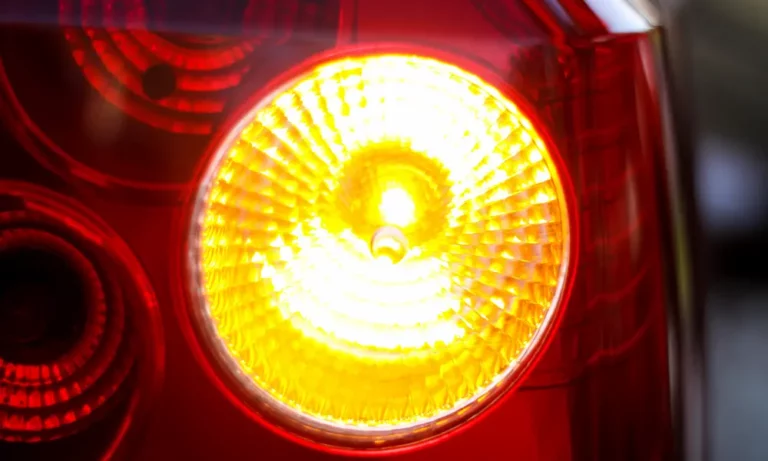
Your turn signal not working is more than annoying — it’s a safety issue and a ticket waiting to happen. The fix could be a $5 bulb or something trickier hiding inside your car’s computer. This guide walks you through every real cause, from blown fuses to a failing Body Control Module, so you can stop guessing and start fixing.
Why Your Turn Signal Isn’t Working (Start Here)
Before you pull anything apart, ask yourself two questions:
- Is the problem on one side or both sides?
- Is the signal dead or hyperflashing?
Your answers cut the diagnostic list in half. One dead side almost always means a bad bulb, socket, or wiring. Both sides failing together points to a shared component — the flasher relay, a blown fuse, or the Body Control Module (BCM) on newer vehicles.
The Most Common Causes of a Turn Signal Not Working
1. Burned-Out Bulb
This is the first thing to check. A burned-out bulb is the most common reason a turn signal stops working, and replacement bulbs cost between $5 and $10.
The catch? Not all bulbs are interchangeable. Most American trucks and domestic vehicles use 3157 bulbs — a wide plastic wedge base with dual indexing tabs. Many Japanese imports (Toyota, Honda, Nissan) use 7443 bulbs — a narrower wedge with thin wire leads.
Don’t force the wrong bulb in. Jamming a 3157 into a 7443 socket can bend the contacts, crack the socket, or blow a fuse instantly.
| Bulb Type | Base Style | Common Vehicles |
|---|---|---|
| 3157 (SAE Standard) | Wide wedge, dual tabs | Ford F-150, Chevy Silverado, Ram |
| 7443 (JIS Standard) | Narrow wedge, thin leads | Toyota, Honda, Nissan, modern compacts |
| 1157 (Legacy) | Round bayonet, dual pins | Classic cars, trailers, motorcycles |
Check your owner’s manual or the inside of your fuse box cover for the correct bulb number before you buy anything.
2. Blown Fuse
A blown fuse kills the signal without warning. Find your fuse box (usually under the dashboard or in the engine bay), grab the turn signal fuse, and pull it out. If the metal strip inside is broken, replace it with the exact same amperage fuse.
Never swap in a higher-amp fuse to “fix” a blowing fuse. That’s a wire fire waiting to happen. If fuses keep blowing, there’s a short circuit somewhere in the wiring.
3. Bad Flasher Relay
Older vehicles (roughly pre-2015) use a dedicated flasher relay to create the blinking rhythm. This small component costs $10 to $20 to replace and sits in the fuse box or on a bracket under the dashboard.
You can test it with a 12-volt test light:
- Turn the ignition to ON.
- Find the B (Battery) terminal on the relay socket.
- Touch your test light to the B terminal. If it lights up, power is reaching the relay.
- Now probe the L (Load) terminal. A working relay makes the test light blink. No blink means the relay is dead — replace it.
Quick heads-up: Transistorized flasher units can’t be tested with a standard test lamp. The lamp’s own resistance throws off the reading and can damage the internal circuit. If you suspect a solid-state relay, test everything else first.
4. The Hazard Switch Is Blocking Power
This one trips up a lot of owners, especially on older vehicles and classic British imports like the Triumph TR250 and TR6.
On these cars, the turn signal circuit runs directly through the hazard switch contacts. If the hazard switch is even slightly unplugged or its contacts are oxidized, the entire turn signal system goes dead — even with perfect fuses, bulbs, and wiring.
The contacts inside a hazard switch are designed to “wipe” clean when you toggle them. But if you rarely use your hazard lights, those contacts oxidize and lose their connection.
Quick fix: Cycle the hazard switch 20 to 30 times rapidly. That wiping action can scrub off the corrosion and restore power. For stubborn cases, open the switch housing and clean the copper contacts with a pencil eraser until they’re shiny again.
5. Bad Ground Connection
Every bulb needs a clean return path back to the chassis to complete the circuit. If the ground wire (usually black or brown) corrodes or loosens at its chassis bolt, the current hunts for another path home.
This causes weird symptoms: your brake lights dim when you signal, all your rear lights flash at once, or your dashboard indicator stays solid instead of blinking. These are all signs of a ground failure, not a bad bulb.
Find the ground connection point near the affected light assembly. Wire-brush the contact point, remove any rust or paint, and bolt the ground wire back down tight.
6. Faulty Turn Signal Stalk Switch
If power reaches the circuit but the stalk switch doesn’t pass it through, nothing works. Test it with a multimeter:
- Connect your meter between an output terminal on the switch and a chassis ground.
- Turn the ignition ON and move the stalk.
- If there’s no voltage reading, the switch is faulty and needs replacement.
Replacing the stalk means disassembling the steering column, which brings up an important safety step — see the airbag section below.
Turn Signal Not Working on Modern Vehicles: BCM Problems
If you drive a 2015 or newer vehicle, there may be no serviceable flasher relay at all. Modern vehicles route everything through a Body Control Module (BCM) — a central computer that controls door locks, headlights, turn signals, and more.
The BCM also simulates the classic clicking sound through your speakers since there’s no physical relay clicking anymore.
Signs Your BCM Is Failing
- Turn signals work randomly or not at all
- Dashboard indicators flicker with no input from you
- Multiple unrelated systems (locks, lights, windows) act up at the same time
- The car drains your battery overnight
That last point is key. A failing BCM can’t enter sleep mode when you park. Test it by turning off the car, locking it, waiting 15 minutes, and gently touching the infotainment screen without unlocking. If the screen lights up immediately or dashboard lights flicker, your module is staying awake when it shouldn’t be.
Reading BCM Trouble Codes
Plug in a professional OBD-II scanner and look for these specific codes:
- U1000 — BCM lost communication with another module on the CAN bus. The stalk may work physically but the signal never reaches the computer.
- B1000/B1001 — Internal microprocessor fault inside the BCM. The module needs replacement.
- B2575 — Short or open circuit in the wiring harness between the BCM and the lamp sockets.
A failing BCM can also throw phantom codes across other systems — engine misfires, coolant temperature errors — because communication delays ripple across the entire vehicle network.
Common BCM Failure Causes
- Water intrusion — The leading cause. A leaky windshield seal or clogged sunroof drain can drip onto the module’s circuit board.
- Thermal stress — Constant heat cycles crack solder joints over time, causing intermittent failures.
- Electrical overload — A bad alternator or incorrect jump-start can destroy the module’s solid-state drivers.
Turn Signal Hyperflashing After an LED Upgrade
Your turn signal not working correctly after an LED swap is almost always hyperflashing — rapid, frantic blinking. LEDs draw far less current than incandescent bulbs. Your car’s current-sensing circuit interprets that low draw as a missing bulb and speeds up the flash rate as a warning.
The fix is adding resistance back into the circuit:
- Locate the positive turn signal wire and the ground wire at the light socket.
- Splice a 6-ohm or 10-ohm resistor in parallel across those two wires.
- Mount the resistor against a metal surface — away from plastic and wiring — because resistors get hot.
On some Ford Super Duty trucks, the hyperflash won’t stop until you clear the stored trouble codes with an OBD-II reader, even after you’ve installed the resistor correctly.
If you want a cleaner solution, buy LED bulbs with built-in load resistors. Premium designs wire the resistor only to the turn signal circuit — not the running light circuit — so the resistor only heats up when you’re actually blinking.
Replacing the Turn Signal Stalk: Airbag Safety First
Swapping a turn signal multifunction stalk means getting near the driver’s airbag. The NHTSA requires at least 10 inches of space between your breastbone and the airbag cover during normal driving — and an accidental deployment during repairs is extremely dangerous.
Always disarm the airbag system before touching the steering column:
- Disconnect the negative battery cable and tape it off so it can’t contact the terminal.
- Wait at least 30 minutes. The airbag control module has backup capacitors that hold enough charge to fire the bag even with the battery disconnected. Give them time to drain completely.
Once disarmed, remove the steering wheel shroud covers, unscrew the airbag module (usually a T30 Torx bit), disconnect the yellow and orange connectors by releasing their locking tabs, and set the airbag face-up on a clean non-conductive surface. Never rotate the clock spring while the wheel is off — it has an internal ribbon cable that breaks if you spin it.
Is Your Turn Signal Color Actually Legal?
Here’s something most drivers don’t know: the color of your rear turn signal is a federal safety regulation under FMVSS 108, enforced by the NHTSA.
- Front turn signals must be amber.
- Rear turn signals can be red or amber in the US — but Europe requires amber only.
A 2009 NHTSA study found that amber rear signals reduce rear-end crashes by 5.3% compared to red — more effective than the federally mandated third brake light. Many manufacturers still use red rear signals in America for styling and cost reasons, despite that data.
Replacing factory lenses with clear housings is also a federal violation unless it’s a front turn signal paired with a certified amber bulb. Clear lenses on taillights don’t meet SAE J578c color specs with any currently available red bulb.
State laws add another layer. Florida Statute 316.234, for example, requires turn signals to be visible from 300 feet in normal sunlight for standard vehicles, and 500 feet for commercial vehicles over 80 inches wide. Tinted covers or smoked lenses that reduce brightness below those thresholds are illegal under both state and federal law.
Your Turn Signal Diagnostic Checklist
Work through this order before spending money on parts:
- Check the bulb — Is it the right type? Is the filament intact?
- Pull the fuse — Broken strip? Replace with the exact amperage.
- Test the flasher relay — Power in, blinking power out? Replace if dead.
- Cycle the hazard switch — Especially on older or classic vehicles.
- Inspect the ground wire — Look for corrosion at the chassis connection point.
- Test the stalk switch — Voltage in, voltage out when you move it?
- Scan for BCM codes — On 2015+ vehicles, skip straight to an OBD-II scanner if basics check out.
- Add a load resistor — If hyperflashing after an LED swap.
Start cheap and simple. Most turn signal problems end at step one or two.