Curious about who actually builds those sleek Lucid electric vehicles? The answer’s more interesting than you’d expect. It involves a Saudi sovereign wealth fund, a Formula E racing contract, and a company that almost never made cars at all. Stick around — this gets good.
Who Makes Lucid Cars?
Lucid Group, Inc. makes Lucid cars. It’s an American automotive and technology company headquartered in Newark, California, and it trades on the NASDAQ under the ticker LCID.
But here’s the thing — Lucid wasn’t always a carmaker. The company started as a battery technology supplier and only pivoted to building full vehicles after realizing that’s where the real opportunity sat. More on that in a moment.
How Lucid Got Started: The Atieva Years
Lucid’s origin story begins on December 14, 2007, when the company launched under the name Atieva.
The founding team wasn’t building cars. They were building battery packs and powertrain components for other manufacturers. Bernard Tse, a former VP at a major EV competitor, served as CEO. Sam Weng handled operations, and Sheaupyng Lin led battery architecture development.
Atieva’s big early win? Securing an exclusive contract to supply battery packs for the entire Formula E racing circuit. That deal proved the technology worked under brutal real-world conditions — and laid the groundwork for everything that came after.
The Pivot That Changed Everything
In 2013, Peter Rawlinson joined as Chief Technology Officer. Rawlinson had previously served as the lead vehicle engineer on a widely praised luxury EV sedan at a competing firm, and he brought a clear vision: stop supplying components to other manufacturers and start building complete vehicles.
The logic was simple. Component suppliers get commoditized. Vehicle manufacturers capture brand equity and profit margins. Rawlinson catalyzed a full strategic pivot — from B2B supplier to direct-to-consumer luxury automaker.
In 2016, Atieva officially rebranded as Lucid Motors, unveiled the Air sedan prototype, and declared its intention to compete at the top of the luxury EV market.
Who Owns Lucid Cars? Saudi Arabia’s Role
This is where the story gets genuinely fascinating. Without its majority owner, Lucid almost certainly wouldn’t exist today.
Since April 2019, the Public Investment Fund (PIF) — Saudi Arabia’s sovereign wealth fund — has been Lucid’s primary financial backer. The relationship started with a $1 billion strategic investment in 2018, which funded the Arizona factory and the final development of the Air.
As of April 2026, PIF beneficially owned roughly 280,992,324 shares — approximately a 56.85% controlling interest in Lucid Group. That’s not a passive investment. PIF’s voting bloc determines the outcome of every stockholder vote, as demonstrated at the 2026 annual meeting where every item on the ballot passed.
The arrangement works for both sides. Lucid gets essentially unlimited capital to survive the brutal early years of automotive manufacturing. Saudi Arabia advances its Vision 2030 economic diversification strategy by developing a homegrown EV sector.
Other institutional investors include Vanguard, BlackRock, and State Street — but their stakes are dwarfed by PIF’s controlling position.
Who Runs Lucid Today?
The company recently went through a significant leadership transition that signals a shift in priorities.
From Engineer to Industrialist
Peter Rawlinson served as both CEO and CTO for over a decade, driving Lucid’s engineering-first culture. On February 25, 2025, he stepped down from both roles and transitioned to Strategic Technical Advisor.
Silvio Napoli took over as CEO on April 14, 2026. His background? He previously led Schindler Group, the Swiss elevator and escalator manufacturing giant. He holds an MBA from Harvard Business School and an engineering degree from the Swiss Federal Institute of Technology.
That’s a deliberate choice. Lucid doesn’t need more engineering breakthroughs right now — it needs someone who knows how to scale complex global manufacturing operations without bleeding cash.
Marc Winterhoff serves as Chief Operating Officer, Taoufiq Boussaid handles the finances as CFO, and Derek Jenkins — designer of the award-winning Mazda MX-5 Miata — leads design and brand as Senior Vice President.
The leadership team also expanded in May 2025 with serious automotive manufacturing veterans, including Jason Ryska (VP of Global Manufacturing Engineering, formerly of Ford and Fiat Chrysler) and Dr. Kay Stepper (VP of ADAS and Autonomous Driving, formerly of Qualcomm).
Where Are Lucid Cars Made?
Lucid operates two manufacturing plants across two continents.
AMP-1: Casa Grande, Arizona
This is the main hub. Lucid opened AMP-1 in September 2021 as the first greenfield EV factory built from scratch in North America by the company.
On January 24, 2024, Lucid inaugurated a massive Phase 2 expansion, adding approximately 3 million square feet and bringing the total campus to over 3.85 million square feet. Current installed capacity sits at 90,000 vehicles per year.
Here’s the uncomfortable reality: in 2024, Lucid only built about 9,000 vehicles. That’s a massive gap between what the factory can do and what it actually produces. The company is actively working to close it with new models and aggressive pricing strategies.
AMP-2: King Abdullah Economic City, Saudi Arabia
Lucid’s international facility opened in September 2023 near Jeddah, Saudi Arabia — the first car manufacturing plant in the Kingdom’s history.
Currently, it operates as a Semi-Knock Down assembly facility, meaning components are partially built in Arizona and shipped to Saudi Arabia for final assembly. Current capacity: 5,000 units annually.
By end of 2026, the plant is set to transition to full independent production, with a long-term target of up to 155,000 vehicles per year.
What Cars Does Lucid Make?
Lucid currently produces two vehicle lines, with a third in active development.
The Lucid Air Sedan
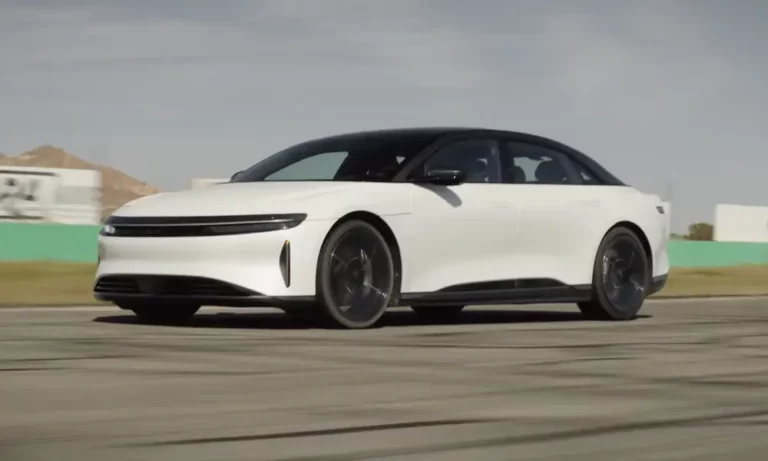
The Air is the flagship. It offers up to 520 miles of EPA-estimated range — achieved not by packing in a bigger battery, but through aerodynamic efficiency and proprietary inverter technology descended from those Formula E racing roots. It won the 2022 MotorTrend Car of the Year.
| Model Trim | Starting Price | Max Power | Key Highlight |
|---|---|---|---|
| Pure | $70,900 | Standard | Entry-level luxury |
| Touring | $79,900 | 620 hp | Dual motors, 885 lb-ft torque |
| Grand Touring | $114,900 | High Output | Max range, premium materials |
| Sapphire | $249,000 | 1,111 hp | Track-ready halo vehicle |
The Lucid Gravity SUV
Production on the Gravity electric SUV began in December 2024, and it’s already racking up awards — 2026 World Luxury Car of the Year, Car and Driver’s 10Best SUVs, Esquire’s Car of the Year.
| Model Trim | Starting Price | Max Power | 0-60 mph | Range | Charge to 200 mi |
|---|---|---|---|---|---|
| Touring | $79,900 | 560 hp | 4.0 sec | 337 miles | 15 min |
| Grand Touring | $98,900 | 828 hp | 3.4 sec | 450 miles | Under 11 min |
The Upcoming Midsize Platform
A midsize vehicle platform targeting a significantly lower price point is slated for around 2026. This model is essential — Lucid needs higher volumes to justify that 90,000-unit Arizona factory. Without a mass-market model, the math doesn’t work.
Lucid’s Robotaxi Ambitions With Uber
Lucid isn’t just selling luxury cars to individuals. It’s going all-in on autonomous ride-hailing.
On April 14, 2026, Lucid and Uber expanded their robotaxi partnership to at least 35,000 vehicles — a 75% increase from a prior 20,000-unit commitment. Uber also made a $200 million equity investment in Lucid, bringing its total stake to $500 million.
The autonomous driving software comes from Nuro, while the vehicles run on NVIDIA DRIVE AGX Thor hardware. Testing in the San Francisco Bay Area began in early 2026, with a full commercial driverless launch targeted for late 2026.
The vehicles feature 360-degree sensor arrays integrated into the body panels, LIDAR, radar, and a roof-mounted halo module — all while maintaining Lucid’s aerodynamic profile. Inside, interactive screens let passengers control everything without a human driver.
The Financial Reality
Lucid’s Q1 2026 revenue hit $282.5 million — a solid 20% year-over-year increase. But operating cash burn reached $1.185 billion in that same quarter alone.
The company hit a rough patch in early 2026 when a seat supplier failure left thousands of finished Gravity SUVs sitting in Arizona unable to be delivered. Lucid produced 5,500 vehicles but only delivered 3,093 in Q1 2026. The resulting stock price drop to $8.80 — and an eventual all-time low of $5.09 — triggered multiple class-action securities lawsuits alleging the company failed to disclose the supply chain disruption.
To shore up its position, Lucid completed a $1.05 billion capital raise in April 2026, structured across preferred stock, a public common stock offering, Uber’s equity investment, and an additional $500 million draw on its PIF-backed loan facility.
It’s a company with genuinely world-class technology, unlimited Saudi capital, and serious operational growing pains — all at the same time.