If you’ve ever stared at a Kenworth or Peterbilt spec sheet and wondered who actually builds the engine under that hood, you’re asking the right question. The answer isn’t simple — and it matters for your buying decision, your maintenance budget, and your shop’s toolbox. Stick with us, and you’ll know exactly what’s going on inside every PACCAR powertrain.
The Short Answer: It Depends on the Engine
PACCAR Inc. doesn’t have just one engine source. The company builds its own heavy-duty engines in Mississippi and partners with Cummins for its medium-duty lineup. So when someone asks who makes PACCAR engines, the honest answer is: sometimes PACCAR, sometimes Cummins — and knowing which is which changes everything.
Here’s the full picture.
PACCAR’s Proprietary Heavy-Duty Engines: The MX Series
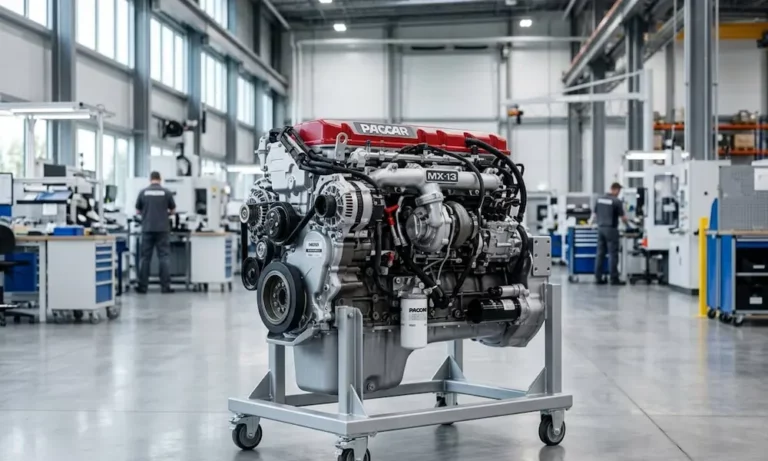
PACCAR makes its own heavy-duty engines. The MX-11, MX-13, and MX-15 are all designed and built in-house, exclusively for Kenworth and Peterbilt trucks.
Before the MX series launched in 2010, PACCAR functioned more like a truck assembler, dropping third-party engines into its chassis. That changed when the company invested roughly $400 million in a new manufacturing facility and logged 50 million test miles across North American roads before releasing the MX to the public. That’s a serious commitment.
What’s Inside the MX Engines
The MX series uses compacted graphite iron for both the engine block and cylinder head. That material is 75% stronger and 20% lighter than traditional grey iron, which translates to 150–400 pounds of weight savings per truck. More payload capacity means more revenue on every run.
The engines also use a rear-mounted gear train with a single in-block camshaft. This design lowers the engine’s profile, which lets Kenworth and Peterbilt engineers slope the hood more aggressively for better aerodynamics. It also pushes gear noise to the rear of the engine, keeping the cab noticeably quieter.
Fuel delivery runs through a high-pressure common rail system capable of 36,000 PSI — a level of precision that helps the engine hit modern NOx limits without burning through emissions credits.
The MX Engine Lineup at a Glance
| Engine | Displacement | Horsepower | Peak Torque | Best Use |
|---|---|---|---|---|
| PACCAR MX-11 | 10.8L | 335–430 HP | 1,250–1,650 lb-ft | Regional haul, tanker, refuse |
| PACCAR MX-13 | 12.9L | 405–510 HP | 1,450–1,850 lb-ft | Line-haul, highway, heavy vocational |
| PACCAR MX-15 | 15.0L | 425–605 HP | 1,650–2,050 lb-ft | Dump trucks, concrete mixers, heavy haul |
Each engine is designed with a B10 life of one million miles, meaning 90% of MX engines are expected to run a million miles before needing a major overhaul. That’s a spec worth knowing before you sign a fleet purchase order.
Where PACCAR Actually Builds These Engines
The PACCAR Engine Company facility sits in Columbus, Mississippi, inside the Golden Triangle Industrial Park on a 400-acre site. The plant employs over 600 workers and produces roughly 160 engines per day.
The manufacturing process includes CNC machining for blocks and heads, robotic assembly for heavy components, torque-controlled tooling that electronically records every fastener, and a hot test protocol where 100% of engines run under load before they leave the factory.
The plant is also a zero-waste-to-landfill facility. In 2026, PACCAR opened a $209 million expansion adding 50,000 square feet dedicated to engine remanufacturing and next-generation engine production that meets the 2027 NOx standards. If you’re running an aging Kenworth or Peterbilt, that remanufacturing center means you can get a factory-spec engine rebuild without buying new.
The PACCAR and Cummins Partnership: Medium-Duty Engines
Here’s where it gets interesting. The PACCAR PX-7 and PX-9 engines — found in medium-duty Kenworth and Peterbilt trucks — are actually Cummins-built engines wearing PACCAR badges.
PACCAR and Cummins formalized this arrangement in 2006. The PX-7 is based on the Cummins ISB 6.7L platform. The PX-9 comes from the Cummins L9 architecture. Both are configured with PACCAR’s own electronic control parameters so they integrate properly with the truck’s systems, but the core engineering and production belong to Cummins.
This isn’t a weakness in PACCAR’s strategy — it’s a smart business call. Developing a unique engine for the medium-duty segment costs enormous capital. By partnering with Cummins’ high-volume production lines, PACCAR keeps medium-duty trucks competitive on price while directing its R&D spending toward the high-margin MX platform.
PX Engine Specs
| PACCAR Engine | Cummins Base | Displacement | Output |
|---|---|---|---|
| PACCAR PX-7 | Cummins ISB 6.7L | 6.7L | 200–360 HP / 520–800 lb-ft |
| PACCAR PX-9 | Cummins L9 | 8.9L | 260–450 HP / 720–1,250 lb-ft |
Cummins Engines Available as Options in PACCAR Trucks
Beyond the PX branded engines, PACCAR also offers full Cummins engines as customer-selectable options in Class 8 trucks. The Cummins X15 and the X15N natural gas engine are both available in Kenworth and Peterbilt configurations.
The X15N is particularly notable. It’s the first heavy-duty natural gas engine built specifically for Class 8 applications, delivering up to 500 HP and 1,850 lb-ft of torque. Fleets running renewable natural gas can achieve up to a 90% reduction in carbon emissions compared to diesel — or reach carbon neutral status depending on the fuel source — without giving up performance on long-haul routes.
Diagnostic Tools: A Practical Difference You Need to Know
Here’s something that trips up a lot of fleet managers and independent shop owners. Because PACCAR’s MX series is proprietary, it needs proprietary diagnostic software.
MX engines require PACCAR DAVIE4 — the same software PACCAR dealerships use. It gives you master-level access to engine and aftertreatment modules. You can’t use Cummins INSITE on an MX-13 and expect meaningful results.
PX engines, being Cummins at heart, need Cummins INSITE for deep diagnostics. Shops running mixed fleets need both software licenses plus compatible adapters like the USB Link 3.
| Tool / Resource | PACCAR MX (In-House) | PACCAR PX (Cummins) |
|---|---|---|
| Diagnostic Software | PACCAR DAVIE4 | Cummins INSITE |
| Tech Support Portal | PACCAR Powertrain Support | Cummins QuickServe Online |
| Base Engine Warranty | 2 yrs / 250,000 miles | Varies by Cummins plan |
PACCAR also runs a 365 Center providing 24/7 roadside and technical support, backed by over 800 service locations and eight distribution centers across North America. Same-day or next-day parts availability is the target.
Maintenance Costs and Why the MX-13 Wins on Intervals
The MX-13 is engineered for extended service intervals. Oil changes can stretch to 75,000 miles on this platform, compared to 35,000–50,000 miles on some competitors. Over 600,000 miles of truck life, that gap adds up to more than $5,000 in maintenance savings per truck.
| Maintenance Task | PACCAR MX-13 | Competing 15-Liter |
|---|---|---|
| Oil Change Interval | Up to 75,000 miles | 35,000–50,000 miles |
| Valve Adjustment | 180,000 / 300,000 miles | 250,000 / 500,000 miles |
One more thing to consider if you’re buying used: swapping an MX-13 for a Cummins X15 isn’t a bolt-in job. The MX-13 sits roughly two inches higher and half an inch further rearward than a Cummins ISX. That difference means new front trunnion brackets, different frame mounts, and a flywheel housing that won’t match anything else on the market. PACCAR built the truck around the engine on purpose — and that level of integration is exactly why the MX platform performs the way it does.
The Future: PACCAR, Cummins, and Daimler Building Battery Cells Together
The next chapter in who makes PACCAR power systems is taking shape in Mississippi. PACCAR, Cummins (through its Accelera division), and Daimler Truck formed a joint venture called Amplify Cell Technologies. They’re building a 21-gigawatt-hour factory in Marshall County, Mississippi, producing lithium-iron-phosphate battery cells for commercial vehicles.
Three companies that compete in the diesel market are co-investing in the electric future because the development costs are too large for any one of them to absorb alone. That’s not a contradiction — that’s industrial pragmatism at scale.
On the diesel side, the Columbus facility is already tooling up for 2027 EPA NOx standards, which set the limit at 35 milligrams. The next generation of MX engines will use advanced selective catalytic reduction and diesel oxidation catalysts to hit near-zero tailpipe emissions without sacrificing the performance numbers fleet operators count on.
The Complete Breakdown: Who Makes What
This is the answer in plain terms:
- MX-11, MX-13, MX-15 → Built by PACCAR in Columbus, Mississippi. Proprietary design. Exclusive to Kenworth and Peterbilt.
- PX-7, PX-9 → Built by Cummins. Branded and configured for PACCAR medium-duty trucks under a supply agreement formalized in 2006.
- Cummins X15, X15N → Built by Cummins. Available as customer options in Class 8 PACCAR trucks, particularly for heavy-haul and natural gas applications.
- Future battery cells → Produced through Amplify Cell Technologies, the three-way joint venture with Cummins and Daimler Truck in Marshall County, Mississippi.
Understanding that split isn’t just trivia. It shapes which diagnostic tools your shop needs, how you’ll plan maintenance intervals, what your warranty coverage looks like, and whether a used truck you’re eyeing has a proprietary powertrain or a Cummins you can service anywhere. Every one of those factors hits your bottom line — and now you know exactly where each engine comes from.