
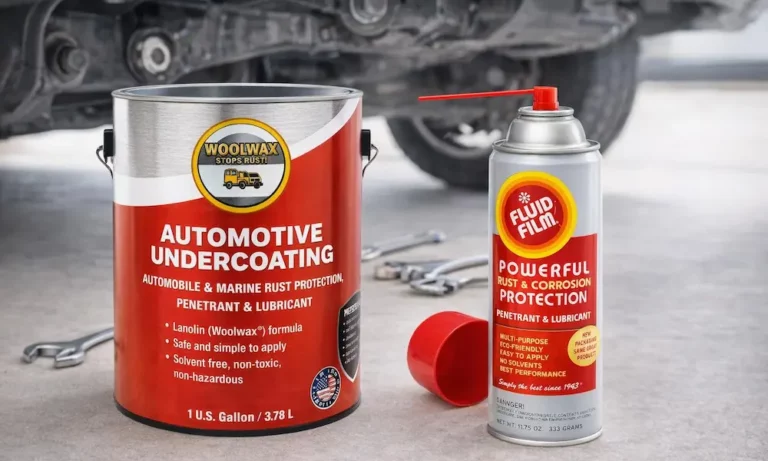
If your truck’s undercarriage looks like it’s auditioning for a horror movie, you’re dealing with the same battle every driver in the Salt Belt faces. Here’s the deal: Woolwax and Fluid Film are both lanolin-based rust fighters, but they work differently. Read on to find out which one fits your needs—or why you might want both.
What Makes These Products Different From Regular Undercoating?
Traditional rubber or asphalt undercoatings crack over time. Water sneaks in, gets trapped, and creates a rust factory under what’s supposed to protect your metal.
Woolwax and Fluid Film don’t dry hard. They stay wet and flexible, which sounds weird but works brilliantly. This lets them self-heal when scratched and continuously creep into seams where moisture hides.
Both use lanolin (wool grease) as their secret weapon. Lanolin repels water naturally while absorbing existing moisture away from metal. It’s like giving your truck’s frame a permanent raincoat that breathes.
The Core Difference: Thick Armor vs Deep Penetration
Here’s where woolwax vs fluid film becomes an actual choice instead of brand loyalty.
Woolwax: The Heavy Shield
Woolwax is thick—think pudding consistency. It’s 100% solvent-free, meaning what you spray stays put. No evaporation, no shrinkage.
When you coat a frame rail with Woolwax, you’re building a barrier that laughs at car washes and slush spray. It’s designed for exposed surfaces that take a beating.
The thickness prevents it from washing away. Users report coverage lasting two years or more on wheel wells and suspension components before needing touch-ups.
Fluid Film: The Creeping Penetrant
Fluid Film mixes lanolin with refined petroleum oils. This makes it flow like… well, a liquid instead of pudding.
The thinner consistency lets Fluid Film creep into tight spaces fast. It wicks into pinch welds, door seams, and rusted lap joints where thicker products just bridge over the gap.
But here’s the trade-off: that same flowability means it washes off easier. Exposed areas often need reapplication every spring and fall to maintain full protection.
Performance Head-to-Head
Let’s break down how these perform in real conditions.
| Feature | Woolwax | Fluid Film |
|---|---|---|
| Wash-Off Resistance | Excellent (2+ years exposed) | Good (needs seasonal touch-ups) |
| Penetration Speed | Slow (heat-activated creep) | Fast (immediate wicking action) |
| Film Thickness | Very thick (10 mils stays 10 mils) | Thin to medium (thins after application) |
| Cold Weather Spray | Requires heating below 60°F | Sprays easily when cold |
| Odor | Nearly neutral | Strong “barnyard” smell for weeks |
| Equipment Needed | Robust compressor (70-90 PSI, 5-8 CFM) | Basic equipment works fine |
The Smell Situation Nobody Talks About
If you’re driving an SUV where the cabin isn’t sealed from the wheel wells—like a 4Runner or GX—this matters.
Fluid Film smells like a barn. Some describe it as dirty socks or manure-adjacent. It’s the petroleum carriers and specific wool wax refining process. That scent can seep into your interior for weeks.
Woolwax has virtually no smell—maybe a faint wool sweater scent that disappears quickly. If you’re sensitive to odors or passengers complain, Woolwax wins here without question.
Application Reality Check
Don’t underestimate how equipment affects your results.
Spraying Woolwax Isn’t Plug-and-Play
That thickness that makes Woolwax durable also makes it finicky to spray. You need serious air pressure and volume—70-90 PSI at the gun with 5-8 CFM continuous flow.
A small pancake compressor won’t cut it. It’ll spit globs instead of misting properly.
Cold weather compounds this. Below 60°F, Woolwax needs heating before application—stick the can in hot water or near a heater. Otherwise, you’ll clog your wands and get terrible coverage.
You’ll also need large-diameter extension wands. Standard narrow tubes for oil spray will block completely.
Fluid Film: DIY-Friendly
Fluid Film sprays at lower pressures (40-60 PSI) through standard undercoating guns. No heating required, even in cool temps.
The aerosol cans work great for spot treatments without needing a compressor at all. The propellant thins it to near-water consistency for exceptional penetration.
What About Existing Rust?
Neither product converts rust chemically. They’re not like phosphoric acid treatments that change iron oxide into something else.
Instead, they penetrate rust scale, fill the porous structure, and cut off oxygen supply. This arrests development but doesn’t reverse existing damage.
Both can be applied over damp surfaces. Their water-displacement chemistry actually lifts moisture and bonds to steel underneath—useful after a pressure wash when the frame isn’t bone dry.
The Black vs Clear Decision
Both brands offer straw (clear) and black versions.
Woolwax Black is incredibly opaque. It hides surface rust completely, giving your undercarriage a factory-fresh matte black appearance. The thick film smooths out pitted rust texture visually.
Fluid Film Black stays more translucent because of thinner film build. It darkens rust but doesn’t black it out completely. It looks wetter and less like solid coating.
Clear versions let you monitor the metal underneath. If corrosion develops beneath the film, you’ll see it during inspections.
Cost Analysis: Cheap Now vs Value Later
Material costs are competitive, but application frequency changes the math.
Fluid Film runs $42-45 per gallon. You can grab it at Lowe’s or Home Depot easily.
Woolwax costs $49-56 per gallon, usually shipped direct. Black formulations hit the higher end.
But consider this: Over 10 years, Woolwax might need only 5 full applications with minor touch-ups. Fluid Film could require 10-20 applications if you’re doing it semi-annually.
Cheaper per gallon doesn’t equal cheaper over time when you factor in labor—or your own time if you’re DIYing it.
The Hybrid Strategy That Actually Makes Sense
Here’s what pros and experienced users figured out: use both products strategically.
Step 1: Cavities Get Fluid Film
Spray Fluid Film (NAS or Liquid A) into frame rails, rockers, door bottoms, and pillars using a 360° flexible wand.
Why? The thin viscosity mists completely inside box sections and wicks rapidly into pinched seams where moisture collects. Woolwax might be too thick to atomize properly in tight spaces or penetrate lap joints immediately.
Step 2: Surfaces Get Woolwax
Coat exposed frame rails, axles, suspension arms, floor pans, and wheel wells with Woolwax using a high-pressure undercoating gun.
Why? That thick barrier resists road debris sandblasting and slush spray hydraulics. It seals over seams, locking in the Fluid Film you applied internally.
This combo gives you deep penetration where you can’t see plus durable armor where the environment attacks hardest.
Rubber Components: A Real Concern
Petroleum distillates can swell and soften natural rubber over time.
Fluid Film contains refined petroleum oils that can affect non-oil-resistant rubber—weatherstripping, body mounts, certain bushings. Wipe overspray off these components.
Woolwax’s solvent-free formulation is generally safer for soft rubber parts, reducing seal deformation risk.
Safety Stuff You Should Know
Both bulk products have high flash points above 200°C/392°F. They’re safe for shop application as long as you’re not spraying directly onto glowing-hot exhaust components.
Aerosol versions are a different story. Both use hydrocarbon propellants with flash points of -91°C. Keep them far from sparks, flames, and pilot lights during application.
Marine and Military Proof
These aren’t just truck products. Fluid Film meets Boeing specifications and has been used by the Navy for wire rope and rudder preservation. It passes salt-fog testing (ASTM B117) used in aerospace.
Woolwax offers a Marine Formula (XLV) designed for ballast tanks that floats on water and coats steel walls as water levels change—proof of its hydrophobic capability and environmental safety.
Which One Should You Actually Buy?
If you’re in a moderate rust zone with basic equipment and you’re okay with annual reapplication, Fluid Film offers balanced protection that’s forgiving and easy to source.
If you’re in the hardcore Salt Belt (Northeast, Midwest, Canada) and want maximum protection intervals, Woolwax provides superior film build and wash-off resistance for exposed underbody components.
If you want the absolute best protection and have the equipment, use both: Fluid Film for internal cavities, Woolwax for external armor.
A full-size truck typically needs 0.75-1.0 gallons for initial treatment. Maintenance coats need less (around 0.5 gallons) since base layers in protected areas stay intact.
The Messy Truth
Both products stay tacky. You’ll get dirty working under a treated vehicle—especially with Woolwax Black, which is gooier and harder to wipe off than oily Fluid Film.
Road dust sticks to the tackiness and forms a protective crust over time. This isn’t a bug—it’s a feature. The outer layer gets drier while the layer against metal stays active. Some people deliberately drive on gravel roads after application to accelerate this process.
Your truck won’t look showroom-clean underneath. It’ll look protected.
Final Take
The woolwax vs fluid film debate isn’t about one being better universally. It’s about matching properties to purpose.
Fluid Film penetrates fast and spreads aggressively. Woolwax builds thick barriers that resist erosion. Different tools for different jobs.
Your rust environment, equipment capabilities, and patience for reapplication should drive your choice—not online arguments about brand loyalty.
And if you’re serious about stopping rust? The hybrid approach using both products isn’t overkill. It’s precision engineering.


