Your owner’s manual says 75W-85. The parts store only stocks 75W-90. Now you’re standing in the aisle wondering if it even matters. It does — but maybe not for the reasons you think. This guide breaks down the real differences, when you can swap one for the other, and what federal law says about your warranty rights.
What Do Those Numbers Actually Mean?
Both grades follow the SAE J306 viscosity classification standard. That’s the rulebook for gear lubricants — completely separate from the SAE J300 standard that covers engine oils.
The “75W” prefix is identical on both grades. The “W” stands for winter, and both oils must stay below 150,000 centipoise at -40°C to earn that rating. In plain terms: both flow equally well during a cold start.
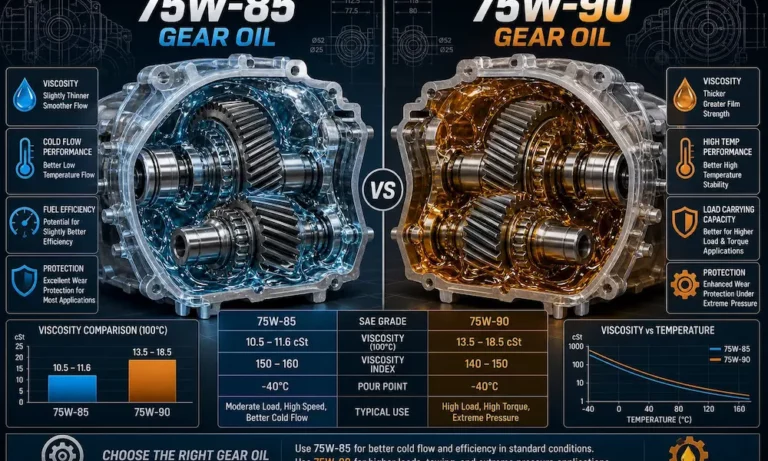
The numbers after the “W” tell you how thick each oil gets at 100°C operating temperature. That’s where they split:
| SAE Grade | Minimum Viscosity at 100°C | Maximum Viscosity at 100°C |
|---|---|---|
| 85 (the “85” in 75W-85) | 11.0 cSt | < 13.5 cSt |
| 90 (the “90” in 75W-90) | 13.5 cSt | < 18.5 cSt |
So a fully sheared 75W-85 could measure 13.2 cSt at 100°C. A fresh 75W-90 starts at 15.4 cSt. You’re looking at a difference of roughly 2–3 cSt under real operating conditions — noticeable to engineers, nearly invisible at the gas pump.
Here’s a quick real-world comparison using products you can actually buy:
| Product | Viscosity at 40°C | Viscosity at 100°C | Viscosity Index | Pour Point |
|---|---|---|---|---|
| Service Pro Full Synthetic 75W-85 | 80.4 cSt | 13.2 cSt | 166 | -49°F |
| Motul Motylgear 75W-85 | 82.6 cSt | 12.6 cSt | 150 | -49°F |
| Red Line MT-85 75W-85 | 62.0 cSt | 12.0 cSt | 198 | -54°F |
| Service Pro Full Synthetic 75W-90 | 100.0 cSt | 15.4 cSt | 163 | -40°F |
Why Did Automakers Switch to 75W-85?
Here’s the honest answer: fuel economy regulations and dealership profits.
The Corporate Average Fuel Economy (CAFE) standards push manufacturers to squeeze efficiency gains from every system — including differentials. Thinner gear oil means less fluid drag inside the differential housing. A fleet-wide improvement of even one percent helps GM, Ford, Toyota, and Ram avoid steep federal penalties.
The second reason is more cynical. 75W-85 is genuinely hard to find at your local parts store. 75W-90, by contrast, sits on every shelf. By specifying an uncommon grade, automakers push owners back to the dealership for routine differential services — at dealership prices.
So no, it’s not purely about your truck’s mechanical needs.
75W-85 vs 75W-90: Which Protects Better Under Stress?
For normal daily driving, 75W-85 is completely adequate. It meets spec, it protects the gears, and it runs cooler.
But crank up the load, and the picture changes.
When you’re towing a heavy trailer or hauling a full payload in August heat, gear oil temperature spikes fast. A thicker 75W-90 film does a better job separating metal surfaces under those conditions. It resists thermal runaway — the destructive cycle where rising temperature drops viscosity, which raises friction, which raises temperature even faster until something fails catastrophically.
Premium synthetic 75W-90 uses wax-free base stocks that flow freely in cold weather while holding viscosity under heat. That low-friction base stock largely cancels out the minor efficiency penalty of the slightly thicker grade. Most real-world drivers won’t notice any fuel economy difference at the pump.
One more thing: synthetic 75W-85 and 75W-90 are fully chemically compatible. Topping off a low differential with the other grade won’t cause separation or damage.
Quick rule of thumb:
- Daily commuting, light loads → 75W-85 (stick to spec)
- Heavy towing, hot climates, off-road use → 75W-90 synthetic (better protection margin)
GL-4 vs GL-5: Don’t Mix These Up
Viscosity grade is only half the story. The API service classification matters just as much — and getting it wrong will destroy your synchronizers.
API GL-4 and GL-5 both use sulfur-phosphorus extreme-pressure (EP) additives. The difference is concentration. GL-5 carries roughly double the EP additive load of GL-4.
Here’s why that matters: under high heat, those sulfur compounds react with copper in brass synchronizer rings. They form copper sulfide crystals — hard, abrasive compounds that eat soft metal surfaces. In a GL-5 fluid, the chemical bond to brass is stronger than the brass’s own internal structure. Every gear shift tears away microscopic layers of the synchronizer ring. Over time, the synchronizer fails to slow the gear, and you get grinding.
GL-5 is also too slippery for synchronizers. They need controlled friction to grab and match speeds. If the oil is too slick, the blocker ring can’t squeeze out the film fast enough, and you get slow, rubbery shifts — or gear clash.
| Feature | API GL-4 | API GL-5 |
|---|---|---|
| Primary use | Manual transmissions with synchronizers | Differentials and hypoid axles |
| EP additive concentration | Moderate (1.5–3.0% S-P compounds) | High (roughly 2× GL-4) |
| Safe for brass/bronze synchronizers? | Yes | No — causes brass stripping |
| Friction for synchronizer engagement | Optimized | Too slippery; causes gear clash |
If your manual transmission calls for GL-4, use GL-4. Red Line MT-85 75W-85 GL-4 is a popular choice that’s chemically safe for yellow metals.
Your differential almost certainly wants GL-5.
Limited-Slip Differentials: An Extra Wrinkle
Many trucks and SUVs that specify 75W-85 run a limited-slip differential (LSD) with spring-loaded clutch packs. As those clutches slip during cornering, they can develop stick-slip vibrations — that harsh chattering or popping sound you’ve probably heard.
LSDs need gear oil blended with friction modifiers to smooth out clutch engagement. Many premium synthetic gear oils already include them, so you won’t need an extra bottle. If your LSD still chatters after a fluid change, a small top-up of a standalone modifier like Motorcraft friction modifier usually fixes it.
For heavily modified trucks with oversized tires, armor, or aftermarket axles, standard gear oil sometimes can’t handle the extra load. You may need a dedicated LSD synthetic like Ravenol DGL 75W-85 GL-5 LS to eliminate binding when turning.
What Does Your Specific Truck Require?
Here’s how the major OEM specs break down:
| Make | Spec Grade | OEM Part/Spec Number | Good Aftermarket Options | Common Applications |
|---|---|---|---|---|
| Toyota / Lexus | 75W-85 GL-5 | 08885-02506 (LT) / 08885-03006 (LX LSD) | Ravenol DGL 75W-85 GL-5, Eurol MTF 75W-85 GL-5 | Tacoma, Tundra, 4Runner, Sequoia, GX460, LX570 |
| General Motors | 75W-85 GL-4 | 19368514 (ACDelco 10-4122 Dexron LV) | Red Line MT-85 75W-85 GL-4 | Silverado, Sierra, Cadillac CT4/CT5 |
| Ford / Lincoln | 75W-85 GL-5 | XY-75W85-QL (WSS-M2C942-A) | Eurol MTF 75W-85 GL-5, Amsoil Severe Gear 75W-85 | F-150, F-150 Raptor, Bronco |
| Ram (front diff) | 75W-85 GL-5 | 68210057AB (Mopar) | Ravenol DGL 75W-85 GL-5, Driven Racing 75W-85 | Ram 1500, Jeep Compass, Grand Cherokee |
| Ram (rear axle) | 75W-90 GL-5 | 68218655AC (MS-9763) | Ravenol LS 75W-90, Royal Purple MaxGear 75W-90 | Ram 1500 rear axle with 3.21 or 3.55 ratios |
Note the Ram split: front differential gets 75W-85, rear axle gets 75W-90. If you’re towing frequently with a 3.92 axle ratio, Ram actually recommends jumping all the way to 75W-140. Always check your specific model year’s owner’s manual.
Will Using 75W-90 Void Your Warranty?
Short answer: no, not legally.
The Magnuson-Moss Warranty Act of 1975 (15 U.S.C. § 2302(c)) makes it illegal for a manufacturer to require you to use their proprietary brand of fluid — unless they provide it free of charge. You can use any aftermarket gear oil that meets the required API classification, including a slightly different viscosity grade like 75W-90 instead of 75W-85.
If a dealer tries to deny a warranty claim because you used an aftermarket synthetic, the legal burden of proof sits entirely on them. They must prove through physical failure analysis that your fluid directly caused the failure — not just that you used a different brand or grade.
Protect yourself with these steps:
- Keep dated, itemized receipts for every fluid change — include mileage, date, and the exact product used
- Verify the fluid meets the required API service class (GL-5 for axles, GL-4 for manual transmissions)
- If a dealer denies a claim verbally, ask for the denial in writing with specific diagnostic evidence
- You can file a complaint with the Federal Trade Commission if a manufacturer unlawfully voids your coverage
How Often Should You Change Gear Oil?
Driveline lubricants break down from heat cycles, mechanical shearing, moisture, and wear particles. Skipping changes leads to gearshift failures and accelerated gear wear.
Typical service intervals:
- Manual transmissions: every 30,000–60,000 miles
- Differentials and final drives: every 50,000–100,000 miles (shorten this for towing, off-road, or commercial use)
When you do change it, a flush machine pulls out over 90% of the old fluid — far better than a gravity drain that leaves degraded oil and debris behind. Always replace the drain plug O-ring and check the magnetic plug for metal debris.
Watch for these warning signs between changes:
- Stiff or notchy shifts — especially during cold starts
- Gear grinding or clashing under load
- Whining or howling from the differential
- A burnt sulfur smell when checking the fluid
- Metal flakes on the magnetic drain plug
If your manual gearbox shifter feels stiff or vague, don’t assume it’s the fluid. Many gearboxes have nylon shift guides under the shifter boot. A shot of white lithium spray grease on those guides once a year can dramatically clean up shift feel without touching the gear oil.
The Bottom Line on 75W-85 vs 75W-90
For normal driving in a daily driver, run the factory-specified 75W-85 and call it done. You stay within OEM spec, you sidestep any warranty disputes, and the efficiency advantage is real at the fleet level.
If you tow regularly, run oversized tires, wheel hard off-road, or live somewhere that bakes in the summer, a quality full-synthetic 75W-90 gives you a meaningful extra layer of protection. The slightly thicker film fights gear scuffing and thermal runaway better than 75W-85 under sustained stress. And because synthetic 75W-90 is widely available and typically costs half what dealerships charge for proprietary 75W-85, you’ll save money too — with the Magnuson-Moss Act backing your warranty rights the entire time.