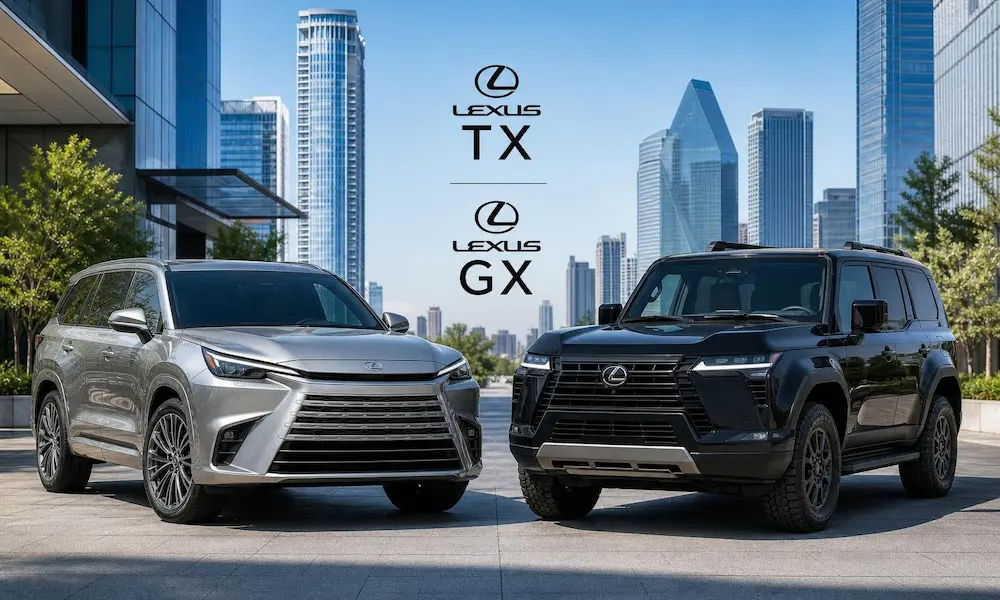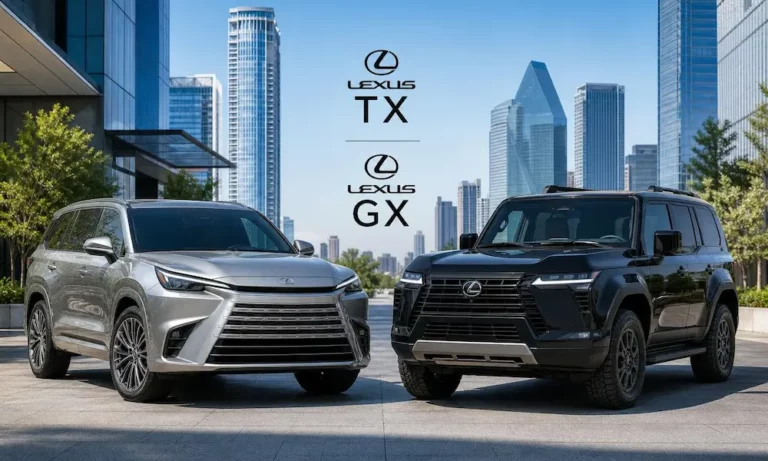
Choosing between the Lexus TX and GX feels like picking between two very different personalities. One’s a polished family hauler, the other’s a trail-ready beast. This guide breaks down exactly what sets them apart — so keep reading to find the right fit.
What Are You Actually Comparing?
The Lexus TX vs GX debate comes up a lot, and it makes sense. Both are premium three-row SUVs from Lexus. But they’re built for completely different buyers.
The Lexus TX runs on a car-based unibody platform. Think smooth highway ride, easy parking, and a cushy interior. The Lexus GX 550 rides on the GA-F ladder-frame platform — the same rugged bones under the flagship LX. That difference alone shapes everything else.
Here’s the short version:
- TX = luxury crossover, family-first, city and suburb friendly
- GX = body-on-frame SUV, off-road capable, tow-ready
Engine and Performance: TX vs GX Head-to-Head
Lexus TX Powertrain
The TX comes in three flavors:
- TX 350 — 2.4-liter turbocharged four-cylinder, 275 hp
- TX 500h — 2.4-liter turbo hybrid, 366 hp combined
- TX 550h+ — plug-in hybrid, 406 hp combined
These engines feel smooth and refined on the highway. The TX 500h is the sweet spot for most buyers — quick enough, efficient enough, and genuinely enjoyable to drive.
Lexus GX 550 Powertrain
The GX 550 gets one engine: a 3.4-liter twin-turbocharged V6 making 349 horsepower and 479 lb-ft of torque. Peak torque hits at just 2,000 RPM — a big deal when you’re hauling a trailer or climbing a steep trail.
The GX hits 0-60 mph in about 6.5 seconds. That’s faster than you’d expect from a body-on-frame SUV.
| Spec | Lexus TX 500h | Lexus GX 550 |
|---|---|---|
| Engine | 2.4L Turbo Hybrid | 3.4L Twin-Turbo V6 |
| Horsepower | 366 hp | 349 hp |
| Torque | 406 lb-ft | 479 lb-ft |
| 0–60 MPH | ~6.0 sec | ~6.5 sec |
| Combined MPG | 28 mpg | 17 mpg |
| Drive System | AWD (unibody) | Full-time 4WD |
The TX wins on fuel economy — by a significant margin. The GX wins on torque and towing. Your priorities decide the winner here.
Towing Capacity: A Clear GX Advantage
If you tow anything — a boat, a trailer, a camper — the GX wins this round without question.
The GX 550 Overtrail and Premium grades tow up to 9,096 pounds. That’s a serious number. Even the lower GX trims manage around 7,600–7,844 lbs.
The TX? It maxes out at around 5,000 pounds. Fine for a small trailer or a jet ski, but not built for heavy hauling.
If towing is part of your regular life, the GX 550 is the obvious pick.
Off-Road Capability: No Contest
This is where the Lexus TX vs GX comparison gets really clear.
The TX is a crossover. It’s got AWD and decent road manners, but it’s not designed for technical off-roading.
The GX was literally built for it.
The GX 550 Overtrail trims feature the Electronic Kinetic Dynamic Suspension System (E-KDSS). This system automatically disengages the stabilizer bars off-road, letting each wheel move independently for maximum traction on uneven ground. On pavement, the bars re-engage to keep body roll in check.
The Overtrail also comes with:
- 33-inch all-terrain tires on 18-inch wheels
- 1-inch suspension lift
- Electronically locking rear differential
- Full-time 4WD with a Torsen limited-slip center differential
- Ground clearance up to 9.84 inches
The TX simply doesn’t operate in this space. If weekend trails are in your plans, the GX is your vehicle.
Interior Space: Surprising Results
Here’s where it gets interesting. The TX is often marketed as the more family-friendly choice — but the GX holds its own.
Passenger Room
The GX’s boxy roofline actually works in its favor. It delivers 43.1 inches of second-row headroom and 35.4 inches of third-row headroom. Those are impressive numbers.
The TX has a lower, sleeker roofline. Second-row passengers get more legroom, but tall adults may feel cramped in the third row.
Cargo Space
The GX’s vertical rear design and flat-folding seats deliver up to 90.5 cubic feet of cargo space in its 5-passenger Overtrail configuration. That’s a massive load floor.
| Cargo Volume | Lexus TX | Lexus GX 550 |
|---|---|---|
| Behind 1st Row (Max) | ~65 cu ft | 76.9–90.5 cu ft |
| Behind 2nd Row | ~34 cu ft | 40.2–45.6 cu ft |
| Behind 3rd Row | ~11 cu ft | 10.3 cu ft |
If you’re hauling gear, the GX wins on raw volume. If you just need a comfortable third row for the kids, either works — though the GX gives taller third-row passengers noticeably more legroom.
On-Road Driving Experience: TX Feels Smoother
Let’s be honest. The TX drives like a luxury car. Its unibody construction absorbs road imperfections quietly. Steering feels light and responsive. City driving is easy and parking isn’t a workout.
The GX drives like a proper truck-based SUV. You feel the road more. It takes wider turns. The ladder frame adds character but also weight and body motion compared to a crossover.
For daily suburban driving — school pickups, grocery runs, highway commuting — the TX feels more natural and effortless.
The GX redeems itself on long highway stretches and rough terrain. The twin-turbo V6 has enough grunt to feel composed at any speed. But in tight parking garages or crowded city streets, its size demands attention.
Infotainment and Technology
Both SUVs bring modern tech to the table, but the GX gets a bigger screen.
GX 550 features:
- 14-inch HD touchscreen
- 12.3-inch digital instrument cluster
- Wireless Apple CarPlay and Android Auto
- Voice-activated Intelligent Assistant
TX features:
- 14-inch touchscreen
- Standard digital cluster
- Wireless Apple CarPlay and Android Auto
- Available panoramic roof
Tech-wise, they’re closely matched. Both offer solid infotainment systems without feeling outdated. The GX gives you additional off-road displays for tilt, pitch, and camera views — useful data on the trail.
Safety Features: Both Get LSS+ 3.0
Good news for either choice. Both the TX and GX come standard with Lexus Safety System+ 3.0, which includes:
- Pre-Collision System with pedestrian and bicycle detection
- All-Speed Dynamic Radar Cruise Control — works down to a full stop
- Lane Tracing Assist — keeps you centered when cruise control is active
- Proactive Driving Assist — gentle braking and steering support in traffic
- Road Sign Assist — displays speed limits and signs on your dash
- Blind Spot Monitor with Rear Cross-Traffic Alert
Both vehicles also include Intuitive Parking Assist with Auto Braking — helpful given how large these SUVs are in traffic.
It’s worth noting that in late 2025, around 127,000 Toyota and Lexus vehicles were recalled due to potential engine debris issues related to the new V6 manufacturing process. If you’re buying a used GX 550 from 2024, verify that the inspection has been completed by a certified Lexus technician.
Pricing: What You Actually Pay
The Lexus TX generally starts lower and offers better value for buyers who don’t need off-road capability or high towing ratings.
Lexus TX Starting Prices (approximate):
- TX 350 — around $57,000
- TX 500h — around $63,000
- TX 550h+ — around $74,000
Lexus GX 550 Starting Prices:
| GX 550 Trim | Starting MSRP | Highlights |
|---|---|---|
| Premium | $67,835 | Base features, 7-passenger |
| Premium+ | $72,300 | 360° camera, heated rear seats |
| Overtrail | $75,480 | AT tires, E-KDSS, 5-passenger |
| Luxury | $80,300 | Semi-aniline leather, massaging seats |
| Overtrail+ | $82,945 | Massaging seats + Overtrail hardware |
| Luxury+ | $84,300 | Mark Levinson audio, panoramic roof |
The TX delivers more for the money if you’re primarily driving on pavement. The GX justifies its premium with serious off-road hardware and towing capability — features you just can’t get from a crossover.
Ownership Benefits: LexusCare
Both the TX and GX include the same LexusCare package:
- Complimentary maintenance for the first two scheduled services
- 24/7 roadside assistance for 4 years with unlimited mileage
- 3-year trials for Remote Connect and Drive Connect navigation
- 4-year/50,000-mile Basic Warranty
- 6-year/70,000-mile Powertrain Warranty
Ownership experience is consistent across the lineup. Whichever you choose, Lexus backs it with solid support.
So Which One Should You Actually Buy?
Here’s the honest breakdown:
Choose the Lexus TX if you:
- Drive mostly on pavement and highway
- Want better fuel economy (especially the 500h or 550h+)
- Prefer a quieter, car-like driving experience
- Don’t tow heavy loads
- Park in tight city garages
Choose the Lexus GX 550 if you:
- Tow trailers, boats, or campers regularly
- Want genuine off-road capability
- Need maximum cargo volume
- Travel with tall adults in the third row
- Value a proven ladder-frame platform built for durability
The Lexus TX vs GX decision really comes down to one question: do you drive mostly on roads, or do you need a vehicle that handles more? Answer that honestly, and the right Lexus SUV becomes obvious.