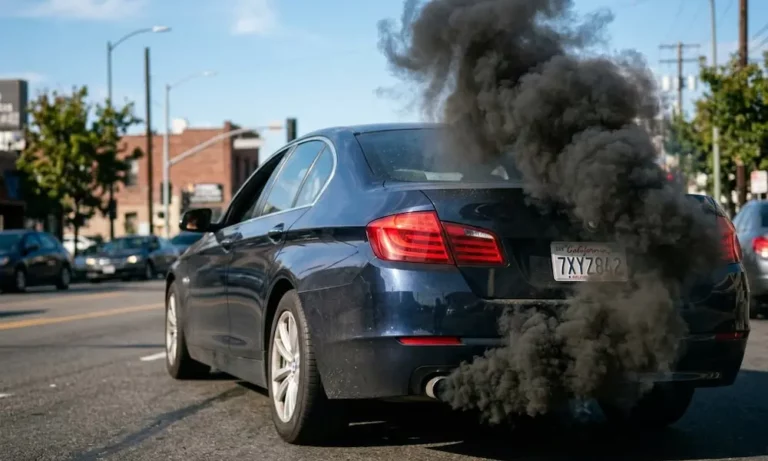
That dark cloud puffing from your tailpipe every time you press the gas pedal? It’s your engine screaming for help. Black smoke from exhaust when accelerating points to one core problem: too much fuel, not enough air. This guide breaks down exactly why it happens, which parts fail, what repairs cost, and how to stay on the right side of your state’s emissions inspector. Read every section — the cost table alone could save you thousands.
Why Your Engine Produces Black Smoke Under Acceleration
When you hit the gas, your engine needs a precise mix of air and fuel to burn cleanly. Push too much fuel in — or starve the engine of air — and incomplete combustion happens.
Here’s what goes wrong at the molecular level:
- Unburned hydrocarbon molecules crack under heat instead of burning completely
- This process leaves behind solid carbon particles
- Those particles exit through your tailpipe as dense black soot
The result isn’t just ugly. Incomplete combustion wastes fuel, kills power, and destroys emissions equipment downstream. Your catalytic converter or diesel particulate filter takes the worst of it.
During hard acceleration specifically, your engine control unit deliberately commands a richer fuel mixture to prevent engine knock. If airflow can’t keep up with that fuel demand, black smoke rolls out.
Gasoline vs. Diesel: Which Engine Smokes More?
These two engine types react very differently to the same conditions.
Gasoline engines run on a tight closed-loop air-fuel feedback system. Sensors constantly trim the mixture to a precise ratio. Because gasoline molecules are lighter and vaporize easily, clean combustion is the norm. Black smoke on a gas engine signals something seriously wrong — a leaking injector, dead spark plugs, or a failed sensor.
Diesel engines run on heavier, carbon-dense fuel molecules that need far more oxygen to burn completely. They operate across a wider air-fuel range, which puts them much closer to soot-producing thresholds by design. Even a small drop in boost pressure or airflow triggers visible black smoke.
| Attribute | Gasoline Engines | Diesel Engines |
|---|---|---|
| Ignition Type | Spark ignition | Compression ignition |
| Fuel Molecule Weight | Light, short-chain hydrocarbons | Heavy, large hydrocarbons |
| Air-Fuel Management | Strict closed-loop sensor control | Wide range, closer to soot threshold |
| Soot Risk | Low — needs serious component failure | High — sensitive to minor airflow drops |
| Primary Downstream Damage | Catalytic converter melts | Diesel particulate filter clogs |
The Parts That Actually Cause Black Smoke From Exhaust When Accelerating
Black smoke traces back to three integrated systems: air intake, fuel delivery, and electronic engine management. Here’s what breaks inside each one.
Air Intake Failures
A clogged air filter is the most common culprit. When debris blocks the filter, the engine can’t pull in enough oxygen to match the fuel being injected. Rich mixture, black smoke — simple cause, cheap fix.
On turbocharged engines, the problem compounds fast:
- Worn compressor shaft seals leak engine oil into the intake stream
- Loose ducting clamps bleed pressurized air before it reaches the cylinders
- Stuck variable geometry turbocharger vanes fail to build boost during acceleration
Fuel Delivery Failures
A stuck-open fuel injector drips raw liquid fuel into the cylinder instead of spraying a fine mist. Liquid fuel doesn’t mix with air properly. It exits as soot.
A failed fuel pressure regulator stuck in the closed position drives rail pressure beyond specification, forcing excessive fuel through every injector on each cycle. On common-rail diesel platforms, even one failing injector distorts cylinder pressures enough to cause serious thermal damage.
Electronic Sensor Failures
Your engine control unit makes thousands of fuel adjustments per minute based on sensor data. Feed it bad data, and it makes bad decisions.
- A contaminated mass airflow sensor underreports incoming air volume — the computer responds by injecting more fuel
- A degraded oxygen sensor stuck reading “lean” fools the computer into the same over-fueling response
The Diesel EGR and DPF Doom Loop
This one’s nasty. The EGR valve recirculates exhaust gas back into the intake to lower combustion temperatures. Over time, soot clogs the valve mechanism and it sticks open. Now exhaust gas constantly displaces fresh oxygen — and your engine runs rich under every load condition.
That excess soot dumps straight into the diesel particulate filter. The filter saturates. Exhaust backpressure climbs. The engine can’t breathe. More incomplete combustion. More black smoke. The loop feeds itself until something expensive breaks.
OBD-II Codes to Watch
| Component | Failure Cause | OBD-II Code | Physical Symptoms |
|---|---|---|---|
| Mass Airflow Sensor | Dirt contamination, circuit failure | P0101, P0102 | Rough idle, hesitation, poor MPG |
| Oxygen Sensor | Carbon coating causing false lean reading | P0172 | Fuel smell, sooty spark plugs |
| EGR Valve | Carbon buildup, stuck open | P0400, P0401 | Knock, rough idle, slow acceleration |
| Diesel Particulate Filter | Soot/ash saturation | P242F | Limp mode, severe power loss |
| Fuel Injectors | Clogged tips, worn seals | P0300 | Misfires, rough idle, oil dilution |
| Turbocharger | Worn bearings, stuck actuator | P0299 | Whining noise, high exhaust temps |
One note on code P0401 — insufficient EGR flow — the fix depends heavily on the platform. Ford diesels commonly point to a damaged vacuum regulator solenoid or reversed sensor hoses. Toyota Prius models typically fail at the electric EGR valve motor itself. Same code, completely different diagnosis path.
What Black Smoke Repairs Actually Cost
Repair costs span a massive range depending on what broke and how long you waited to fix it.
Independent shops charge $80–$120 per hour. Dealerships run $120–$180 per hour. European luxury vehicles and heavy commercial diesel platforms push well beyond those numbers.
| Component / Service | Action | Total Installed Cost (USD) |
|---|---|---|
| Engine Air Filter | Replace filter, clean air box | $25 – $75 |
| Spark Plugs | Replace full set (gasoline) | $100 – $300 |
| Mass Airflow Sensor | Replace sensor, clear codes | $200 – $500 |
| Oxygen Sensor | Replace feedback sensor | $200 – $500 |
| EGR Valve Cleaning | Carbon deposit removal | $120 – $250 |
| EGR Valve Replacement | New valve and gaskets | $400 – $650 |
| Forced DPF Regeneration | Computer-commanded cleaning | $150 – $300 |
| Off-Vehicle DPF Cleaning | Thermal or ultrasonic cleaning | $500 – $1,500 |
| Light-Duty DPF Replacement | Passenger car or light pickup | $1,200 – $3,500 |
| Heavy-Duty DPF Replacement | Class 6–8 commercial trucks | $8,000 – $12,000 |
| Single Fuel Injector | Replace injector and seals | $700 – $1,800 |
| Full Injector Set | Replace all injectors | $2,500 – $6,500+ |
EGR valve replacement costs vary widely by model — from around $243 on a Nissan Altima to over $730 on a Toyota Camry.
For diesel particulate filters, BMW and Mercedes-Benz owners face $3,500–$8,000 at dealerships due to proprietary software requirements and limited aftermarket availability. Ford, Chevy, GMC, and Ram light-duty diesel owners average around $3,500 at dealerships. Independent diesel specialists can often source certified aftermarket units and cut that cost by 20–30%.
Full injector set replacement on a Duramax LMM or LML easily exceeds $5,000 at an authorized shop. A Cummins 5.9 set averages around $3,200. Most reputable diesel shops recommend replacing the full set rather than a single injector — cylinder fuel balance matters that much.
State Emissions Rules and Black Smoke
Black smoke from exhaust when accelerating doesn’t just hurt your engine. It can ground your registration. Here’s how five states handle it.
Connecticut gives you 60 days to repair and retest after a failure. One free retest is included within that window. Miss the deadline and you pay $20 for the test plus a $20 state late fee. Your DMV registration renewal gets blocked until you’re compliant.
Massachusetts runs a two-track system. Heavy diesel vehicles over 10,001 lbs face opacity testing that physically measures smoke density. Lighter vehicles face strict OBD-II readiness standards — only one “not ready” monitor allowed on 2012 and newer models.
New York requires annual OBD-II testing for most 1996 and newer vehicles. Newer 2001+ models get only one “not ready” non-continuous monitor. If you recently cleared codes or disconnected the battery, the car must complete a full cold-start drive cycle — coolant temperature must be below 122°F at the start to validate all sensor self-tests.
Virginia treats visible black smoke with zero tolerance. Any visible exhaust smoke triggers an automatic failure. You get 14 days for a free retest at the original station. Unlike most states, Virginia explicitly prohibits repair waivers for smoke failures — you fix it completely or you don’t drive it.
Wisconsin lets you buy a 30-day temporary plate if your registration expires during the repair window. To qualify for a cost waiver, your vehicle must fail twice, and repairs must come from a certified facility. Any repair performed more than 180 days before the waiver application doesn’t count toward the minimum repair cost threshold.
| State | Testing Method | Repair Window | Free Retest | Waiver Available |
|---|---|---|---|---|
| Connecticut | OBD-II / Opacity | 60 days | Yes — 60 days | Yes — cost, economic, functional |
| Massachusetts | OBD-II / Opacity | 60 days | Yes — 60 days | Yes — cost and economic |
| New York | OBD-II self-test | 10-day extension | Yes — 10 days | Limited cost waiver |
| Virginia | OBD-II / Visible smoke | 14 days | Yes — 14 days | Prohibited for smoke failures |
| Wisconsin | OBD-II self-test | 30-day temp plate | Yes — 30 days | Repairs must be under 180 days old |
How to Prevent Black Smoke From Exhaust When Accelerating
Prevention costs a fraction of what repairs do. These habits keep the smoke away.
Replace your air filter regularly. Every 15,000–30,000 miles under normal conditions. Drop that to 12,000 miles if you drive in dusty or high-pollen environments. A clean filter is the single cheapest thing standing between you and a rich running condition.
Use Top-Tier certified fuel. Independent testing shows vehicles run consistently on Top-Tier fuel generate up to 19 times fewer carbon deposits on injectors and combustion surfaces compared to standard fuels. For diesel owners, a quality fuel system additive every 5,000–10,000 miles helps dissolve injector tip deposits before they restrict spray patterns.
Give your diesel a proper highway run. Short city trips don’t get exhaust temperatures high enough to trigger passive DPF regeneration. Soot builds up fast. Drive at highway speeds for 20–30 minutes at least once a week to burn off accumulated carbon and extend filter life.
Act on the first warning sign. A raw fuel smell under acceleration or a check engine light during hard driving isn’t something to postpone. Waiting to run a diagnostic scan and read live fuel trim data turns a $200 sensor replacement into a $3,500 catalytic converter or DPF replacement. The math on acting fast is obvious.