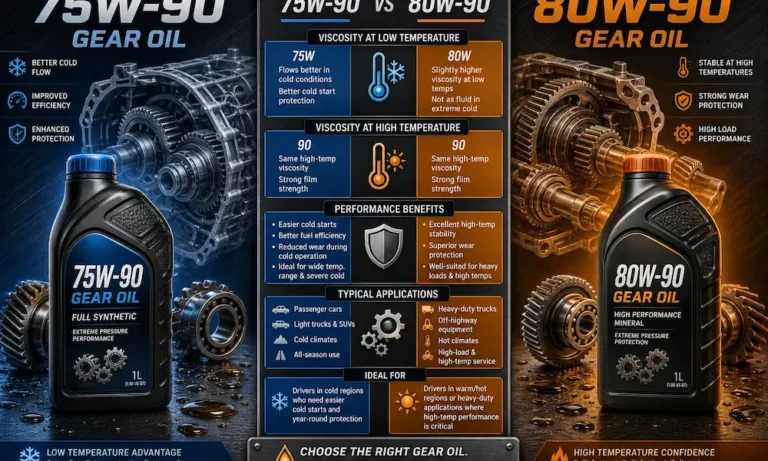
Picking the wrong gear oil can silently destroy your differential, shred synchronizers, or leave your bearings bone-dry on a cold morning. The difference between 75W-90 and 80W-90 isn’t just a number swap — it’s chemistry, temperature physics, and real money. Read this before you pop that fill plug.
What Those Numbers Actually Mean
The numbers on gear oil aren’t random. They follow the SAE J306 standard, which defines viscosity requirements specifically for axles and manual transmissions — a completely different scale from engine oil.
Here’s how to read the label:
- The “W” number (75W or 80W) = winter cold-flow rating
- The number after the W (90) = hot operating viscosity at 212°F (100°C)
- Both oils share the same 90-weight hot viscosity — that’s the key detail most people miss
The cold rating tells you the lowest temperature at which the oil stays thin enough to flow. The SAE J306 standard sets a hard limit of 150,000 centipoise — beyond that threshold, cold, stiff oil channels through your gears instead of coating them, leaving metal surfaces completely unprotected during startup.
| SAE Grade | Max Temp for 150,000 cP | Min KV at 100°C | Max KV at 100°C |
|---|---|---|---|
| 75W | -40°C / -40°F | 3.8 cSt | — |
| 80W | -26°C / -14.8°F | 8.5 cSt | — |
| 90 | — | 13.5 cSt | <18.5 cSt |
Testing per ASTM D2983 (cold Brookfield) and ASTM D445 (hot kinematic viscosity)
So 75W-90 flows freely down to -40°F. The 80W-90 only guarantees flow down to -14.8°F. That gap matters enormously if you live anywhere that gets a real winter.
The Cold-Start Problem: Where 80W-90 Falls Short
This is where 75W-90 clearly wins against 80W-90 in cold climates.
When you start your truck on a freezing morning, your differential gears start spinning immediately. The oil needs to reach pinion bearings, carrier bearings, and gear meshes within seconds. A 75W-90 synthetic does exactly that — it’s thin enough to migrate through the housing fast.
An 80W-90 conventional oil in cold weather is sluggish and thick. It delays lubrication delivery to the pinion nose bearing, which sits high in the differential housing and relies on gear sling to get splash lubrication. During that cold-start delay, your bearings run metal-on-metal — causing microscopic galling and surface fatigue every single time you start the vehicle.
Manual transmission drivers feel this too. Cold 80W-90 resists synchronizer rings, making gear shifts stiff and grindy until everything warms up.
The efficiency penalty is real. Gear churning losses — the drag from gears spinning through thick oil — eat directly into fuel economy. A thinner 75W-90 cold start cuts those parasitic losses significantly, which is why synthetic 75W-90 is the recommended fluid for EV drivetrains like the Tesla Model 3’s differential.
Where 80W-90 Still Wins
Don’t write off 80W-90 just yet. In specific situations, conventional 80W-90 actually outperforms synthetic 75W-90.
Physical cling under load. Conventional mineral oils have a higher pressure-viscosity coefficient than synthetic polyalphaolefins. That means 80W-90 sticks to hot gear teeth better under load — it doesn’t sling off as easily under centrifugal force. When you lift off the throttle, that lingering oil film cushions the next power application and actually dampens gear noise.
Water resistance. Axle housings collect moisture from condensation and water crossings. Conventional 80W-90 naturally separates from water — it demulsifies cleanly, letting water settle harmlessly to the bottom of the housing. Many synthetic base oils emulsify with water instead, turning the lubricant into a milky fluid with zero load-carrying capacity. That leads to pitting and bearing failure fast.
New gear break-in. This one surprises a lot of people. New ring and pinion gear sets need a controlled wear-in period — typically the first 500 miles — where microscopic high spots wear down to establish a proper contact pattern. Synthetic 75W-90 is often too slippery for this process, preventing the gears from seating correctly and causing them to skid instead of mate.
During break-in, differentials regularly run at 250–275°F as the protective phosphate coating wears off new gears, turning the oil gray and filling it with metallic particles. You drain and discard this fluid anyway. Using cheap conventional 80W-90 for break-in — then switching to synthetic 75W-90 afterward — is both technically correct and cost-effective.
| Operating State | Normal Temp Range | Max Threshold |
|---|---|---|
| Standard service | 170–220°F | 250°F |
| Heavy towing / severe load | 200–250°F | 275°F |
| New gear break-in | 250–275°F | 300°F |
Field tolerances for domestic truck and utility differentials
Synthetic vs. Conventional: What’s Inside the Bottle
The cold-temperature gap between these two oils comes down to base oil chemistry.
To flow at -40°F while still holding a 90-weight hot viscosity, 75W-90 formulations require advanced synthetic base stocks — API Group III (hydrocracked petroleum), Group IV (polyalphaolefins), or Group V (synthetic esters). These engineered molecules are uniform and fully saturated, which makes them resistant to thermal breakdown and oxidation.
Standard 80W-90 uses conventional Group I or II mineral oils — refined directly from crude oil, with a mix of ring-shaped hydrocarbons, sulfur traces, and paraffins. Less uniform structure means more vulnerability to heat-driven oxidation, sludge, and oil thickening over time.
Here’s the practical comparison:
| Property | Synthetic 75W-90 | Conventional 80W-90 |
|---|---|---|
| Base Oil Group | Group III, IV, or V | Group I or II |
| Brookfield Viscosity at -40°C | 75,000–135,000 cP | Solid / non-measurable |
| Kinematic Viscosity at 100°C | 15.0–18.4 cSt | 13.5–15.0 cSt |
| Viscosity Index | 145–161 | 95–105 |
| Pour Point | -39°C to -51°C | -26°C to -30°C |
| Shear Stability | Excellent | Moderate |
That Viscosity Index number is telling. A higher VI means the oil changes viscosity less as temperature swings. Conventional 80W-90 compensates for its low VI by loading up on polymeric viscosity index improvers — long polymer chains that get physically torn apart under hypoid gear stress over time. This permanent shear thinning permanently lowers hot viscosity and reduces film protection.
Synthetic 75W-90 doesn’t rely on those polymer chains — it holds its viscosity grade through mechanical stress. That’s why commercial synthetic gear oils can meet extended drain intervals up to 500,000 km (roughly 310,000 miles) in line-haul trucking.
GL-4 vs. GL-5: The Chemical Spec That Matters More Than Viscosity
Here’s the truth most people skip: getting the additive classification wrong will destroy your gearbox faster than the wrong viscosity grade.
The API classifies gear lubricants from GL-1 to GL-5. GL-4 and GL-5 are the relevant options for modern vehicles. Both use sulfur and phosphorus extreme-pressure compounds that react with iron surfaces under heat to form a sacrificial boundary layer. The difference is concentration.
GL-5 contains roughly twice the EP additive concentration of GL-4. That’s essential for hypoid differentials — the kind used in virtually all modern automotive rear axles — where significant axis offset creates intense sliding contact under load. Without GL-5 chemistry, hypoid gears score and fail quickly.
The problem? That aggressive sulfur-phosphorus chemistry is chemically corrosive to yellow metals — brass, bronze, and copper. Manual transmissions rely on brass and bronze synchronizer rings to enable smooth shifts. GL-5 additives physically eat those synchronizers by bonding so strongly to copper alloys that meshing gears shear away metal instead of oil film. The result: accelerated synchro wear, poor shift quality, high copper readings in oil analysis, and eventual gearbox failure.
The rule is straightforward:
| Application | Correct Spec | Wrong Spec |
|---|---|---|
| Manual transmission (brass synchros) | GL-4 | GL-5 — corrodes synchronizers |
| Hypoid rear differential | GL-5 or SAE J2360 | GL-4 — causes gear face scoring |
| Agricultural wet brake axles | Specialized UTF fluids (John Deere J20C, Case Hy-Tran) | Standard gear oil — causes brake chatter |
For military and heavy commercial applications, the SAE J2360 standard supersedes MIL-PRF-2105E and adds rigorous testing including ASTM D7038 for moisture corrosion resistance and ASTMD8165 for low-speed, high-torque wear protection.
Which Oil Goes in Your Vehicle
Use synthetic 75W-90 if:
- You live in a region with cold winters (below 0°F regularly)
- You drive a modern passenger car, light truck, or SUV with a manufacturer spec calling for it
- You’re running a high-efficiency drivetrain or EV differential
- You want extended drain intervals and long-term gear protection
- Your axle is a GM 10-Bolt, GM 12-Bolt, Ford 8-inch, Ford 9-inch, Dana 30, or Dana 60 in a cold climate
Use conventional 80W-90 if:
- You’re doing a 500-mile break-in on a new or rebuilt gear set
- You operate in a warm climate with no sub-zero temperature risk
- You run heavy agricultural or construction equipment subject to frequent fluid changes
- Your axle frequently encounters water crossings or moisture contamination
- You’re maintaining older domestic trucks and farm equipment where the OEM spec calls for it
Always match the GL rating to your hardware — not just the viscosity. Running GL-5 in a synchronized manual transmission is one of the most common and expensive drivetrain mistakes people make. Check your owner’s manual or differential tag first.
The viscosity numbers matter. The chemistry matters more. Get both right, and your drivetrain will outlast everything else on the vehicle.