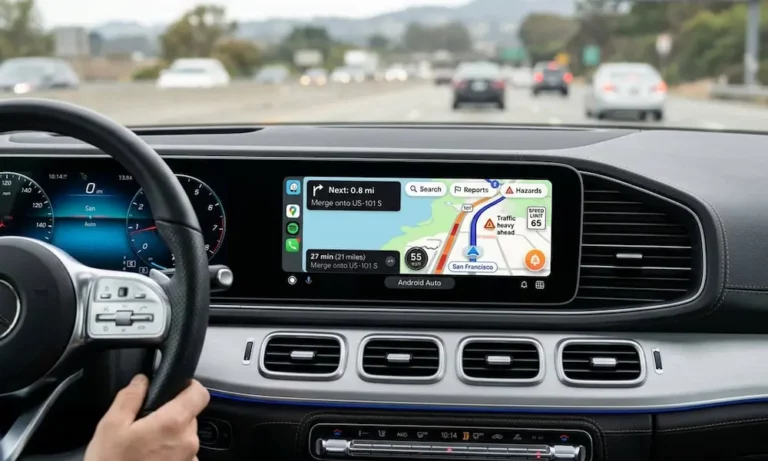
Android Auto not connecting is one of the most frustrating things that can happen before a drive. Whether it’s a blank screen, a dropped wireless signal, or a phone that just won’t talk to your car — you’re in the right place. This guide covers every real fix, from bad cables to hidden software bugs. Read to the end because the solution might surprise you.
Start Here: Is It the Cable?
Most people blame their car or phone first. Nine times out of ten, it’s the cable.
By 2026, Android Auto needs serious bandwidth to push high-resolution maps and navigation to your car’s screen. That old charging cable stuffed in your glovebox? It probably can’t handle it.
You Need a USB 3.2 Gen 2 Cable
Here’s the honest truth: older USB 2.0 or early USB 3.0 cables simply lack the internal architecture to support modern Android Auto. They might charge your phone just fine, but data transfer is a different story.
Here’s what your cable needs to be in 2026:
| Cable Characteristic | What You Need | Why It Matters |
|---|---|---|
| Standard | USB 3.2 Gen 2 | Handles 4K map rendering |
| Shielding | Multi-layer foil | Blocks electrical noise from your engine |
| Length | 3 feet max | Longer cables lose signal integrity |
| Certification | USB-IF Certified | Guarantees it meets data transfer specs |
| Connector | Reinforced USB-C | Survives vibration without losing connection |
Keep your cable under three feet. Signal attenuation gets worse beyond six feet, and a poor signal means constant drops.
Clean Your USB Port First
Before you buy anything, check your port. Lint from your pocket is one of the most common physical reasons Android Auto won’t connect. It creates a tiny barrier that blocks the data handshake — even if your phone still charges.
Here’s how to clean it safely:
- Compressed air — Best option. Blow out loose debris without touching the pins.
- Wooden or plastic toothpick — For stubborn buildup, gently scrape debris out.
- Isopropyl alcohol on a cloth — Fine for the outside casing, never inside the port.
Never use metal objects. A pin or needle can short the pins or permanently bend them.
Also check if the port feels loose. A port that’s lost spring tension will drop connection every time you hit a bump. If that’s your situation, a wireless adapter is your best long-term fix.
Android 16 Broke Things — Here’s What Happened
If your Android Auto stopped working after a software update, you’re not imagining it. Android 16 introduced security changes that disrupted the connection handshake between phones and cars.
Advanced Protection Mode Is Blocking Your Connection
Android 16 added a security feature that locks down USB data transfers when your phone hasn’t been unlocked yet. Even if you’ve set Android Auto to start while locked, the system may still block it after a reboot.
This is called the Before First Unlock (BFU) state. Your phone boots up, connects via Bluetooth, but refuses to send data until you physically unlock it.
The fix:
- Set your car as a Trusted Device in your phone’s security settings
- Make sure “Start Android Auto while locked” is toggled on
- After any reboot, unlock your phone manually before plugging in
It’s annoying, but until Google patches it fully, this is the workaround.
Battery Optimization Is Killing the Connection
Android’s power management now treats Android Auto as a system service. That sounds good, but the OS can still decide to throttle or hibernate it to save battery — especially if your phone runs warm.
The result? Your connection drops after a few minutes, or navigation becomes laggy.
Set these apps to Unrestricted in battery settings:
| App / Setting | What to Set It To | Why |
|---|---|---|
| Android Auto (Gearhead) | Unrestricted | Stops the OS hibernating the projection engine |
| Google Play Services | Unrestricted | Keeps authentication running in the background |
| Adaptive Battery | OFF | Prevents the OS overriding your manual settings |
| Adaptive Connectivity | OFF | Stops radio power cycling that kills Wi-Fi tunnels |
| Intelligent Wi-Fi | OFF | Prevents smart-switching from disrupting car signals |
Go to Settings → Apps → Android Auto → Battery → Unrestricted. Do the same for Google Play Services and Google Maps.
Wireless Android Auto Keeps Dropping? Read This
Wireless connections fail for different reasons than wired ones. The process works in two stages: first a Bluetooth handshake, then a jump to a 5GHz Wi-Fi Direct channel. If either stage breaks, you lose the whole connection.
Other Devices Are Interfering
If your smartwatch or headphones are actively connected via Bluetooth when you start the car, they can block the Wi-Fi Direct migration. Same goes for a home Wi-Fi network your phone auto-connects to while you’re still in the driveway.
Quick fixes:
- Disable auto-connect for home Wi-Fi networks
- Disconnect headphones or smartwatches before starting the car
- Turn off Wi-Fi, wait five seconds, then turn it back on before connecting
You Might Be Hitting a Radar Conflict
This one sounds strange, but it’s real. Wireless Android Auto uses 5GHz Wi-Fi, and some of those channels (called DFS channels) are shared with weather radar systems. By law, your device must instantly abandon a DFS channel if it detects radar activity.
If your connection always drops in the same spot — near an airport, a storm monitoring station, or a dense urban area — this is likely why.
The fix: In your wireless adapter or head unit settings, lock the Wi-Fi to non-DFS channels (36–48). These channels are more stable because they’re not subject to radar-evasion rules.
Phone-Specific Fixes by Brand
Android Auto not connecting doesn’t look the same on every phone. Your manufacturer’s software might be the whole problem.
Samsung Galaxy S26
Samsung’s SmartThings and SmartView apps can intercept the vehicle handshake. Your phone connects via Bluetooth but never launches the Android Auto interface.
Fix: Open SmartThings → disable Easy Connection. If that doesn’t work, uninstall the app entirely.
Google Pixel (7 through 10 Pro)
Pixel devices have an Adaptive Connectivity feature that switches between 5G bands and Wi-Fi networks to optimize performance. In a car, this switching interrupts the Wi-Fi Direct tunnel and causes random freezes or disconnects.
Fix: Go to Settings → Network & Internet → Adaptive Connectivity → Toggle OFF. Many Pixel users call this the “magic fix.”
OnePlus
The initial OxygenOS 16 rollout caused a persistent connect-disconnect loop on wireless setups. It was a bug in the Wi-Fi Direct driver.
Fix: Update your firmware to version 16.0.2.401 or higher. Check Settings → System → Software Update.
| Phone Brand | Problem Feature | Fix |
|---|---|---|
| Samsung | SmartThings / Easy Connection | Disable Easy Connection or uninstall SmartThings |
| Google Pixel | Adaptive Connectivity | Toggle OFF in Network & Internet |
| OnePlus | OxygenOS 16 Wi-Fi driver bug | Update to firmware 16.0.2.401+ |
| Motorola | Hinge/unfold logic | Unfold and unlock phone before connecting |
What Those Error Codes Actually Mean
Don’t ignore error messages — they tell you exactly what’s wrong.
Error 8: Time Sync Failure
Android Auto requires the car’s clock and your phone’s clock to match for encryption to work. Even a slight mismatch causes a rejected connection.
Fix: Set both your phone and car to Automatic date and time.
Error 16: Dual App or Cloned App Conflict
If you use a cloned WhatsApp, a Secure Folder, or any duplicated app, Android Auto detects multiple app user IDs and crashes trying to decide which one to use.
Fix: Disable cloned or duplicated apps before connecting.
Error 22: VPN Blocking Local Traffic
A VPN routes your traffic through a remote server. Wireless Android Auto needs a direct local Wi-Fi connection to your car, and a VPN can hide the car from your phone entirely.
Fix: Open your VPN app and enable Split Tunneling. Exempt Android Auto and Google Play Services from the VPN tunnel. Or just disable the VPN while driving.
Reset Options When Nothing Else Works
Hard Reset Your Infotainment System
Many modern cars (Toyota RAV4, Honda models) keep the infotainment in a fast-boot sleep mode when you turn off the engine. A regular restart doesn’t clear the system cache.
Fix: Press and hold the physical power button or volume knob on your dashboard for 3–15 seconds until the manufacturer logo appears. That’s a true hard reset.
Clear Android Auto’s App Data
Go to Settings → Apps → Android Auto → Storage → Clear Cache. Still broken? Hit Clear Storage too.
Clearing storage removes your saved cars and settings, so you’ll set it up fresh. It’s the nuclear option, but it works for persistent software loops.
Change the Default USB Configuration
This is a hidden fix most people never find. Your phone defaults to “Charging Only” mode when plugged in — for security. If the car can’t negotiate a data connection fast enough, the phone stays in charging mode and Android Auto never launches.
Fix:
- Go to Settings → About Phone → Build Number — tap it 7 times to unlock Developer Options
- Go to Settings → Developer Options → Default USB Configuration
- Set it to File Transfer / Android Auto
Now your phone sends data the moment it connects, skipping the slow negotiation.
Keep It Working: Monthly Maintenance
| Frequency | Task | Purpose |
|---|---|---|
| Monthly | Clean USB ports | Remove lint and dust before it blocks the connection |
| Monthly | Check for app updates | Keep Android Auto, Maps, and Play Services current |
| Quarterly | Clear app cache | Flush corrupted Gearhead temp files |
| Annually | Replace USB cable | Internal wire fatigue is real after 12 months |
| As needed | Hard reset infotainment | Clears system cache when things feel sluggish |
A little maintenance goes a long way. Most android auto not connecting issues that seem random are actually the result of slow cable degradation or a bloated cache that built up over months.
One Last Thing for EV Drivers
If you drive an EV, Android Auto is your primary tool for finding NACS-compatible chargers and preconditioning your battery before you arrive. A broken connection isn’t just inconvenient — it affects your range planning and charging efficiency.
Make sure Google Maps is updated and filtered for NACS plug types in your app settings. And if Gemini AI is causing your screen to lag or freeze, update the Google app to version 16.5 or higher and disable AI Message Summaries if your phone is mid-range or older.
Android Auto not connecting is fixable in almost every case. Start with the cable, work through the software settings, and match the fix to your phone brand. You’ll be back on the road with a working connection faster than you think.