Your engine dies in traffic on a hot day. You try to restart it — nothing. Sound familiar? Vapor lock might be your problem, and the right fuel additive to prevent vapor lock can fix it before it strands you again. Keep reading to find out exactly which additives work and why.
What Is Vapor Lock, Exactly?
Vapor lock happens when your fuel turns from a liquid into a gas inside the fuel lines before it reaches the engine. Your fuel pump is built to push liquid, not gas. Once bubbles form, the pump loses pressure, fuel flow stops, and your engine starves.
You’ll notice it most on hot days, right after shutting off a warm engine, or when sitting in slow traffic. Older carbureted vehicles are hit hardest because their fuel pumps sit in the engine bay, right where heat is worst.
Modern fuel-injected cars avoid this almost entirely. They use electric pumps inside the fuel tank that keep the whole system under positive pressure. That pressure raises the fuel’s boiling point, keeping it liquid even above 200°F. Older systems don’t have that advantage.
Why Modern Gas Makes Vapor Lock Worse
Here’s something most people don’t realize. Today’s gasoline is actually more prone to causing vapor lock in older engines, not less.
Modern fuel is formulated for fuel-injected engines with pressurized systems. When you put that same high-volatility fuel into a carbureted engine with a low-pressure mechanical pump, you’re asking for trouble.
Ethanol makes it worse. Adding just 10% ethanol to gasoline raises the Reid Vapor Pressure by about 1 psi. That might sound small, but it makes your fuel roughly 10% more likely to vaporize under heat stress. Ethanol also absorbs moisture from the air. If enough water builds up, phase separation occurs — the water and ethanol sink to the bottom of your tank, the remaining gas loses stability, and your boiling point becomes completely unpredictable.
The Seasonal Fuel Problem Nobody Talks About
The EPA requires refiners to adjust fuel volatility by season. Winter blends contain extra butane to help cold starts. They can hit 15 psi vapor pressure. Summer blends cap out around 7–9 psi to reduce smog.
The danger zone? Spring. If your tank still holds winter-grade fuel when the first warm days hit, that high-volatility blend will start boiling at temperatures that would be perfectly safe for summer gas.
| Fuel Blend | Reid Vapor Pressure | Risk Period |
|---|---|---|
| Winter Blend (12–15 psi) | Highest | Unseasonably warm spring days |
| Transition Blend (9–12 psi) | Moderate | Early spring, late fall |
| Summer Blend (7–9 psi) | Lowest | Peak summer heat |
Lesson: burn through your winter fuel before April, especially if you’re in the South.
How a Fuel Additive to Prevent Vapor Lock Actually Works
Not all fuel additives do the same job. The ones that actually fight vapor lock work through three different mechanisms. Knowing which one you need helps you pick the right product.
Antioxidants and Stabilizers: Keep the Fuel Fresh
Gasoline degrades over time. Oxygen reacts with fuel molecules to form gum and varnish deposits. These deposits create tiny impurity sites inside your fuel lines that act as bubble-starters when the fuel heats up. More bubbles mean faster vapor lock.
Antioxidants — compounds like phenylenediamines — stop this oxidation before it starts. They keep your fuel at its original volatility spec, so it behaves predictably even in heat. If your car sits for more than three weeks, a fuel stabilizer isn’t optional — it’s essential.
Surfactants: Break Up Bubbles Before They Block Flow
This is where the real chemistry gets interesting. Surfactant-based additives don’t stop your fuel from heating up. Instead, they change what happens when it does.
Surfactants sit at the boundary between liquid fuel and forming vapor bubbles. They reduce surface tension at that boundary, which does three important things:
- Stops bubble coalescence — tiny micro-bubbles stay small instead of merging into one big blockage
- Balances internal bubble pressure — prevents explosive vapor pocket growth
- Triggers the Marangoni effect — liquid automatically flows back to thin spots in the bubble wall, keeping the film intact
The result? Even if your fuel starts to boil, the vapor stays dispersed instead of forming a solid gas plug. Your pump can still push that mixture through.
Detergents: Remove the Heat Traps
Carbon deposits on injector tips and intake valves act as insulation. When you shut off a hot engine, heat soaks upward from the block. Deposits trap that heat right next to your fuel lines, pushing temperatures even higher.
High-quality detergent additives containing Polyether Amine (PEA) strip those deposits away. Clean metal transfers heat away from the fuel much faster. Cleaner injectors also atomize fuel better, which helps cool the mixture as it enters the intake — a small but real bonus during hot restarts.
The Best Fuel Additives for Vapor Lock Prevention
Here’s how the main commercial categories stack up:
| Product Type | Top Brands | What It Does | Best Situation |
|---|---|---|---|
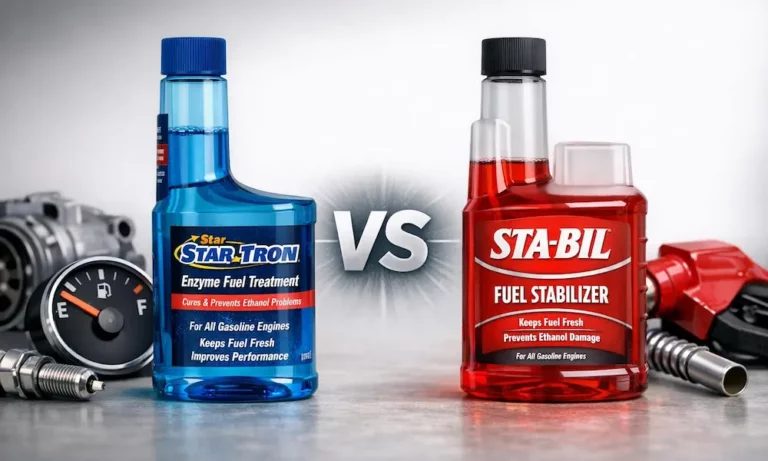
| Fuel Stabilizer | Sta-Bil, PRI-G | Prevents gum formation, locks in volatility | Classic cars, boats, stored equipment |
| Ethanol Defense | StarTron, Lucas Safeguard | Disperses water, stops phase separation | Daily drivers using E10 or E15 fuel |
| System Detergent | Red Line SI-1, Chevron Techron | Cleans deposits, reduces heat soak | High-mileage engines, hot-start problems |
| Pre-Mixed Fuel | VP Racing, TruFuel | Ethanol-free, stable base fuel | Chainsaws, trimmers, small air-cooled engines |
| Traditional Heavy Additive | Marvel Mystery Oil | Raises boiling point, lubricates upper cylinders | Vintage carbureted engines, flatheads |
For most daily drivers running E10 fuel, a combination approach works best. Use an ethanol defense product regularly and do a full detergent clean once or twice a year.
The Old-School Fix: Heavy-End Blending
If you own a pre-1953 vehicle or a low-compression flathead engine, traditional heavy-end blending still works. Adding a small amount of diesel, kerosene, or mineral spirits to your gas tank raises the average boiling point of the entire mixture.
A half-pint of mineral spirits per five gallons is a well-documented starting dose for flathead Fords and similar engines. Keep the amount conservative — too much reduces octane and leaves carbon deposits.
Don’t use this in modern high-compression or turbocharged engines. The drop in octane rating can cause knocking.
What to Do When Vapor Lock Hits Right Now
Even with the best fuel additive to prevent vapor lock, a bad enough heat event can still catch you. Here’s the fastest way out:
- Pull over and pop the hood. Get out of traffic, park in shade if possible, and let the engine compartment breathe.
- Wait it out. Natural convection will cool the fuel lines in 10–20 minutes.
- Speed it up with cold water. Pour cold water directly over the fuel pump, fuel lines, and carburetor. The vapor condenses back to liquid almost immediately.
- Restart with a light foot. Press the accelerator about one-third of the way down while cranking. This opens the throttle so the engine draws in more air and pushes vapor pockets through. Don’t pump the pedal repeatedly — you’ll flood the engine.
- Hold a fast idle for 30 seconds. This flushes remaining vapor with fresh cool fuel from the tank.
Regional Strategy: Where You Live Changes What You Need
The U.S. covers a huge range of climates. Your vapor lock prevention plan should match your geography.
High altitude (Colorado, Nevada, mountain West): Thin air lowers atmospheric pressure, which drops your fuel’s boiling point. Even summer-grade fuel can cause problems. An electric in-tank fuel pump is worth installing on any carbureted engine you drive here regularly. Focus on system cleanliness so the pump doesn’t fight restrictions.
Southern states (Texas, Florida, the Gulf Coast): Your biggest risk is the spring transition window. Burn through winter fuel before heat season starts. Keep a bottle of stabilizer and a dose of Marvel Mystery Oil ready for warm spells in March and April.
Small engine users everywhere: Lawn mowers, chainsaws, generators — these air-cooled engines have no liquid cooling to buffer heat. They’re extremely vulnerable to vapor lock. Use ethanol-free pre-mixed fuel whenever you can, and add stabilizer to every tank if you’re storing fuel for more than a few weeks.
Aviation: When Vapor Lock Becomes a Safety Issue
Vapor lock isn’t just an inconvenience in aircraft — it’s a documented cause of forced landings. Aircraft climb thousands of feet in minutes, and lower air pressure at altitude dramatically drops the fuel boiling point.
Aviation fuel (Avgas) meets far stricter volatility specs than automotive gasoline. Aircraft also use electric booster pumps near the fuel tanks to maintain positive pressure throughout the system. Aviation-specific additives include static dissipaters — critical because a vapor pocket in a fuel line can ignite from static electricity generated by fast-moving fuel. That’s a very different category of problem than a stalled car.
Keeping Your Fuel Strategy Simple
You don’t need a chemistry degree to beat vapor lock. Pick the right tool for your situation:
- Storing anything seasonal? Grab a fuel stabilizer. Use it every time.
- Running E10 in an older vehicle? Add an ethanol treatment regularly.
- Dealing with hard hot starts or power loss in traffic? Run a PEA-based cleaner like Red Line SI-1 or Chevron Techron every 10,000–15,000 miles.
- Driving a vintage carbureted car in summer? Consider heavy-end blending or Marvel Mystery Oil as a seasonal addition.
The right fuel additive to prevent vapor lock isn’t a single magic product. It’s a combination that matches your engine, your climate, and your fuel. Start with the biggest risk factor in your situation and build from there.