You’re staring at worn shocks and wondering if Bilstein’s premium price tag is worth it. Let’s cut through the marketing speak and dig into what actually makes these yellow (or zinc) cylinders different—and whether they’re the right choice for your specific ride.
What Makes Bilstein Different from Other Shocks
Bilstein didn’t just wake up one day and decide to paint shocks yellow. The company’s been perfecting damping technology since they introduced the first monotube gas-pressure shock in 1957. That’s not just history—it’s engineering DNA.
Here’s the core difference: most budget shocks use a twin-tube design. Bilstein’s reputation rides on monotube gas-pressure architecture. Instead of trapping oil between two tubes (which overheats and foams under stress), Bilstein separates oil from a 360-psi nitrogen chamber using a floating piston.
Why does this matter to you? The monotube design keeps oil temperature stable even when you’re towing through mountains or hitting washboard roads repeatedly. Twin-tubes lose damping force when hot—that mushy, floaty feeling you get after hard use. Bilstein’s don’t.
The larger working piston (46mm in most truck applications, 60mm in performance models) also means more precise control. More surface area equals better valving accuracy and lower internal pressure for the same damping force.
The “Bilstein Feel”: Understanding Digressive Valving
You’ll see people describe Bilstein as “firm” or “sporty.” That’s not some vague marketing term—it’s the direct result of digressive valving.
Shock valving determines how damping force changes as the shaft moves. Most shocks are linear (force increases steadily) or progressive (starts soft, gets firmer). Bilstein goes the opposite direction: high resistance at low speeds, controlled resistance at high speeds.
What this means when you’re driving:
Low-speed movements (steering, braking, acceleration): The shock resists hard. Your truck doesn’t wallow in corners or nose-dive when braking. Trailers don’t sway. You feel connected to the road.
High-speed impacts (potholes, ledges): The valving has a “blow-off” mechanism that lets the wheel absorb the hit without slamming the chassis.
The trade-off? Small, sharp bumps like expansion joints can feel harsher than softer competitors. You’re getting road feedback instead of isolation. Some drivers love this communication. Others find it too busy for daily comfort.
Bilstein’s Passenger Car Lineup: B4, B6, and B8 Explained
Bilstein’s “B” series confuses a lot of people. Here’s the breakdown without the corporate jargon:
B4: The Restoration Option
The B4 series brings your car back to showroom specs—nothing more, nothing less. If your car came with a twin-tube shock, the B4 is a twin-tube. If it came with monotube, B4 is monotube.
This is for drivers who want to restore original handling without modification. Though interestingly, VW and BMW owners report the B4 feels about 10% firmer than worn OEM units—a subtle handling improvement without sacrificing comfort.
B6: Performance Without Lowering
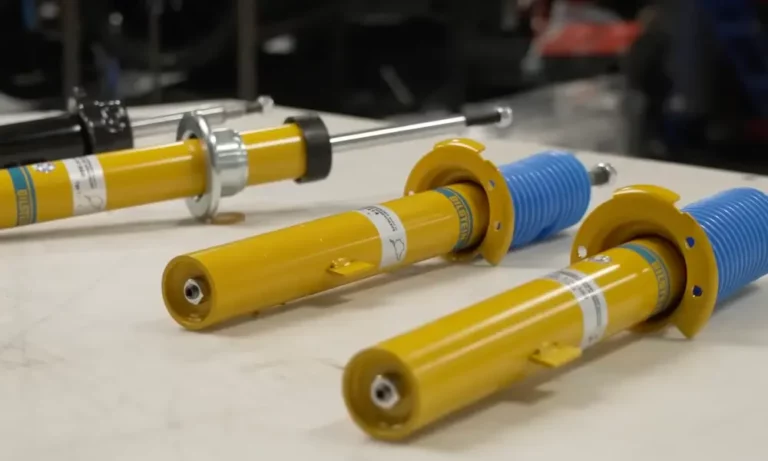
The B6 Performance (yellow body, blue boot) is where Bilstein’s monotube philosophy shines. These are designed for stock height vehicles only.
You get the full monotube gas-pressure system even if your car originally had twin-tubes. The digressive valving eliminates body roll and provides serious chassis control. Perfect for towing, spirited driving, or just eliminating that floaty feeling from worn suspension.
The catch? On rough pavement, you’ll feel more road texture and noise than softer competitors. It’s the price of precision control.
B8: The Lowering Spring Partner
Here’s where people mess up: installing B6 shocks with lowering springs.
The B8 Performance Plus has a shortened piston rod specifically engineered for lowered applications (like Eibach Pro-Kit or H&R Sport springs). If you use standard-length shocks with short springs, you risk unseating the spring at full droop or bottoming out the piston—both can destroy your suspension.
The valving is nearly identical to B6 on many applications (the BMW F30 has identical damping curves—the only difference is 20mm less overall length). On other cars, the B8 runs 5-10% stiffer to control the higher spring rates common in lowering springs.
Bottom line: Stock height = B6. Lowered = B8. Don’t mix them.
Truck Shocks: The 4600 vs 5100 Confusion
This is where most truck owners get lost. The 4600 and 5100 use nearly identical internal engineering—same 46mm digressive piston, same 360-psi nitrogen charge. The difference is geometry, not quality.
B6 4600 (Yellow/Blue): Stock Height Specialist
The 4600 is tuned for factory suspension geometry. If your truck is bone stock, Bilstein explicitly states the 4600 provides superior ride quality because it’s optimized for your existing spring rates and travel.
B8 5100 (Zinc/Black): Lift and Level Ready
The 5100 is physically longer to handle lifted suspension geometry (typically 0-2+ inches). The front struts include multiple snap-ring grooves that let you adjust the spring seat height, effectively leveling your truck without separate spacers.
The valving is similar to the 4600 but tuned for the higher center of gravity and potentially larger tires common on lifted trucks.
The real-world twist: Many people buy 5100s for stock trucks just because they prefer the brushed zinc finish over the yellow paint. But running 5100s set to 0″ lift on a stock truck often results in a slightly firmer ride than 4600s due to the valving bias.
How Bilstein Stacks Up Against Competitors
Let’s benchmark against the usual suspects:
Bilstein vs Koni (European Sedan Battle)
Koni Sport “Yellow” shocks are rebound-adjustable and use twin-tube hydraulic design. They’re generally softer on compression, providing better small-bump compliance than Bilstein.
Bilstein B6/B8 delivers immediate turn-in response and zero lag but transmits more road texture. Koni lets you tune stiffness but the twin-tube design is more susceptible to heat fade on track.
For pure handling feedback? Bilstein wins. For adjustable comfort with good handling? Koni takes it.
Bilstein vs Fox (Off-Road Debate)
Fox 2.0 Performance shocks use linear valving, creating a much plusher feel over washboards and trail chatter. They soak up small bumps better than Bilstein’s digressive design.
The trade-off? Fox feels “looser” on the highway—more body roll, more nose dive. And Fox warranties typically run 1 year versus Bilstein’s lifetime coverage.
Bilstein 5100s are the “sports car of truck shocks”—excellent on-road manners, fantastic for towing, great for rock crawling. But they can feel harsh on high-speed washboards.
Bilstein vs KYB/Monroe (Budget Battle)
KYB and Monroe are mass-produced twin-tubes, usually 10-20% cheaper than Bilstein. Users consistently report they feel softer or looser than stock—often degrading handling rather than improving it.
Given that labor costs the same whether you install $100 shocks or $150 shocks, the slight Bilstein premium delivers massive ROI through longevity and performance.
Real-World Durability and Ownership Issues
Internal longevity is legendary—100,000+ mile lifespans are common. But external durability varies.
The Rust Belt Reality
In heavy salt regions, the yellow paint on B6/4600 units can rust if chipped. The zinc/clear-coat on 5100/B16 units looks great initially but some owners report surface oxidation after one winter despite the “Triple-C-Technology” marketing.
Smart move? Apply Dynax UC or wax before installation if you’re in salt country.
The Clunk Mystery
Occasional clunking or rattling shows up in forums. Before assuming shock failure, check:
- Worn mounting bushings
- Improper torque specs (top nut must be torqued with vehicle on the ground)
- Dried mud on shock shafts (causes seal failure and leaks)
Actual internal failures are rare, though isolated incidents of reservoir separation have occurred on specific applications like the Ford Bronco.
The Warranty Reality Check
Bilstein offers a Limited Lifetime Warranty to the original purchaser—sounds great until you read the fine print.
Required: Original receipt.
The lowering loophole: If you install B6 shocks on a lowered car (instead of the required B8s), your warranty claim gets denied. Bilstein strictly enforces proper application specs.
The process: You typically buy a replacement upfront, install it, then ship the defective unit for inspection. If approved, you get a refund. This keeps your vehicle mobile but requires initial cash outlay.
Who Should Actually Buy Bilstein Shocks
Let’s match the product to the driver:
Towing and work trucks: B6 4600. The digressive valving manages heavy loads and prevents trailer sway better than linear competitors.
Lifted trucks: B8 5100. Provides necessary travel and geometry correction while maintaining stable handling.
Sports car enthusiasts: B6/B8. Monotube design eliminates heat fade during spirited driving and provides immediate steering feedback.
Lowered show builds: B14/B16 coilovers. Offers the stance you want with validated OE-tier durability.
Who Should Skip Bilstein
You’re prioritizing a floating, isolationist ride quality. Attempting to make a truck feel like a luxury sedan won’t work with Bilstein’s firm low-speed compression. Consider Koni Special Active or Fox linear shocks instead.
You’re doing high-speed desert off-roading. The 5100 series can feel harsh on washboards compared to dedicated race shocks with remote reservoirs.
You don’t maintain receipts. The lifetime warranty requires documentation—lose it and you’re buying shocks at full price.
The Bottom Line on Bilstein Quality
After 150 years and partnerships with Porsche, Mercedes-Benz, and Bugatti, Bilstein’s engineering philosophy is crystal clear: control over comfort, precision over plushness.
Are Bilstein shocks good? They’re exceptional at what they’re designed to do—eliminate body roll, maintain damping force under extreme conditions, and provide communicative handling feedback. They’re not designed to isolate you from the road.
The monotube gas-pressure design and digressive valving make them the benchmark for towing stability, track durability, and responsive street handling. The lifetime warranty (when properly documented) backs that confidence.
But “good” is subjective. If you equate quality with a planted, controlled vehicle that tells you exactly what the road is doing, Bilstein remains the standard others chase. If you want your F-150 to ride like a Cadillac, look elsewhere.
The premium over KYB or Monroe is modest. The performance gap is enormous. For most drivers willing to trade some isolation for control, that’s an easy calculation.