
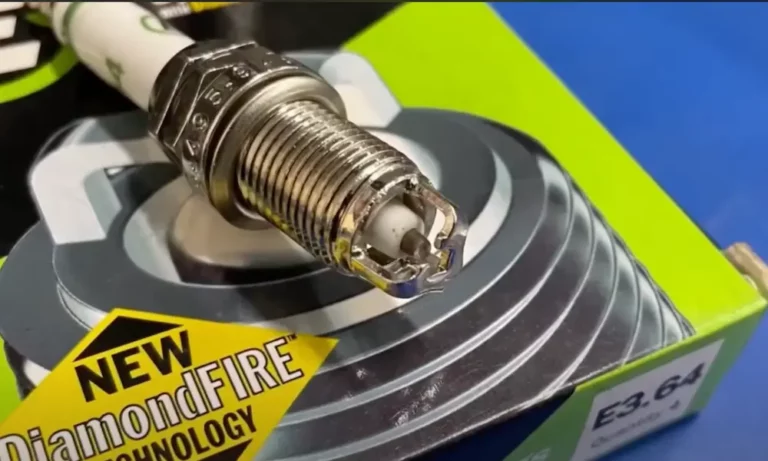
Shopping for spark plugs shouldn’t feel like solving a puzzle. E3’s diamond-shaped electrode looks cool, but does it actually work better? This guide breaks down real testing data, mechanic opinions, and user experiences to help you decide if E3 plugs deserve a spot in your engine.
What Makes E3 Spark Plugs Different?
E3 spark plugs ditch the traditional J-shaped wire electrode you’ll find in standard plugs. Instead, they use a patented DiamondFire design with three legs welded to the shell, creating what looks like a diamond shape around the center electrode.
This isn’t just marketing hype. The design actually changes how combustion happens in your engine. According to research at Michigan Technological University, the diamond shape creates faster flame kernel development and more complete fuel burning compared to traditional designs.
Here’s how it works: the open architecture lets the flame front expand directly toward the cylinder’s center where most fuel sits, rather than getting blocked by a traditional ground electrode. The three-legged design also creates turbulence in the air-fuel mixture, improving how everything mixes at the spark point.
Sounds promising, right? But there’s more to the story.
Performance Testing: Do E3 Plugs Actually Add Horsepower?
Let’s talk numbers. Professional dyno testing shows mixed results that might surprise you.
Richard Holdener tested E3 plugs on a 5.3-liter LS engine and found virtually no power difference compared to NGK and standard copper plugs. The variations stayed within 1-2 horsepower, which is basically just normal testing noise. However, other independent tests showed a 12 horsepower gain at the rear wheels, representing about 4% improvement.
Here’s where things get interesting. Fuel economy testing shows more consistent benefits. E3 claims a 3.9% reduction in Brake Specific Fuel Consumption based on dyno work. Real-world testing on small engines showed 2.5-3.5% better fuel efficiency compared to standard NGK plugs.
Where E3 Plugs Shine
Performance gains aren’t equal across all applications. According to Steve Joiner from E3, improvements tend to be “more substantial and noticeable on older carbureted applications than newer EFI engines.”
Best results appear in:
- Small engines (chainsaws, lawn mowers, leaf blowers)
- Older carbureted vehicles
- Two-stroke equipment
- RC vehicles
Small engine users consistently report easier starting, smoother idle, and better overall performance. RC vehicle testing demonstrated noticeable power and top speed improvements with E3 plugs compared to NGK equivalents.
Modern fuel-injected engines? Not so much. They already have highly efficient combustion systems, leaving little room for improvement.
The Durability Problem Nobody Talks About
Here’s where E3 plugs run into serious trouble. Despite claiming 100,000-mile longevity for automotive applications, real-world experience tells a different story.
Multiple users report premature electrode wear, with plugs failing between 15,000-20,000 miles in cars. BMW Forum users documented E3 plugs developing excessive electrode gap wear causing misfires within 20,000-30,000 miles.
One detailed analysis of E3 plugs after 45,000 miles showed significant center electrode erosion and rounding. The user concluded they’d be “quite wary running them to 100K” despite the manufacturer’s claims. Premium NGK Iridium plugs regularly achieve their full service life ratings without these issues.
Common Failure Patterns
Watch for these problems with E3 plugs:
Electrode erosion: The center electrode wears down faster than expected, increasing the gap and causing misfires.
Carbon fouling: Some users report increased susceptibility to carbon buildup compared to traditional plugs.
Complete spark failure: Small engine users report E3 plugs “going dead” with no recoverable spark despite proper gap.
Inconsistent performance: Multiple reports of E3 plugs working initially but developing problems within months of installation.
What Professional Mechanics Actually Think
Professional mechanics don’t mince words about E3 spark plugs. A Dodge dealership technician reported that E3 plugs were “the 1 plug I have seen kill the performance of more than 1 engine.” He noted losing track of how many times cars came in running poorly with E3 plugs installed.
One experienced mechanic on Reddit pointed out that E3 plugs “have a shitton of material around the spark” which is “literally the opposite of what you actually want to achieve with a spark plug.”
The consistent professional recommendation? Stick with OEM specifications using NGK, Denso, or Bosch plugs.
E3 vs. NGK: A Reality Check
NGK remains the gold standard for spark plugs, with OEM approval from virtually every major manufacturer and a product line exceeding 1,000 different plug types.
Testing consistently shows NGK plugs providing superior starting performance, better fuel economy, and significantly longer service life compared to E3 plugs. While E3 may provide slight power advantages in some applications, NGK’s reliability and longevity make it the preferred choice for most users.
Here’s a comparison that matters:
| Feature | E3 DiamondFire | NGK Iridium | Standard Copper |
|---|---|---|---|
| Price per plug | $5-7 | $8-12 | $2-3 |
| Claimed lifespan | 100,000 miles | 100,000+ miles | 20,000-30,000 miles |
| Real-world lifespan | 15,000-45,000 miles | 100,000+ miles | 20,000-30,000 miles |
| Power gains | 0-4% (application dependent) | 0-1% | Baseline |
| Fuel economy | 2.5-3.9% improvement | 1-2% improvement | Baseline |
| Reliability rating | Moderate | Excellent | Good |
The fundamental issue centers on the trade-off between potential performance gains and proven reliability. For most applications, the modest 1-4% performance improvements don’t justify the reliability concerns and higher replacement frequency.
Installation Headaches You Should Know About
E3 plugs come with installation quirks that can cause problems. The diamond electrode design can’t be adjusted for gap like traditional plugs. Trying to bend it would damage the multi-sided electrode.
This pre-gapped design creates issues if the factory gap doesn’t precisely match your engine’s requirements. You’re stuck with whatever gap E3 provides.
Installation torque specs are critical, especially in aluminum heads where over-tightening causes thread damage. E3 provides detailed torque charts, but the fixed-gap design means there’s no room for adjustment if installation issues arise.
Compatibility Problems
Multiple users report that E3 plugs cause performance problems in certain applications. Fiesta ST owners report rough idle and poor performance when switching to E3 plugs, requiring immediate return to OEM NGK plugs.
Similar issues have been documented with BMW applications where E3 plugs caused hesitation and misfires that were immediately resolved by switching back to Bosch OEM plugs.
The Warranty Sounds Great (But There’s a Catch)
E3 offers what looks like generous warranty coverage on paper:
- Automotive plugs: 5 years or 100,000 miles
- Lawn & Garden plugs: Lifetime warranty for the life of the first engine
- PowerSports plugs: Warranty varies by application
Here’s the catch: warranty claims require returning plugs with receipts and completed forms. Coverage excludes commercial use, racing, or “improper installation.”
Given the premature failure reports, warranty processing becomes a practical concern. You’ll need to keep your receipts, document the failure, remove the plugs, and mail them back. For a product that costs $5-7 per plug, is that hassle worth it?
Cost Analysis: Are E3 Plugs Worth the Money?
Let’s break down the math. E3 plugs cost $5-7 each, positioning them between standard copper plugs ($2-3) and premium NGK Iridium plugs ($8-12).
For a typical 4-cylinder engine, you’re looking at $20-28 for a set of E3 plugs. That’s reasonable for a premium option, except E3 plugs don’t deliver premium longevity.
If E3 plugs last 30,000 miles versus 100,000+ miles for NGK Iridium, you’ll replace E3 plugs 3-4 times in the same period. Suddenly, that lower upfront cost doesn’t look so attractive.
Cost over 100,000 miles:
- E3 plugs: $60-112 (3-4 replacement sets)
- NGK Iridium: $32-48 (1 replacement set)
- Standard copper: $40-60 (4-5 replacement sets)
This doesn’t include your time or labor costs if you’re paying someone to install them.
When E3 Plugs Actually Make Sense
Despite the concerns, E3 plugs aren’t completely worthless. They work well in specific situations.
Consider E3 plugs for:
Small engines where reliability matters less: Lawn mowers, chainsaws, and leaf blowers that run seasonally benefit from E3’s easier starting without the durability concerns of high-mileage automotive use.
Older carbureted vehicles you don’t drive daily: If you’ve got a classic car that sees limited use, the potential performance improvements might outweigh longevity concerns.
Short-term performance applications: Racing or track days where maximum power matters more than plug life.
Experimental use: If you’re curious and willing to trade reliability for potential performance gains, E3 plugs won’t damage your engine. Just keep your old plugs handy.
When to Avoid E3 Plugs
Skip E3 plugs for these applications:
Daily driver vehicles: The reliability concerns outweigh modest performance gains. You don’t want to deal with misfires on your commute.
Modern fuel-injected engines: The benefits are minimal over OEM plugs. Your engine’s computer already optimizes combustion.
Commercial or high-mileage applications: Durability issues make E3 plugs cost-prohibitive when you’re racking up miles quickly.
Performance engines requiring consistency: Variable quality affects tuning and reliability. Stick with proven brands.
Any vehicle still under warranty: Using non-OEM spark plugs could complicate warranty claims if engine problems develop.
The Bottom Line on E3 Spark Plugs
So, are E3 spark plugs good? The answer depends entirely on what you’re putting them in.
E3’s DiamondFire technology represents genuine innovation in spark plug design. The research is real, and the combustion improvements are measurable in certain applications. Small engines and older carbureted vehicles can see legitimate benefits.
But for most automotive applications, the reliability concerns sink the value proposition. When professional mechanics consistently recommend against a product, that’s worth paying attention to.
The established brands—NGK, Denso, and Bosch—continue to offer superior reliability, longer service life, and better overall value. They’re OEM-approved for a reason. Your vehicle’s manufacturer spent millions engineering the right spark plug specification. Deviating from that usually doesn’t end well.
If you’re running a modern fuel-injected engine, save your money and stick with OEM specifications. The 1-2% performance improvement you might see with E3 plugs isn’t worth the risk of premature failure and replacement hassle.
For small engines and weekend toys? E3 plugs are worth trying. The easier starting and modest performance gains can make a noticeable difference, and if they fail early, the replacement cost and hassle are minimal.
Just keep your expectations realistic. E3 spark plugs aren’t going to transform your engine’s performance. They’re an interesting alternative with specific use cases, not a universal upgrade that works everywhere.


