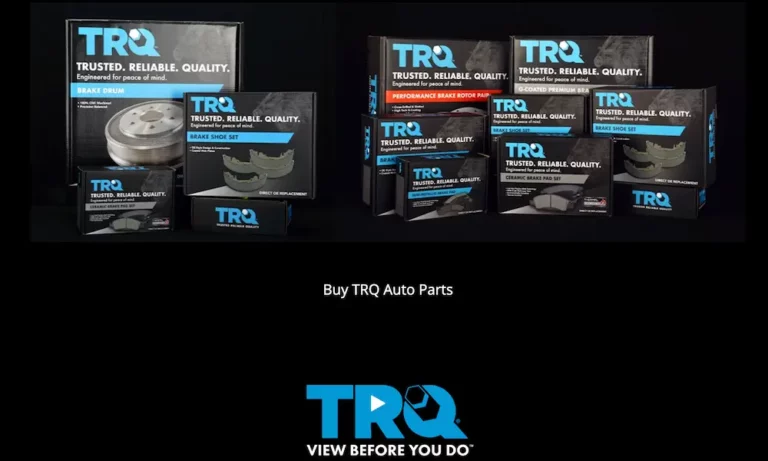
Trying to figure out if TRQ parts are worth your money? You’ve landed in the right place. This post breaks down exactly where TRQ parts shine, where they fall short, and which components you should never cheap out on — so you can make a smarter call before your credit card comes out.
What Is TRQ, Exactly?
TRQ stands for Trusted Reliable Quality. It’s the private-label brand sold primarily through 1A Auto, and it targets DIYers who want affordable parts without hunting through junkyards or paying dealer prices.
The brand manages over $50 million in inventory across four U.S. warehouses. Orders ship same-day, and most arrive within two business days. That’s genuinely impressive for an online-only parts brand.
TRQ also bundles related hardware — gaskets, fasteners, clips — into single kits. That means fewer trips back to the parts store when you realize mid-job that you’re missing something small but critical.
Where Are TRQ Parts Made?
Most TRQ parts come from manufacturers in China. That’s not a secret, and it’s not automatically a red flag either. The aftermarket parts industry runs on globally sourced components, including brands you’d consider premium.
What separates TRQ from cheap no-name parts on discount marketplaces is their quality-control process. TRQ claims rigorous testing to meet or exceed OEM specs, and their fitment data follows ACES and PIES digital standards — the same machine-readable formats that the big-box auto stores use.
The honest answer? TRQ sits in what enthusiasts call the “premium Chinese part” tier. Not OEM. Not bottom-of-the-barrel. Somewhere in between — and where exactly depends heavily on the part category.
Are TRQ Brake Parts Good?
For most daily drivers, yes. TRQ brake kits are genuinely solid.
Their rotors use G3000 gray iron casting — an industry-standard alloy that balances heat dissipation and structural integrity well. The brake pads go through a positive molding process, which creates uniform friction density. That matters because poorly molded pads wear unevenly and can delaminate under heat.
TRQ pads also come thermally scorched, so the break-in process is easier. Multi-layer shims and chamfered edges cut down on brake squeal.
| Brake Component | Technical Feature | What It Does |
|---|---|---|
| Rotor Alloy | G3000 Gray Iron | Better heat management, quieter operation |
| Pad Molding | Positive Pressure | Even wear, prevents glazing |
| Surface Finish | Non-directional | Shorter break-in, less vibration |
| Design | Application-specific | Installs without modification |
How do they stack up against PowerStop? PowerStop wins on initial bite and performs better under heavy towing or spirited driving. But for regular commuting, many users say TRQ kits feel indistinguishable from OEM — at a fraction of the price.
If you drive a performance-oriented vehicle like a BMW M-series, you’ll likely want Akebono or EBC instead. But for a family sedan or daily commuter? TRQ brakes get the job done.
Are TRQ Suspension Parts Good?
This is where things get more complicated — and where the answer to “are TRQ parts good” shifts.
TRQ suspension components are sealed-for-life, meaning you can’t grease them. That’s fine for mild climates and average use. But if you live somewhere with harsh winters and heavy road salt, a sealed boot that develops even a micro-crack will fail fast. There’s no way to flush out contamination with fresh grease when the fitting simply isn’t there.
Consumer feedback on TRQ suspension is all over the place:
- Positive: Owners of older vehicles — like a 1991 Jeep XJ — report thousands of trouble-free miles with TRQ control arms. When OEM parts cost more than the car’s worth, TRQ makes financial sense.
- Negative: Some users have experienced ball joint failure in under 10,000 miles, and the enthusiast community has coined the phrase “buy cheap, buy twice” for good reason.
| Suspension Part | Common Issue | Reported Lifespan |
|---|---|---|
| Control Arms | Bushing tear or ball joint play | 5,000–15,000 miles (variable) |
| Strut Assemblies | Leaking seals or spring bind | 1–2 years under normal use |
| Ball Joints | Boot failure, internal slop | Highly variable — safety-critical |
| Tie Rods | Loose fit, thread issues | Often reported as lacking snugness |
Here’s a hard truth: Toyota enthusiasts strongly recommend OEM-only lower ball joints. A failed lower ball joint doesn’t just wear — it can cause your front wheel to detach while you’re driving. That’s a line you don’t want to cross to save $40.
Bottom line on TRQ suspension: Use them on older, lower-value vehicles where OEM isn’t financially sensible. Avoid them on safety-critical joints in daily drivers, especially in high-stress or high-corrosion environments.
Are TRQ Wheel Bearings Good?
TRQ wheel hub assemblies are bolt-on, pre-assembled units. For a DIYer, that’s a huge deal — you skip the hydraulic press entirely. They’re easy to install, and many users report quiet, smooth operation after fitting them.
But longevity is inconsistent. Some hubs fail within six months. Others last years. The variability points to batch-level inconsistency in bearing tolerances or grease quality rather than a design flaw across the board.
Here’s how TRQ stacks up against the competition:
| Brand | Bearing Design | Material | Price Tier |
|---|---|---|---|
| Timken | Tapered / Precision Fit | High-grade steel | Premium |
| SKF | Tapered / Durable | High-performance alloys | OEM-grade |
| Moog | Sealed / Maintenance-free | Rust-resistant coating | Mid-range |
| TRQ | Bolt-on Assembly | Standard casting | Budget |
Timken and SKF are OEM-level suppliers. They use tapered roller designs that handle heat and load better over long mileage. TRQ’s standard ball-bearing design works fine — until it doesn’t.
For high-labor jobs like AWD rear wheel bearings that require significant disassembly, spring for Timken. The math just works out: paying twice for labor because a $60 hub failed stings a lot more than spending $130 upfront.
TRQ vs. The Competition: Where Does It Actually Rank?
TRQ vs. Detroit Axle
These two are the most direct competitors in the budget space. Both focus on kitted solutions sold through eBay, Amazon, and their own storefronts. Detroit Axle may have a slight edge in machining quality on castings and steering knuckles. TRQ wins on instructional support and a more polished customer experience.
TRQ vs. Moog
Moog used to be the gold standard for chassis parts. That reputation has eroded. Recent Moog production has shifted globally, and mechanics now treat many Moog parts as only marginally better than budget brands. If you’re choosing between TRQ and standard Moog, TRQ’s price advantage often makes it the smarter call.
Mevotech’s Supreme and TTX lines are a different story — those feature reinforced designs and greaseable joints that genuinely outperform TRQ in longevity.
TRQ vs. OEM
For safety-critical parts and high-labor jobs, OEM or Tier-1 brands like Denso, Akebono, or Bosch are still the smart move. The math is simple: replacing a failed $50 budget part often costs more in labor than buying a $150 premium part that lasts three times longer.
TRQ Starters, Alternators, and Sensors
TRQ’s electrical catalog is a mixed bag.
Starters: Surprisingly well-regarded. Users on 4Runner forums describe TRQ replacement starters as “amazing quality” with crisp, reliable engagement. Starters are mechanically heavy, so it’s easier to verify quality during manufacturing.
Alternators: Good value overall, though some users report premature bearing noise after extended use.
O2 Sensors and Ignition Coils: Proceed carefully here. Modern ECUs are picky. They’re calibrated for specific resistance signatures from OEM sensors. A budget sensor that deviates even slightly can trigger a Check Engine Light immediately after installation. Some TRQ O2 sensors have been reported as defective out of the box, requiring a swap back to OEM brands like Denso.
For sensors that are buried deep in the exhaust system or behind major components, don’t gamble with budget parts. The labor to replace them a second time costs more than the upgrade.
Where TRQ Parts Are Genuinely Excellent
If there’s one category where TRQ consistently earns praise, it’s lighting and exterior body parts.
Mirrors, headlamp assemblies, tail lamps — these are components where fit and finish are the main success metrics. TRQ lighting units typically cost 70–80% less than dealer prices, install without modification, and include full functionality: heating elements, power adjustment, and integrated turn signals.
The one caveat: some long-term users notice the clear coat on TRQ lenses starts yellowing or peeling after three to four years, versus 10+ years for OEM lenses. For a side-mirror that got clipped in a parking lot, that trade-off is completely reasonable.
What’s the Real Deal With TRQ’s Warranty?
The warranty situation is messier than it looks on the surface.
TRQ’s standard manufacturer documentation cites a 2-year/24,000-mile limited warranty. That warranty covers part replacement only — no labor reimbursement, no towing, no consequential damages.
The “Lifetime Warranty” you’ll see advertised? That typically refers to a specific marketing tier from 1A Auto, not the manufacturer’s base coverage. And even those lifetime warranties are “limited” — meaning normal wear and tear claims can be denied.
| Warranty Element | TRQ Policy | What It Means for You |
|---|---|---|
| Coverage Period | 2 Years / 24,000 Miles | Shorter than “Lifetime” marketing implies |
| What’s Covered | Part Replacement Only | You pay labor if it fails |
| Geographic Limit | U.S. Only | No support for international buyers |
| Documentation Required | Invoice + Registration | Skip this and coverage disappears |
On top of that, some customers report being asked to pay return shipping on heavy items like rotors and hub assemblies — which can wipe out whatever savings you made on the original purchase. And refund processing sometimes stretches past 14 days after the returned item is received.
This doesn’t make TRQ a scam. The BBB gives 1A Auto an A+ rating. But go in with clear expectations about what the warranty actually covers.
The One Thing TRQ Gets Brilliantly Right
TRQ produces hundreds of step-by-step YouTube installation videos every month, paired with specific TRQ-branded parts for specific vehicles. This isn’t just marketing — it’s a genuine support tool that reduces installation errors and return rates.
For a first-timer tackling their own suspension work, having a video that shows exactly which bolts to torque and in what sequence is genuinely valuable. TRQ’s “View Before You Do” philosophy has empowered millions of DIYers to complete repairs that would’ve otherwise gone straight to the shop.
That ecosystem — affordable parts, fast shipping, and free educational content — is what makes TRQ worth considering even when the parts themselves aren’t always the highest quality.
The Smart Buying Guide: When to Use TRQ (and When to Skip It)
TRQ works well for:
- Brake kits on daily drivers and commuter vehicles
- Lighting, mirrors, and exterior trim
- Starters and alternators on older vehicles
- Suspension parts on high-mileage vehicles where OEM cost doesn’t make sense
- Any repair where the cost savings outweigh the risk of early replacement
Skip TRQ and spend more on:
- Lower ball joints on any vehicle (safety-critical — one failure can detach your wheel)
- Wheel bearings on high-labor jobs or newer vehicles
- O2 sensors, crankshaft position sensors, and other ECU-sensitive electronics
- Any part where you’d pay more in labor for a second replacement than you saved buying cheap
Are TRQ parts good? The honest answer is: it depends on the part. For brakes, lighting, and bolt-on electrical items like starters, they’re genuinely solid for the price. For steering, suspension joints, and precision sensors, the variability makes them a calculated risk — sometimes acceptable, sometimes not worth it.
Know what you’re buying, watch the install video first, and inspect rubber boots on any suspension part the moment it arrives. Do that, and TRQ can save you real money on real repairs.