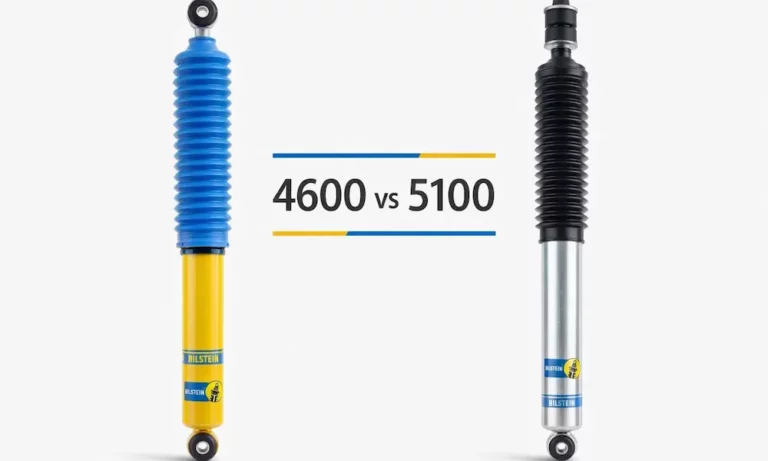
You’re staring at two yellow-labeled boxes in the warehouse, wondering which Bilstein shock will actually improve your truck’s ride. The 4600 and 5100 look similar, but they’re engineered for completely different purposes. Here’s what you need to know before you buy.
What Makes These Shocks Different From Stock?
Both the Bilstein 4600 and 5100 use monotube design, which beats your factory twin-tube shocks in one critical way: heat management.
Your stock shocks trap heat inside a double-wall design. When you’re towing a trailer over rough roads or hitting washboards, that heat builds up. The fluid gets thinner, and your shocks fade—you’ll feel your truck get bouncier and less controlled.
The Bilstein monotube puts the hydraulic oil directly against the outer steel wall. As you drive, air flows over that wall and cools the oil. This keeps your damping consistent, mile after mile.
Both shocks also pack high-pressure nitrogen gas (around 360 PSI) that prevents cavitation. That’s when your hydraulic fluid forms bubbles during hard hits, causing the shock to temporarily lose damping power. The nitrogen keeps constant pressure on the oil, so you get instant response every time.
The Bilstein 4600: Maximum Comfort at Stock Height
The 4600 is the shock you want if you’re keeping your truck exactly how it rolled off the assembly line.
Fixed Height for Factory Specs
The 4600 only works at stock ride height. It’s built to match your factory suspension geometry. Install these on a lifted truck, and you’ll run into problems—the shock will “top out” (hit full extension) before your suspension does, potentially damaging the internal piston.
The 4600 assumes you’re running factory springs and stock-weight wheels and tires. Change any of those variables, and the shock’s tuning becomes less effective.
The Smoothest Daily Driver
Here’s what truck owners consistently say about the 4600: it rides smooth.
The valving strikes a balance between controlling your truck’s body motions (like nose dive when braking) and absorbing small road imperfections. You’ll notice expansion joints and frost heaves less than with stock shocks, but you won’t feel beaten up like you might with race-oriented dampers.
Reddit users report the 4600 gives a “Cadillac” feel on trucks like the F-150 and Silverado. If you spend 90% of your time on pavement, this is your shock.
Where the 4600 Hits Its Limit
Don’t try to make the 4600 do something it wasn’t designed for. If you’ve installed a lift kit or switched to 35-inch mud terrains, the 4600 won’t handle the extra weight and altered geometry.
Heavier wheels create more momentum that needs stronger damping to control. With stock-tuned rebound valving, you might get a bouncy, under-damped feeling with big tires.
The Bilstein 5100: Built for Lifts and Heavy Tires
The 5100 looks different—brushed steel body with a zinc finish instead of yellow paint. That’s not just cosmetic. This shock is engineered for modified trucks.
The Adjustable Height Mechanism
The front 5100 struts have a clever feature: multiple grooves machined into the shock body.
You install a snap ring in one of these grooves, which holds a movable spring seat. Move the snap ring higher, and you compress your factory spring more than stock (adding preload). This preload pushes the suspension down, lifting your chassis relative to the wheels.
You can typically adjust from 0″ (stock height) to about 2.5″ of lift, depending on your truck model. This means you’re not installing a longer spring or a stiffer one—you’re just changing where the factory spring sits.
For rear shocks and non-strut applications, the 5100s are physically longer than the 4600s to accommodate lifted geometry without topping out during suspension articulation.
Firmer Valving for Heavier Components
The 5100 uses stiffer internal valving than the 4600, particularly on the rebound stroke.
Why? Lifted trucks almost always run bigger, heavier tires. A stock P-metric tire might weigh 30 pounds. An LT mud-terrain in 35-inch size can hit 65 pounds. That’s more than double the rotational mass.
The 5100’s firmer rebound damping controls this heavier unsprung weight, stopping the tire from bouncing repeatedly after hitting a bump. It settles the suspension faster and keeps your tire in contact with the road.
Lifted trucks also have a higher center of gravity. The 5100’s compression damping resists body roll during cornering, which is critical for stability when your CG is several inches higher than stock.
How Ride Quality Changes Between Models
This is where opinions get heated in truck forums. Let’s break down what’s actually happening.
Why Some Owners Call the 5100 “Harsh”
Multiple F-150 owners on Reddit report that 5100s feel stiff or jittery on empty trucks with stock tires.
Here’s the technical reason: the 5100 is valved for heavier components than what’s installed. The shock resists compression more aggressively than necessary for lighter stock wheels. On small, sharp impacts like pavement cracks, the shock transmits that energy into the chassis instead of absorbing it.
When you set the 5100 to maximum lift height (2.5″), you’re also reducing suspension droop travel. The highly preloaded spring makes the initial suspension movement feel firmer.
The 4600’s “Just Right” Tuning
The 4600 gets praise for its compliance. The valving matches stock component weights, so it absorbs high-frequency road noise effectively. You still get better control over large movements (speed bumps, dips) compared to worn factory shocks, but without the harshness.
How Load Changes Everything
Throw weight in the truck, and the comparison shifts.
For standard towing, the 4600 performs well, significantly reducing the “porpoising” (bouncing) you’d get with soft stock shocks.
But as you approach your truck’s GVWR, or when you raise the center of gravity with roof-mounted gear, the 5100’s firmer valving becomes an advantage. It resists the tendency to wallow or sway, giving you a more planted, secure feeling that softer shocks can’t match.
Some drivers prefer the 5100’s “truck feel” even on the street—tight control with minimal body motion. They accept the increased harshness as a trade-off for responsive handling.
Rust and Corrosion: The Finish Battle
If you live where they salt roads, pay attention to this section.
The 4600’s Paint Protection
The 4600 wears a yellow powder coat. As long as the paint stays intact, the steel body stays protected. The paint acts as a complete barrier against moisture and salt.
The problem? If a rock chips the paint during installation or driving, moisture can get under the coating. Rust spreads beneath the paint, eventually causing it to flake off in sheets.
In dry climates, the yellow finish lasts indefinitely. In the Salt Belt (Northeast and Midwest), expect cosmetic rust after 2-3 winters, though the shock body rarely develops structural holes.
The 5100’s Zinc Dilemma
The 5100 uses zinc plating over brushed steel. Zinc acts as a sacrificial anode—it corrodes instead of the steel underneath, in theory.
The reality? Owners in rust-prone areas report that 5100 shocks look corroded and pitted after just one winter. The zinc oxidizes from bright silver to dull gray. Once the zinc is gone, the steel rusts.
Bilstein’s warranty doesn’t cover finish corrosion, so this is on you to prevent.
Protecting Your Investment
If you’re buying 5100s and live in salt country, do this before installation:
- Clear coat spray: Apply high-temp clear coat to seal the zinc
- Lanolin-based films: Products like Fluid Film or Woolwax penetrate the brushed finish and repel moisture (they attract dust, though)
- Automotive wax: Requires regular reapplication but works
For “install and forget” applications in the Salt Belt, the painted 4600 might actually outlast the raw zinc 5100 unless you’re willing to maintain the finish annually.
What You’ll Actually Pay
Here’s the pricing breakdown for popular light trucks (F-150, Silverado 1500) as of 2025:
| Component | Bilstein 4600 | Bilstein 5100 | Difference |
|---|---|---|---|
| Front pair (struts) | $200-$270 | $280-$350 | +$80-$100 |
| Rear pair (shocks) | $180-$200 | $190-$220 | +$10-$30 |
| Complete set | $380-$450 | $470-$600 | $90-$150 |
The Hidden Value in the 5100
That $100-$150 premium gets you built-in leveling capability. A separate spacer leveling kit costs $50-$150, so you’re essentially getting the lift function for free compared to buying 4600s plus spacers.
Labor costs run the same for both—you’re still compressing springs and removing strut towers. This makes the 5100 efficient if you’re already paying for installation.
Warranty Coverage
Both shocks carry Bilstein’s Limited Lifetime Warranty for the original purchaser, covering defects in materials and workmanship.
What’s not covered: damage from off-road racing, improper installation, and—importantly—surface finish corrosion. Rust prevention is your responsibility.
Installation Details That Matter
Getting these shocks installed correctly is critical for safety and performance.
Front Strut Assembly Caution
You need a heavy-duty spring compressor to transfer your factory spring to the Bilstein strut body. Modern truck springs store lethal amounts of energy (often 500-700 lb/in). Professional wall-mounted compressors are safer than rental claw-style tools.
For the 5100, make absolutely sure the snap ring is fully seated in your chosen groove. The spring seat adapter must cover the snap ring in the correct orientation. Installing it upside down is a common mistake that can cause suspension collapse.
Follow the washer and bushing diagram exactly. Getting the top stem stack-up wrong causes clunking noises post-installation.
Rear Shock Orientation
Bilstein monotubes can technically mount in any direction due to the high-pressure gas charge. However, they’re designed “boot up” (rod pointing up) to protect the chrome rod from rock strikes.
Most rear applications mount them body-up, rod-down to reduce unsprung weight. Check the orientation label on your specific shock.
The Boot Controversy
The 4600 comes with boots pre-installed and clamped. The 5100 includes loose boots you must secure with zip ties.
Some serious off-roaders remove the boots entirely, arguing they trap mud and salt against the shaft, accelerating corrosion. For highway trucks, the boot protects the chrome rod from stone pitting that tears seals.
Vehicle-Specific Behavior
These shocks perform differently depending on your truck’s platform.
Ford F-150 (2015+ Aluminum Body)
The lighter aluminum body makes modern F-150s sensitive to over-damping. Owners frequently report that 5100s feel exceptionally stiff on the rear axle when the bed is empty, leading to “bed hop” over expansion joints.
The 4600 is the preferred choice for F-150s used primarily as daily drivers without heavy payloads.
Toyota Tacoma and 4Runner
These vehicles have high centers of gravity and notoriously soft factory suspension. The 5100 is the standard upgrade on Tacoma forums.
The ride height adjustability fixes the factory rake (nose-down stance) and “Tacoma Lean” (driver-side sag). The firmer valving reduces the excessive nose dive under braking that these trucks are known for.
Ram 2500/3500 (Solid Front Axle)
The heavy unsprung weight from the solid front axle changes the equation. Here, it’s less about comfort and more about control.
The 5100 helps mitigate “death wobble” (steering oscillation) by strictly controlling axle movement, though a dedicated steering stabilizer is the primary solution for that issue.
Which Shock Should You Buy?
The Bilstein 4600 vs 5100 decision isn’t about better or worse—it’s about matching the shock to your truck’s configuration.
Choose the 4600 If You:
- Plan to keep your truck at stock ride height
- Prioritize daily driver comfort on pavement
- Use your truck for standard towing within factory limits
- Live in heavy salt areas and want low-maintenance finish durability
- Run stock or near-stock wheel and tire sizes
Choose the 5100 If You:
- Want to level or lift your truck (up to ~2.5″) without spacers
- Run larger, heavier aftermarket tires (33″ or 35″ LT-rated)
- Carry high center-of-gravity loads (slide-in campers, roof tents)
- Prefer firm, responsive handling over plush comfort
- Will maintain the finish to prevent cosmetic corrosion
Both shocks share the same 46mm monotube core technology, so you’re not compromising on durability either way.
The 4600 maximizes what your truck can do at factory specs. The 5100 expands what your truck can do beyond those specs. Pick the one that matches your actual use case, not the one that sounds tougher.