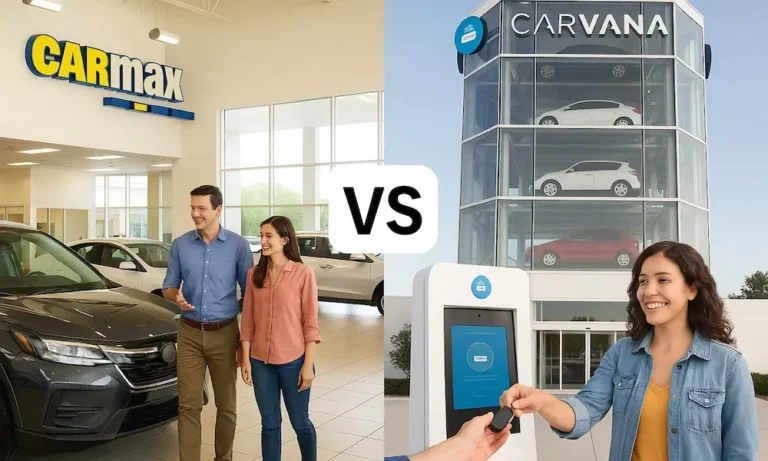
Looking for a hassle-free way to buy a used car? You’ve probably come across two major players: CarMax and Carvana. These companies have transformed how Americans buy used vehicles, but they offer distinctly different experiences. From shopping convenience to inspection quality and financing options, your choice between these giants could make or break your car-buying journey.
How CarMax and Carvana Transformed Car Buying
The $841 billion used car market in America has been revolutionized by two very different approaches. CarMax, founded in 1993, pioneered the no-haggle pricing model with physical stores nationwide. Carvana, launched in 2012, disrupted the industry with a completely online experience featuring those eye-catching car vending machines.
While both companies sell used cars, their business models couldn’t be more different. Let’s break down exactly how these companies operate and what it means for you as a buyer.
Business Models: Traditional vs Digital Disruptor
CarMax: The Brick-and-Mortar Hybrid
CarMax operates what industry experts call an “omnichannel” approach. With 245 physical stores across the US, they blend traditional dealership experiences with modern online capabilities. This hybrid model gives you multiple ways to shop:
- Browse inventory online and visit stores for test drives
- Complete financing applications digitally
- Finalize purchases either online or in-person
About 70% of CarMax customers use at least some digital features during their purchase journey, but the company’s strength lies in giving you options. Want to see and test drive before buying? No problem. Prefer handling everything from your couch? They’ve got you covered there too.
CarMax also diversifies its revenue through wholesale vehicle auctions and its own financing arm (CarMax Auto Finance), which serves about 40% of its retail customers.
Carvana: The Pure Digital Experience
Carvana has taken a completely different approach, eliminating dealerships entirely in favor of a digital-first experience. Their business revolves around:
- A comprehensive e-commerce platform for browsing and purchasing
- A network of inspection centers where they prepare vehicles
- Those iconic car vending machines that serve as optional pickup locations
What makes Carvana unique is their commitment to convenience. They offer home delivery nationwide, often within 24-48 hours of purchase. For those who want a more memorable experience, their 37 car vending machines across 20 states provide that Instagram-worthy moment where you use an oversized coin to retrieve your new ride.
Carvana expanded its capabilities in 2022 by acquiring ADESA auction services, giving them greater access to vehicle inventory while maintaining their digital-first approach.
Purchasing Experience: Flexibility vs Convenience
CarMax: Options for Every Buyer
CarMax’s purchasing process prioritizes flexibility. You can:
- Research vehicles online through detailed listings
- Visit physical locations to inspect and test drive cars
- Take advantage of 24-hour test drives at many locations
- Complete transactions through your preferred channel
Their “Love Your Car Guarantee” includes a 10-day return policy with no questions asked (as long as the car remains in the same condition). They’ll even transfer vehicles between locations if you find one you like at a different store.
The no-haggle pricing philosophy remains central to their experience, eliminating the traditional dealership negotiation that many buyers dread.
Carvana: Speed and Simplicity
Carvana has streamlined the car buying process to be remarkably fast and straightforward:
- Complete the entire purchase process in minutes
- Get instant financing approval
- Schedule delivery or pickup with a few clicks
- Skip the dealership experience entirely
Their platform features high-resolution photography showing even minor cosmetic imperfections, attempting to replicate what you’d see in person. Their 7-day return policy, while shorter than CarMax’s, lets you test the vehicle in your daily life before committing.
Many customers appreciate avoiding the traditional dealership environment altogether, though it means sacrificing the ability to inspect the vehicle before purchase.
Vehicle Quality and Inspection: What’s Under the Hood?
CarMax’s Inspection Process
CarMax implements a comprehensive inspection covering major systems and components of each vehicle. Their reconditioning centers perform necessary repairs before cars reach retail locations. Vehicles that don’t meet their standards get diverted to wholesale auctions rather than being sold to consumers.
Customer feedback on CarMax’s quality control is generally positive, with many buyers reporting satisfaction with vehicle conditions. However, some recommend getting independent inspections during the 10-day return period for additional peace of mind.
Carvana’s 150-Point Inspection
Carvana markets a “150-point inspection” process for their vehicles, but customer experiences are more mixed. Some report receiving cars with issues that should have been caught during inspection, while others praise the condition of their purchases.
The company’s rapid growth may have created challenges in maintaining consistent inspection quality, particularly in markets where they rely on third-party logistics providers.
| Inspection Aspect | CarMax | Carvana |
|---|---|---|
| Inspection Scope | Comprehensive check of major systems | 150-point inspection |
| Customer Satisfaction | Generally positive with some recommending independent checks | Mixed reviews, more variable quality reports |
| Return Window | 10 days | 7 days |
| Test Drive Option | In-person and 24-hour options at many locations | Post-purchase during 7-day return window |
Financing Options: Traditional vs Accessible
CarMax Financing: Competitive Rates with Options
CarMax provides financing through both its internal CarMax Auto Finance (CAF) division and partnerships with third-party lenders. Their rates start around 5.75% APR for qualified buyers, with terms ranging from 24 to 72 months.
The company’s approach to financing includes:
- Loan amounts from $500 to $100,000
- Relatively high acceptance rates through multiple lending partners
- Options for various credit profiles
- Ability to apply online or in-store
Carvana Financing: Easy Access, Higher Rates
Carvana emphasizes accessibility in their financing approach with no minimum credit score requirements beyond basic income thresholds ($5,100 annual income and being at least 18 years old).
However, their interest rates tend to run higher than traditional lenders, ranging from 3.99% to 27.99%. Many customers use Carvana’s financing for the convenience of completing their purchase, then refinance through credit unions or banks to secure better rates.
Warranty Coverage: Protection After Purchase
CarMax’s Warranty Programs
CarMax includes a 90-day or 4,000-mile limited warranty with every vehicle purchase, covering major systems including the engine, transmission, drivetrain, electrical systems, and climate control. This warranty applies regardless of any remaining manufacturer coverage.
Their MaxCare extended service plan is widely considered one of their competitive advantages, offering:
- Coverage up to five years or 150,000 miles
- Costs ranging from approximately $1,559 to $4,289 depending on the vehicle
- 24/7 roadside assistance
- Rental car reimbursement up to $40 daily for seven days
- $50 deductible discounts when repairs are performed at approved locations
Industry experts and customers frequently praise MaxCare’s comprehensive coverage and claim handling processes, with many considering it competitive with manufacturer warranties.
Carvana’s Warranty Options
Carvana offers a 100-day or 4,189-mile limited warranty, slightly longer than CarMax’s standard protection. The coverage includes similar systems and components.
For extended protection, Carvana partners with third-party provider SilverRock, though customer experiences with this program are generally less favorable than with CarMax’s MaxCare. Some buyers report difficulties with claim approvals and repair authorization processes.
Regulatory Issues: Clean Record vs Troubled History
Carvana’s Legal Challenges
Carvana has faced significant regulatory scrutiny across multiple states regarding title transfer and registration processes. These issues have resulted in:
- License suspensions in several jurisdictions
- Class-action lawsuits from customers experiencing documentation delays
- Cases where temporary tags expired before permanent titles arrived
- A $1.5 million settlement with Connecticut over hundreds of consumer complaints
- Criminal charges in Illinois against a Carvana legal representative including 27 counts of failure to transfer vehicle titles
These problems have damaged Carvana’s reputation and created operational constraints in affected areas.
CarMax’s Regulatory Standing
CarMax maintains a generally positive regulatory relationship across its operating jurisdictions, with fewer consumer complaints regarding title and registration processes. The company’s established dealership network and longer operating history have enabled development of robust compliance systems for state-specific requirements.
Price Comparison: Who Offers Better Value?
When it comes to pricing, the comparison between CarMax and Carvana isn’t straightforward. Their different business models affect their cost structures and pricing strategies.
CarMax’s pricing tends to be consistent and transparent, reflecting their no-haggle philosophy. While their prices aren’t always the lowest in the market, they often represent fair value considering the inspection process and return policy.
Carvana’s pricing can sometimes be more competitive due to their lower overhead costs without physical dealerships. However, their prices can vary significantly based on market conditions and delivery location.
Both companies use sophisticated data analytics to optimize their pricing, making it essential to compare specific vehicles rather than assuming one company is consistently cheaper than the other.
| Cost Factor | CarMax | Carvana |
|---|---|---|
| Vehicle Pricing | Consistent, often slightly premium | Variable, sometimes lower due to reduced overhead |
| Delivery/Transfer Fees | Varies by distance between stores | Free delivery in many markets, fees in others |
| Financing Rates | Starting around 5.75% APR | 3.99% to 27.99% APR, often higher than traditional lenders |
| Extended Warranty Costs | $1,559 to $4,289 for MaxCare | Varies with third-party SilverRock coverage |
Which Company Is Right for You?
Your choice between CarMax and Carvana should depend on your personal preferences and priorities:
Choose CarMax if you:
- Value seeing and test driving a car before purchasing
- Prefer having human interaction during the buying process
- Want a longer return window (10 days vs 7 days)
- Appreciate the security of a well-established company with physical locations
- Are interested in their highly-rated MaxCare extended warranty
Choose Carvana if you:
- Prioritize convenience and a fully digital experience
- Want to avoid dealerships entirely
- Prefer home delivery right to your door
- Enjoy innovative approaches like their car vending machines
- Need more accessible financing options regardless of credit history
The Bottom Line: Two Valid Options for Different Buyers
CarMax and Carvana represent two successful but fundamentally different approaches to used car retail. CarMax offers a more traditional experience enhanced by digital capabilities, while Carvana delivers a purely online approach that prioritizes convenience and innovation.
For consumers concerned about making such a major purchase sight unseen, CarMax provides the security of physical inspection and established processes. Those prioritizing convenience and speed might prefer Carvana’s digital-first approach.
Both companies continue to grow and evolve, with CarMax expanding its online capabilities and Carvana working to address its regulatory challenges. Whichever you choose, be sure to research the specific vehicle you’re interested in, consider an independent inspection during the return period, and compare financing options beyond what the companies offer directly.
The used car market offers more choices than ever, and understanding the differences between these two giants puts you in the driver’s seat for making the right decision.