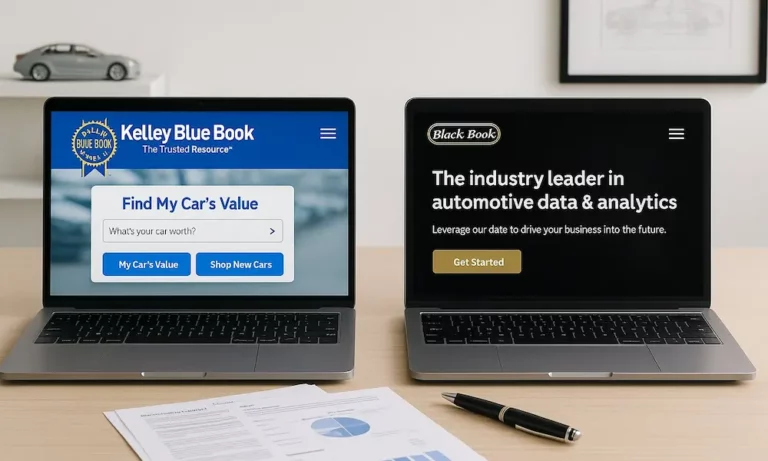
Ever wondered why the trade-in value the dealer offers is way lower than what you saw online? You’re not alone. The difference often comes down to which valuation tool is being used – Kelley Blue Book or Black Book. These two guides can show drastically different values for the exact same vehicle, leaving car sellers confused and sometimes disappointed.
I’ll walk you through the key differences between these valuation tools, explain why they often don’t agree, and help you understand which one to trust for your specific situation.
What Are Kelley Blue Book and Black Book?
Kelley Blue Book (KBB) and Black Book are both vehicle valuation services, but they serve different purposes and audiences.
Kelley Blue Book started in 1926 as a dealer resource but transformed into a consumer-friendly service in the 1990s when it made its data freely available online. Today, it’s owned by Cox Automotive and operates on an advertising-supported model, making it accessible to anyone looking up car values.
Black Book, established in 1955, remains primarily an industry tool. It’s subscription-based and typically only accessible to automotive professionals like dealers, lenders, and insurance companies. The average consumer rarely gets direct access to Black Book values.
Target Audience: Who Uses Each Guide?
The biggest difference between these guides starts with who they’re designed for.
Kelley Blue Book (KBB) targets:
- Everyday consumers
- Private sellers
- Car shoppers
- People researching vehicle values
Black Book targets:
- Car dealerships
- Auto auctions
- Lenders and banks
- Insurance companies
- Fleet managers
This fundamental difference in audience shapes everything from how data is collected to how values are presented.
Data Collection Methods: How Values Are Determined
Kelley Blue Book’s Approach
KBB collects data from hundreds of thousands of vehicle transactions weekly. Their sources include:
- Dealership transactions
- Private party sales
- Online listings
- Consumer data
They update their values weekly, which provides regular but not real-time information. KBB’s approach is comprehensive but often reflects what sellers hope to get rather than what buyers actually pay.
Black Book’s Approach
Black Book takes a more hands-on approach to data collection:
- Representatives physically attend over 60 wholesale auctions weekly
- They collect actual transaction prices from dealer-only auctions
- Values are updated daily, sometimes multiple times per day
- Focus exclusively on wholesale market activity
This method provides a much more accurate picture of what dealers are actually paying for vehicles in the wholesale market.
Why Values Often Differ
The table below illustrates typical value differences for the same vehicle:
| Vehicle Condition | Kelley Blue Book Value | Black Book Value | Typical Difference |
|---|---|---|---|
| Excellent | $15,500 | $13,800 | $1,700 higher in KBB |
| Good | $14,200 | $12,700 | $1,500 higher in KBB |
| Fair | $12,800 | $11,400 | $1,400 higher in KBB |
| Poor | $10,500 | $9,200 | $1,300 higher in KBB |
These differences exist because:
- Different markets: KBB includes retail transactions while Black Book focuses on wholesale
- Update frequency: Black Book’s daily updates respond faster to market changes
- Purpose: KBB aims to help consumers while Black Book aims to help dealers make profit
- Data sources: KBB includes asking prices while Black Book only uses actual sales data
Geographic and Regional Variations
Interestingly, there are strong regional preferences for which guide dealers use:
- West Coast: Kelley Blue Book dominates
- Southeast: Black Book is the preferred reference
- National average: Many dealers use multiple sources, including NADA (now J.D. Power)
These regional preferences reflect historical dealer relationships and local market conditions that favor particular valuation methodologies.
Which Guide Is More Accurate?
The question of accuracy depends entirely on what you’re trying to measure.
Black Book is more accurate for:
- Wholesale auction prices
- What dealers will actually pay for trade-ins
- Short-term market fluctuations
- Regional market variations
Kelley Blue Book is more accurate for:
- Retail asking prices
- What consumers might pay in private sales
- General market trends
- Consumer expectations
Neither guide is “wrong” – they’re just measuring different things.
Advanced Features and Technology
Both guides have evolved significantly with technology, but their features reflect their different purposes.
Black Book’s Professional Tools
Black Book offers sophisticated features for industry professionals:
- History Adjusted Valuations that incorporate vehicle history reports
- Market Analytics dashboards
- Integration with dealer management systems
- Auction-specific data feeds
- Daily market insights
These tools help dealers make quick, data-driven decisions in fast-moving auction environments.
KBB’s Consumer-Friendly Features
KBB focuses on features that help consumers:
- Price Advisor tool showing fair market ranges
- Instant Cash Offer program
- User-friendly mobile apps
- Integration with listing sites
- Vehicle comparison tools
These features aim to make car valuation accessible and understandable for the average person.
How Dealers Use These Guides
When you bring your car to a dealership for a trade-in, the process typically works like this:
- The dealer looks up your vehicle in Black Book (not KBB)
- They assess your car’s condition based on professional standards
- They factor in reconditioning costs needed to make your car retail-ready
- They consider local market demand for your specific vehicle
- They aim to buy your car at a price that allows for profit after these factors
Many consumers arrive at dealerships with KBB values in hand, only to be disappointed when the dealer’s offer is significantly lower. This isn’t because dealers are trying to lowball you – they’re simply using a different guide that reflects their actual cost structure and market reality.
How The Wholesale Market Works
Understanding why Black Book values tend to be lower requires understanding the wholesale market:
- Dealers buy vehicles at wholesale with the intention of selling at retail
- They need to cover reconditioning costs (typically $500-2,500 per vehicle)
- They need to make a profit margin (typically 8-12% on used vehicles)
- They take on the risk of holding inventory that might not sell
Black Book focuses exclusively on this wholesale market, where prices are naturally lower than retail. KBB, in contrast, blends wholesale and retail data, resulting in higher values that may not reflect what dealers can realistically pay.
Best Guide for Different Situations
When to Trust Kelley Blue Book
KBB is your best reference when:
- Selling your car privately to another consumer
- Setting an asking price for a private sale
- Getting a general idea of a vehicle’s market value
- Comparing different vehicle models you might purchase
- Understanding retail pricing in your area
When to Trust Black Book
Black Book (or estimates based on it) is more relevant when:
- Trading in your car at a dealership
- Selling to a dealer directly
- Understanding a dealer’s offer
- Getting a quick cash sale
- Understanding wholesale market trends
How to Access Each Guide
Accessing Kelley Blue Book:
- Visit kbb.com
- Use their free online tools
- Check their mobile app
- Find KBB in many car listing sites
Accessing Black Book:
Since Black Book is subscription-based, direct access is limited. However, you can:
- Ask dealers about Black Book values during trade-in discussions
- Use third-party sites that reference Black Book data
- Check certain lender websites that may incorporate Black Book data
- Find services that provide estimates based on Black Book
The Impact of Vehicle History
Both guides have evolved to incorporate vehicle history into their valuations, but they approach it differently.
Black Book offers History Adjusted Valuations that automatically factor in vehicle history reports, saving dealers time in manual adjustments. This feature creates VIN-specific pricing that’s more precise than general model values.
KBB allows consumers to input certain history factors manually but doesn’t automatically adjust for specific vehicle history reports in most cases.
Market Volatility and Value Changes
One of Black Book’s key advantages is how quickly it responds to market changes. This has become particularly important in recent years with unprecedented market volatility:
- During the pandemic, used car values fluctuated dramatically
- Supply chain issues caused rapid price changes
- Regional demand shifted quickly based on economic conditions
Black Book’s daily updates captured these changes as they happened, while KBB’s weekly updates sometimes lagged behind rapid market movements.
Making Informed Decisions
To get the most accurate picture of your vehicle’s value:
- Check both guides if possible – understand the range between wholesale and retail
- Consider your selling scenario – private sale vs. trade-in
- Be realistic about condition – most people overestimate their car’s condition
- Research local market factors – demand varies by region
- Understand seasonal impacts – convertibles are worth more in spring, SUVs in winter
Remember that neither guide provides an absolute guarantee of what you’ll get – they’re starting points for negotiation based on different market perspectives.
How to Maximize Your Car’s Value
No matter which guide you use, here are tips to get the best possible price:
- Gather documentation – maintenance records, receipts for improvements
- Make minor repairs – fix small issues that might significantly impact value
- Clean thoroughly – first impressions matter in both retail and wholesale
- Take quality photos – if selling privately
- Time your sale – consider seasonal demand for your vehicle type
- Be prepared to explain why KBB and dealer offers differ – knowledge is power
Industry Evolution and Future Trends
Both Black Book and Kelley Blue Book continue to evolve with technology:
- Machine learning algorithms improve valuation accuracy
- Integration with vehicle history data provides more precise pricing
- Mobile accessibility makes values available anywhere
- Real-time data is becoming more important in volatile markets
The fundamental difference between wholesale and retail focus will likely remain, but both services are working to narrow the gap between consumer expectations and market realities.
The Bottom Line
The difference between Kelley Blue Book and Black Book isn’t about which is “better” but rather which better serves your specific needs.
If you’re selling privately, KBB provides valuable guidance on retail pricing. If you’re trading in at a dealership, understanding Black Book values helps set realistic expectations about what dealers can actually offer.
Smart consumers check multiple sources and understand why these guides often show different values for the same vehicle. This knowledge helps you navigate car selling with confidence and realistic expectations.