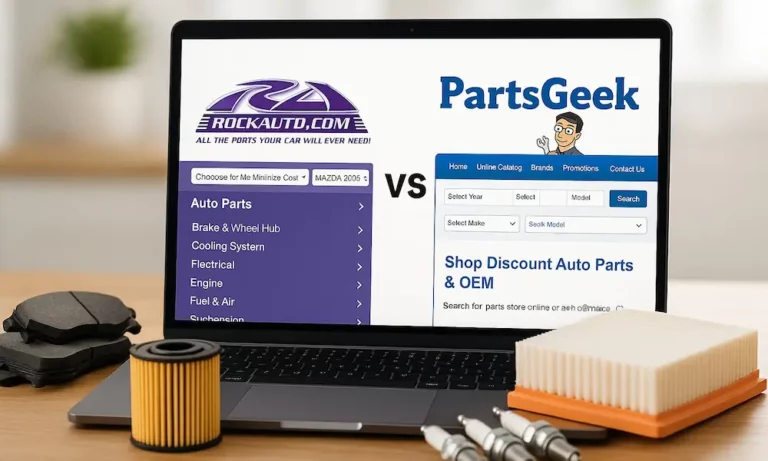
Ever struggled to find the right car parts at a reasonable price? You’re about to discover which of two popular online auto parts retailers—RockAuto or PartsGeek—might be your perfect match. Whether you’re a DIY mechanic or just someone trying to save money on car repairs, the choice between these platforms can significantly impact your wallet and experience.
The Fundamental Difference Between RockAuto and PartsGeek
At their core, RockAuto and PartsGeek operate on completely different business philosophies that shape everything from pricing to customer service.
RockAuto, founded in 1999 by automotive engineers Tom and Jim Taylor, built its reputation on a warehouse-direct model with razor-thin margins. Their mission? To “liberate information hidden behind the auto parts store counter” and make parts affordable by cutting traditional retail markup. The family-owned business has maintained this no-frills approach for over 25 years.
PartsGeek, established in 2008 and headquartered in Pennsylvania, represents a newer generation of auto parts retailers. Their business model prioritizes user experience and convenience features like simplified ordering and free shipping thresholds.
This fundamental difference affects every aspect of the customer experience—from how you search for parts to what happens if something goes wrong with your order.
Product Selection: David vs. Goliath
When it comes to sheer inventory size, these companies aren’t playing the same game.
RockAuto maintains a massive catalog of over 2 million parts sourced from more than 300 manufacturers. Their selection spans vehicles dating back to the 1920s, making them a treasure trove for classic car enthusiasts and those with obscure vehicles. Their selection includes:
- Mechanical components (brake pads, shock absorbers)
- Body parts (bumpers, mirrors)
- Interior trim (door handles, carpets)
- Major assemblies (steering gears, transmissions)
What truly sets RockAuto apart is their multiple quality tiers for the same part. Need a budget-friendly brake rotor? They’ve got it. Want the premium OEM version? That’s available too.
PartsGeek advertises access to over 10 million auto parts and accessories. However, research suggests their actual manufacturer network is smaller than RockAuto’s. Their selection focuses more on popular vehicle applications with fewer brand choices per part.
For rare or vintage vehicle owners, RockAuto’s vast selection is practically unmatched. But for common repairs on popular models, both platforms offer sufficient options.
Pricing Structure: The Hidden Cost Factor
At first glance, RockAuto appears to dominate on pricing—their “warehouse prices” often undercut traditional retailers by 30-50%. This pricing advantage stems from their minimal overhead and direct-from-manufacturer approach.
However, there’s a crucial catch that dramatically changes the cost equation: RockAuto’s multi-warehouse distribution model. Parts for a single order often ship from different locations, resulting in multiple shipping charges that can quickly erase those impressive savings.
Consider this real-world example from customer forums:
- $10 worth of wiper blades
- $13.98 in shipping (from two separate warehouses)
- Total cost: $23.98 (more than double the parts price)
This “shipping warehouse bait and switch” has become RockAuto’s most common customer complaint, with many users reporting that warehouse assignments change during checkout, increasing shipping costs unexpectedly.
PartsGeek takes a different approach. While their individual part prices may be slightly higher than RockAuto’s, they offer free shipping on orders over $99. This consolidated shipping model often results in lower total costs for medium to large orders.
| Order Type | RockAuto Advantage | PartsGeek Advantage |
|---|---|---|
| Single small item | Usually higher total cost due to shipping | Better for small purchases |
| Medium order (~$100) | Can be cheaper if parts ship from same warehouse | Usually cheaper with free shipping |
| Large order ($200+) | Often cheaper despite shipping costs | Convenient shipping, competitive total cost |
| Multiple parts from different categories | Typically much more expensive due to multiple shipping charges | Significantly better with single shipping charge |
The takeaway? Always calculate your total cost including shipping before deciding where to buy.
The Customer Service Divide
The most dramatic difference between these retailers is their approach to customer support.
RockAuto operates with virtually no traditional customer service, maintaining a strict email-only support model with no phone assistance. Their help section explicitly states this approach helps “keep their operational costs low so that they can sell car parts affordably.”
This minimalist approach has created significant customer frustration, reflected in RockAuto’s concerning 1.8/5 Trustpilot rating (from 2,876 reviews). Common complaints include:
- No way to speak with a human representative
- Slow email response times (often days)
- Being “ignored” through the email support system
- Relying entirely on automated systems for complex issues
PartsGeek provides more conventional customer service options including limited phone support, live chat during business hours, and more responsive email support. Their significantly higher 4.4/5 Trustpilot rating (from over 174,000 reviews) suggests this approach better meets customer expectations.
However, PartsGeek’s service quality isn’t perfect. Some customers report unhelpful representatives and inconsistent experiences. Their phone support operates only during limited hours, and complex technical issues may still require email correspondence.
If you value being able to speak with a human when problems arise, PartsGeek holds a clear advantage.
Return Policies: The Fine Print Matters
Both companies maintain 30-day return policies, but the implementation details create vastly different customer experiences.
RockAuto enforces strict return requirements:
- Parts must be in original manufacturer packaging
- Customers pay return shipping in all cases
- Core charges may be non-refundable if packaging is discarded
- Email-only return processing can take weeks
This rigid approach frequently leads to customer complaints, with many BBB filings detailing conflicts over packaging requirements that weren’t clearly communicated during purchase.
PartsGeek’s return policy has its own limitations:
- Restocking fees up to 15% may apply
- Customers must pay return shipping
- Opened electronic components cannot be returned
However, PartsGeek provides more flexible support for processing returns and offers phone assistance for return-related questions. This human element makes navigating return issues significantly easier for most customers.
Neither company offers particularly generous return terms, but PartsGeek’s more accessible customer service gives them an edge when problems arise.
Website Experience: Function vs. User-Friendliness
The digital shopping experience couldn’t be more different between these retailers.
RockAuto’s website looks like a relic from the early internet days—and that’s intentional. The company has maintained its utilitarian, catalog-style interface with minimal updates since 1999. For experienced users, this no-frills design offers advantages:
- Comprehensive search capabilities
- Detailed technical specifications
- Extensive filtering options
- Part number cross-referencing
Professional mechanics often praise RockAuto’s information-dense interface for providing exactly the technical details they need. However, casual users frequently find the site overwhelming and confusing. The shipping calculator is particularly problematic, often showing warehouse changes during the checkout process.
PartsGeek offers a more modern, user-friendly interface designed for general consumers. Their website features:
- Intuitive navigation
- Better visual design
- Simplified vehicle selection tools
- Clearer pricing information
Customer reviews consistently praise PartsGeek’s site for its accessibility, especially for first-time online parts buyers. The trade-off is somewhat less detailed technical information and fewer advanced filtering options compared to RockAuto.
Your preference likely depends on your technical knowledge and how often you purchase auto parts online.
Quality Control: What to Expect in the Box
Both platforms face ongoing challenges with part quality, though in different ways.
RockAuto’s quality varies significantly by manufacturer, with options ranging from budget Chinese parts to premium OEM components. This variety allows customers to select appropriate parts based on budget and quality requirements, but it also means inexperienced buyers may inadvertently purchase substandard components.
Forum discussions frequently advise RockAuto customers to:
- Avoid the cheapest options
- Research manufacturer reputations before purchasing
- Stick with known brands for critical components
When customers select appropriate brands, RockAuto’s part quality generally meets expectations, with OEM and premium aftermarket options performing reliably.
PartsGeek quality control appears less consistent, with more frequent customer reports of receiving incorrect, used, or defective parts. Multiple reviews describe receiving parts with obvious signs of prior installation or missing components. These issues seem to occur across brands, suggesting inventory management problems rather than specific manufacturer issues.
The key difference: when quality issues arise, PartsGeek customers report better resolution experiences thanks to more responsive customer service compared to RockAuto’s rigid policies.
Who Should Shop Where? Recommendations by Customer Type
Based on comprehensive analysis of both platforms’ strengths and limitations, clear recommendations emerge for different types of customers.
Choose RockAuto when:
- You’re an experienced DIYer or professional mechanic who knows exactly what parts you need
- Price is your primary concern and you can tolerate shipping complications
- You need hard-to-find parts for classic or uncommon vehicles
- You’re making large orders that justify complex shipping calculations
- You don’t require customer service support
RockAuto shines for the technically knowledgeable buyer who can navigate their catalog efficiently and doesn’t need hand-holding. As one forum user put it: “RockAuto is for people who know exactly what they want and just need someone to ship it to them.”
Choose PartsGeek when:
- You’re a casual car owner seeking convenience and customer support
- Your order exceeds $99 and qualifies for free shipping
- You value user-friendly website design and simplified purchasing
- You want phone or chat support for fitment questions
- You prefer predictable shipping costs
PartsGeek better serves mainstream consumers who prioritize a smooth shopping experience over absolute lowest prices. Their more forgiving policies and accessible support make them particularly valuable for occasional DIYers.
The Total Cost Reality Check
To illustrate how these differences play out in real-world scenarios, let’s compare total costs for common repair situations:
Scenario 1: Basic Brake Job (Pads & Rotors)
- RockAuto: Parts ($85) + Shipping from 2 warehouses ($25) = $110
- PartsGeek: Parts ($95) + Free shipping = $95
- Winner: PartsGeek by $15
Scenario 2: Major Tune-Up (Plugs, Wires, Filters)
- RockAuto: Parts ($65) + Shipping from 3 warehouses ($35) = $100
- PartsGeek: Parts ($75) + Free shipping = $75
- Winner: PartsGeek by $25
Scenario 3: Rare Part for Classic Vehicle
- RockAuto: Part ($120) + Shipping ($15) = $135
- PartsGeek: Part not available or significantly more expensive
- Winner: RockAuto (only viable option)
The pattern becomes clear: PartsGeek often delivers better total value for common repairs, while RockAuto remains essential for specialized or hard-to-find components.
The Verdict: Different Tools for Different Jobs
The choice between RockAuto and PartsGeek ultimately depends on your specific needs, technical knowledge, and priorities.
RockAuto remains unmatched for price-conscious customers with specific technical knowledge, particularly for hard-to-find parts. Their extensive catalog and manufacturer network make them indispensable for serious automotive enthusiasts and professionals looking to maximize savings on large orders.
PartsGeek offers a more accessible, complete customer experience that better serves mainstream consumers prioritizing convenience and support over absolute lowest prices. For most occasional car owners, their free shipping, modern interface, and customer service availability provide better overall value despite slightly higher individual part costs.
Many experienced DIYers maintain accounts on both platforms, using RockAuto for specialized components and large orders while turning to PartsGeek for simpler purchases where shipping costs would erase RockAuto’s price advantage.
As one forum user wisely summarized: “RockAuto is cheaper until it isn’t. Always calculate your total cost before clicking buy.”
Making the Smart Choice for Your Situation
To determine which platform best fits your needs, ask yourself these key questions:
- How comfortable am I identifying exactly the right parts without assistance?
- Is saving every possible dollar my primary goal, or do I value convenience?
- Am I ordering multiple items that might ship from different warehouses?
- Would I be comfortable handling returns exclusively through email?
- Do I need unusual or hard-to-find components?
Your answers will likely point clearly toward one platform or the other. Remember that neither option is perfect for every scenario, and many savvy shoppers maintain relationships with multiple suppliers to optimize for different purchase situations.
The online auto parts market continues evolving rapidly, with traditional retailers expanding their e-commerce capabilities and Amazon becoming a significant competitor. Both RockAuto and PartsGeek face challenges adapting to changing customer expectations while maintaining their distinctive business models.
For now, these platforms serve different segments of the market effectively—and understanding their strengths and limitations helps you make smarter purchasing decisions for your specific auto parts needs.