Thinking about Cerakote but not sure if it lives up to the hype? You’ve landed in the right place. This post breaks down real-world cerakote ceramic coating reviews across firearms, automotive detailing, and industrial applications — so you can decide if it’s worth your money before you spend it. Stick around, because the honest truth is more nuanced than the marketing suggests.
What Is Cerakote, and Why Does Everyone Talk About It?
Cerakote is a polymer-ceramic composite coating that bonds at the molecular level to metal, plastic, wood, and composites. It cures into an ultra-thin film — roughly one-thousandth of an inch thick — that protects against corrosion, heat, abrasion, and chemicals.
Unlike thick powder coats or flimsy spray paints, Cerakote doesn’t build up enough to mess with tight mechanical tolerances. That’s why gunsmiths, automotive builders, and industrial engineers all reach for it when precision matters.
It also skips the heavy metals and VOC-heavy chemicals found in legacy finishing processes like anodizing. So it’s safer for the techs applying it and easier on the environment.
The Different Cerakote Series: Which One Fits Your Job?
Not all Cerakote is the same. The product line splits into distinct series, each built for specific conditions.
| Series | Curing Method | Max Heat Resistance | Best For |
|---|---|---|---|
| H-Series | Oven (250–300°F) | ~500°F | Firearms, knives, automotive parts |
| C-Series | Air cure (ambient moisture) | 1,800°F | Plastics, electronics, heat-exposed parts |
| E-Series | Oven (advanced prep required) | High | Precision gears, sliding rails, marine |
| V-Series | Oven (500°F, 1 hour) | 1,800°F | Exhaust systems, motorsports, aerospace |
The H-Series is the workhorse — most custom shops use it daily. It mixes as a two-part system, bakes in an oven, and comes out ready for assembly the moment it cools. The C-Series air-cures over five days and handles temperatures up to 1,800°F, but high humidity in your workspace can completely derail the cure.
Cerakote vs. Powder Coating: The Real Difference
This comparison comes up constantly in cerakote ceramic coating reviews, and for good reason. Here’s how they actually stack up.
Powder coating applies two to five thousandths of an inch of plastic-like material. That’s fine for outdoor furniture or large structural parts. But on a precision firearm slide or an engine component, that thickness alters dimensions, obscures engravings, and traps heat inside the substrate.
Cerakote applies at one to two thousandths of an inch and actively disperses thermal energy rather than trapping it. In abrasion testing, Cerakote resists wear up to 100 times better than powder coat.
Powder coat does win on cost for large, bulk industrial jobs. But the moment heat management or tight tolerances enter the equation, Cerakote is the clear choice.
Cerakote vs. Duracoat: Speed and Durability
In the firearms finishing world, Duracoat is Cerakote’s most direct rival. Here’s the honest breakdown.
Duracoat is an air-cured chemical epoxy. It’s forgiving to apply, doesn’t require a blasting cabinet, and comes in aerosol cans for home use. For a hobbyist refinishing a hunting rifle in the garage, it’s genuinely accessible.
But the performance gap is significant:
- Corrosion resistance: Cerakote H-Series survives 2,000–3,000 hours in salt spray testing. Duracoat shows rust after 500 hours.
- Cure time: Cerakote is ready the second it cools from the oven. Duracoat takes two to three weeks to fully cure.
- Heat threshold: Cerakote handles 500°F standard, far more in specialty lines. Duracoat tops out around 300°F.
For professional shops, the slow cure time on Duracoat kills throughput. A job that takes one day with Cerakote ties up a workbench for weeks with Duracoat.
Cerakote vs. Bluing, Anodizing, and Nitride
These are the older-school options. Here’s where they fall apart against Cerakote.
Bluing looks great fresh out of the box. But standard hot bluing fails in salt spray testing within 24 hours. Cerakote lasts over 2,000 hours under the same conditions. If you’re hunting in the rain or live near the coast, bluing demands constant oiling. Cerakote doesn’t.
Anodizing modifies aluminum at the molecular level, creating a porous, brittle oxide layer. It introduces tensile stress that can weaken the alloy over time, and color consistency is notoriously unpredictable between batches. Cerakote sits on top of the metal without altering its metallurgy, and color consistency is tightly controlled.
Black Nitride is popular for firearms barrels. But in direct testing, a nitride-treated barrel shows oxidation after just 8 hours in a salt spray chamber. A Cerakote-coated equivalent lasted over 1,200 hours.
Real-World Cerakote Ceramic Coating Reviews: Automotive Products
Cerakote has pushed hard into consumer automotive detailing. Here’s what actual buyers say about each product.
Headlight Restoration Kit
This three-step kit — chemical strip, wet sand, ceramic seal — gets overwhelmingly positive feedback. Car and Driver includes it among the best-tested restoration kits available. Users in extreme climates like Arizona report it cures well even in dry desert heat, with immediate improvement in nighttime visibility.
The limitations users call out consistently:
- Skipping wet sanding kills results. You need at least five minutes per lens with 2,000 and 3,000 grit sandpaper. Rush it, and you get streaks and fast re-yellowing.
- The chemical wipe smells intense. Reddit reviewers strongly recommend outdoor application.
- It won’t fix deep scratches. Polishing compound isn’t included, so close-up microscopic sanding marks can stay visible.
For most people with moderately to severely yellowed headlights, it saves hundreds compared to dealer replacement housings.
Ceramic Trim Coat Restorer
Faded plastic bumpers and trim pieces meet their match here. Professional detailers and everyday consumers consistently call it a category disruptor. The coating cross-links with the plastic and restores factory-black pigmentation — it doesn’t just add a temporary oily sheen that washes off in the next rain.
Long-term reviews report the finish holding up 12 to 24 months in harsh UV climates and heavy-rain environments. It survives heavy-duty degreasers and high-pressure car washes without fading.
Watch out for these user-reported issues:
- Prep is non-negotiable. Grease or moisture under the coating means it won’t bond properly.
- Keep it off painted surfaces. If the resin cures on your clear coat by accident, machine polishing is the only fix.
- Wear gloves. Direct skin contact causes rapid chemical burning. This isn’t a casual product.
Ceramic Paint Sealant vs. Professional Paint Coating
Cerakote offers two paint protection options that serve very different customers.
The Rapid Platinum Ceramic spray sealant is a spray-on, wipe-off product. It makes water bead aggressively and simplifies future washes. Car and Driver testing and Road & Track evaluations note that it’s highly diluted compared to glass-bottle coatings. Think of it as a premium wax alternative, not a permanent clear coat. Longevity is measured in months.
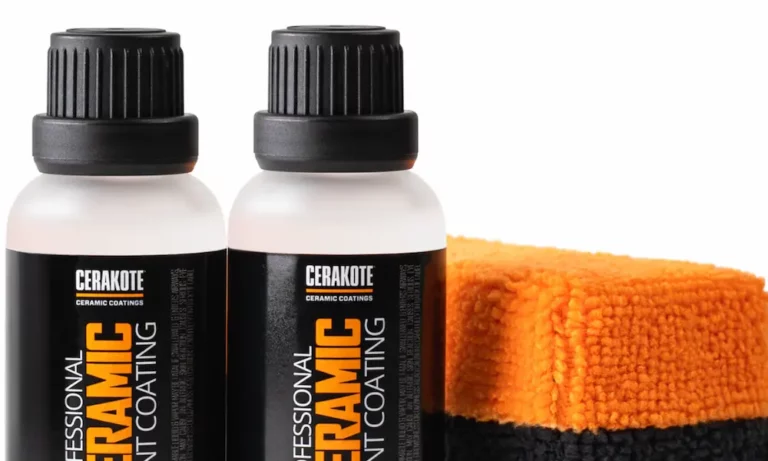
The Professional Ceramic Paint Coating comes in a glass bottle and gets applied panel by panel. Veteran detailers single out its forgiving flash time — that brief window where you buff it away before it hardens. It sweats visibly when it’s ready to level, and it wipes clean even if you’re slightly late. The final gloss is deep and chemically resistant, though some detailing purists say ultra-premium boutique coatings produce a more mirror-like finish.
Glass Coat and Interior Detailer
The Glass Coat works well for rain repellency during storms, but it demands spotless glass before application. Any hard water spots or mineral deposits sealed under the coating become permanent. It also needs a two-hour cure in a shaded, covered space — no garage, no application.
The Interior Detailer spray pulls mixed feedback. Home Depot reviewers point to vague instructions and results that don’t consistently beat cheaper legacy interior sprays. Skip it unless you already love the rest of the Cerakote lineup.
Cerakote on Firearms: What Shooters Actually Report
Firearms are where Cerakote built its reputation, and the community feedback is mostly strong.
Competitive shooters and concealed carry users report that ceramic-coated slides and frames hold up well against repetitive holster wear — far better than factory finishes. The coating’s one-thousandth-of-an-inch profile preserves tight mechanical tolerances inside the action, something powder coat or spray paint simply can’t offer.
Custom builds on Sig Sauer P365s, Glocks, and double-stack 1911 platforms attract serious interest. Reddit’s firearms communities show buyers willing to pay premium prices for personalized multi-color patterns and distressed finishes.
The community also acknowledges the honest drawbacks:
- Full disassembly is required before coating, which can void factory warranties.
- The finish is hard, but not indestructible. Repeated impacts on concrete or steel during tactical training will eventually chip it.
- Removal requires sandblasting. If you hate the color later, stripping it is a project.
Cerakote on Barbells and Fitness Equipment
Commercial gym barbells take punishment daily — sweat, chalk, metal drops. Powder coat fills in machined knurling texture, making the bar harder to grip. Cerakote’s thin profile preserves that sharp, aggressive feel while resisting the oxidative damage that bare steel or zinc plating can’t handle over time.
For facility owners buying high-end barbells, the coating pays for itself in extended equipment lifespan.
The Critical Limitation Nobody Talks About Enough
Every Cerakote ceramic coating review eventually hits this wall: surface preparation makes or breaks the result.
The vast majority of coating failures — bubbling, flaking, premature wear — trace back to one of two things: leftover grease on the substrate, or inadequate aluminum oxide blasting. A single microscopic fingerprint oil or droplet of moisture prevents the molecular bond from forming.
This applies equally to consumer automotive products and professional firearms coatings. If you prep correctly, Cerakote is as close to bulletproof as surface coating gets. If you skip steps, you’ll blame the product for a failure that was entirely preventable.
The other limitation worth knowing: fixing mistakes means sandblasting, not solvent stripping. That permanence is its greatest strength and its biggest operational headache when something goes wrong.
Is Cerakote Worth It?
For precision applications — firearms, performance automotive components, marine hardware, and commercial fitness equipment — the performance data and real-world testimonials consistently support the premium price. Nothing in the accessible surface coating market matches its combination of thin-film protection, heat resistance, corrosion immunity, and color range.
For casual consumer use, the automotive detailing products deliver genuine value on headlights and exterior trim. Just follow the prep instructions exactly, or the chemistry works against you instead of for you.