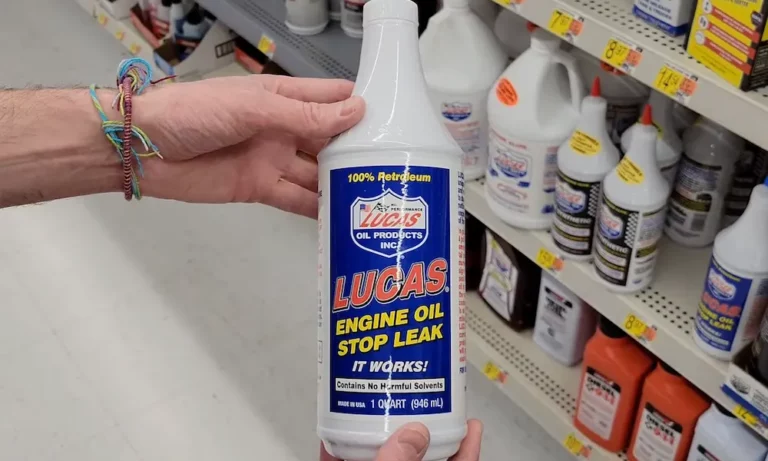
You’ve got oil spots on your driveway and someone suggested trying Lucas Oil Stop Leak before shelling out hundreds for a repair. But does this bottle of additive actually work, or is it just expensive snake oil? Let’s cut through the marketing hype and look at what independent tests and real-world experiences reveal about this popular product.
What Lucas Oil Stop Leak Actually Does
Lucas Engine Oil Stop Leak doesn’t magically seal holes in your engine. Instead, it works through two main mechanisms.
First, it contains seal conditioners that make dried-out rubber parts swell back toward their original size. Think of it like moisturizer for your engine’s gaskets. Over time, heat and age cause rubber seals to shrink and become brittle. The petroleum-based oils in Lucas penetrate these seals, restoring flexibility to hardened components that have shrunk over years of use.
Second, it thickens your oil. By increasing viscosity, Lucas makes your oil less likely to seep through tiny gaps or worn seal surfaces. It’s a mechanical approach – thicker fluid simply doesn’t flow through small openings as easily.
The product also improves lubrication properties using Lucas’s proprietary base stocks. Unlike some cheaper alternatives, it doesn’t contain harsh solvents that might damage engine components.
How It Performs in Independent Testing
Professional testing by Project Farm and other automotive organizations shows Lucas performs moderately well, though it’s not the top performer in its category.
O-Ring Restoration
Lucas scored 6 out of 10 in restoring worn O-rings to their original size and flexibility. That’s better than average but falls short of top competitors like ATP AT-205, which scored 9 out of 10.
Metal Wear Protection
The product showed good lubrication properties with a wear scar measurement of 6.9mm. That’s actually better than straight motor oil at 7.05mm, proving it doesn’t sacrifice protection while working to stop leaks.
Temperature Performance
Lucas maintained acceptable viscosity in both cold and heat testing. It wasn’t exceptional in either extreme, but it didn’t fail either. During heat testing, the product performed adequately without excessive evaporation, though some competitors like Bardahl edged it out.
What Real Users Are Experiencing
Analyzing hundreds of user reports reveals that effectiveness varies dramatically based on your specific situation.
High-Mileage Vehicles (150,000+ miles): This is where Lucas shines. About 75% of owners report positive results, with many experiencing reduced oil consumption and slower leak progression. One user drove over 550 miles with only two drops of oil leakage after treatment – a significant improvement from their previous puddle-forming leak.
Medium-Mileage Vehicles (75,000-150,000 miles): Results get murkier here. Around 65% of users report some benefit, but outcomes vary wildly based on leak severity and seal condition. Some see dramatic improvement, others notice barely any change.
Newer Vehicles (under 75,000 miles): Only 45% success rates here. If your seals aren’t dried out and shrunk yet, there’s not much for the conditioners to fix.
What Mechanics Actually Think
The professional community is split on does Lucas oil stop leak work as a legitimate solution.
Supporters point out that it can be useful for older, high-mileage engines as a temporary solution. Some experienced techs recommend it particularly for reducing engine noise and increasing oil pressure in worn engines.
Skeptics view stop-leak products as Band-Aids that mask underlying problems. BMW and European car specialists often advise against any stop-leak products due to concerns about clogging narrow oil passages in modern engines.
Conditional recommenders suggest Lucas can work for vehicles near end-of-life or when immediate repair isn’t financially feasible. But they emphasize it shouldn’t replace proper maintenance or delay necessary repairs indefinitely.
When You’ll Get the Best Results
Research shows Lucas works best under specific conditions.
Minor seal leaks respond best to treatment. We’re talking valve cover gaskets, oil pan seals, or slightly worn main seals. If you’re losing a few drops or a small puddle, you’re in the sweet spot.
Older engines with naturally aged seals show the highest success rates. Once your vehicle hits 100,000+ miles and those rubber components have hardened from years of heat cycles, that’s when seal conditioners can make a real difference.
Clean oil systems matter more than you’d think. The product works better in engines with relatively clean oil, as contaminated systems can interfere with seal conditioning.
Proper application is crucial. Follow the manufacturer’s instructions precisely – typically using 20% of oil capacity (1 quart per 4 quarts of oil). More isn’t better and can cause other issues.
What Lucas Can’t Fix
Let’s be clear about limitations. Lucas Oil Stop Leak cannot repair structural damage. It won’t fix:
- Cracked engine blocks
- Blown head gaskets
- Severely damaged seals that need physical replacement
- Worn piston rings causing oil burning
Most professionals emphasize that any improvement is temporary, lasting months rather than years. You’re buying time, not a permanent fix.
There’s also a potential downside: seal conditioning affects all engine seals, not just the leaking ones. While rare when used properly, this could potentially cause future problems.
Modern turbocharged and high-performance engines with tight tolerances face higher risks of oil flow restrictions. If you’re driving a performance vehicle, think twice before adding any oil thickener.
The Cost Factor
At roughly $10-15 per bottle, Lucas offers excellent short-term cost effectiveness. That’s about $2.50 per month of protection compared to proper seal replacement costs ranging from $200-800 depending on location and complexity.
| Repair Type | Typical Cost | Lucas Cost | Time Gained |
|---|---|---|---|
| Valve cover gasket | $200-400 | $10-15 | 3-12 months |
| Oil pan gasket | $300-600 | $10-15 | 3-12 months |
| Rear main seal | $600-1,200 | $10-15 | 2-8 months |
However, the temporary nature means long-term costs might be higher if you keep delaying proper repairs. You’ll need to reapply Lucas with each oil change, and eventually, the leak will progress beyond what additives can address.
The Straight Answer
So does Lucas oil stop leak work? Yes, but with important caveats.
It temporarily reduces or stops minor oil leaks in older engines with worn seals. You can’t expect miracles, and effectiveness is highly dependent on leak type and severity.
The product performs best on high-mileage, naturally aspirated engines. If you’re driving a 2005 Toyota Camry with 180,000 miles and a slow valve cover leak, you’ll probably see good results. If you’re driving a 2020 turbocharged BMW with a significant leak, you’re better off heading to the mechanic.
Remember, it’s a temporary fix, not a permanent solution. Think of it as a stop-gap measure while you save up for proper repairs or while deciding whether to keep an older vehicle running a bit longer.
For owners of older vehicles facing minor leaks, Lucas represents a reasonable first attempt at a low-cost solution. Just don’t expect it to replace actual seal replacement, which remains the only permanent fix.
The product’s moderate performance in professional testing, combined with its strong track record in high-mileage applications, suggests it can be a valuable tool when used appropriately. Just keep your expectations realistic about its limitations and temporary nature. You’re buying yourself some time and potentially saving a few hundred bucks in the short term – and sometimes, that’s exactly what you need.