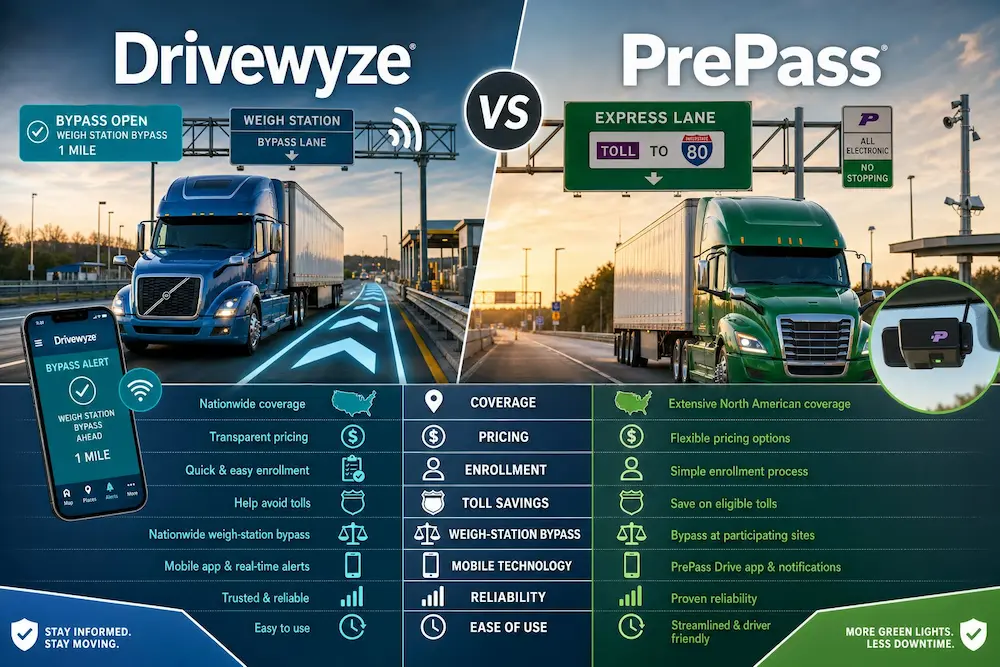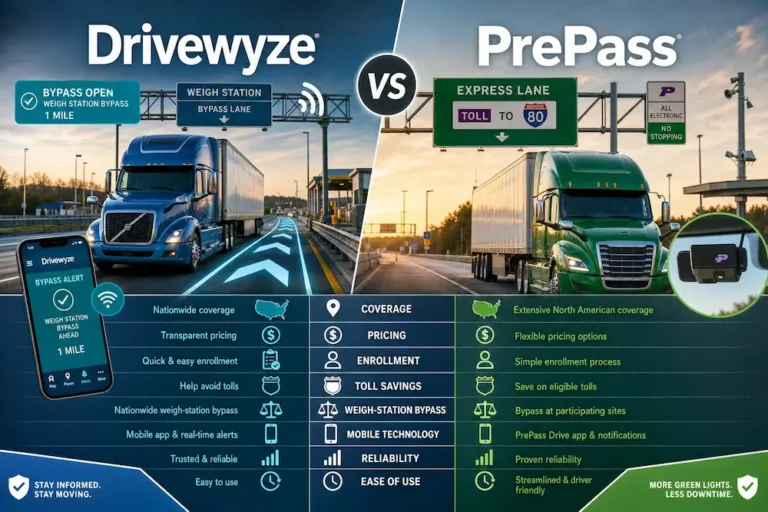
Choosing the wrong bypass system could cost your fleet thousands in wasted fuel, lost drive time, and unnecessary stops. This guide breaks down exactly how Drivewyze and PrePass stack up — covering coverage, cost, hardware, safety tools, and more. Stick around to the end, because the right pick isn’t always the obvious one.
What Is a Weigh Station Bypass System?
Every commercial vehicle over 10,000 pounds must stop at open weigh stations for weight checks and credential verification. That’s the law. But those stops add up fast.
According to the PrePass National Bypass Impact Index, a single weigh station stop burns roughly half a gallon of diesel and costs a carrier around $10.65 in total operational expenses. Multiply that across hundreds of trucks and thousands of stops, and you’re hemorrhaging money.
Bypass systems solve this. They pre-screen your vehicle electronically before you reach the station. If your safety score checks out, you get a green light and keep rolling. No exit. No queue. No wasted time.
Two names dominate this space: PrePass and Drivewyze. They both work — but they work very differently.
Drivewyze vs PrePass: The Core Difference
Here’s the short version:
- PrePass uses a physical RFID transponder mounted to your windshield
- Drivewyze runs entirely as software on your existing ELD or mobile device
That one difference drives almost every other distinction between the two platforms — cost, coverage, flexibility, and how your back-office team manages everything.
How PrePass Works
PrePass, operated by the non-profit PrePass Safety Alliance, has the longest track record in the industry. Its system relies on RFID transponders mounted inside the cab.
As your truck approaches a weigh station, overhead reader poles ping the transponder. In milliseconds, the system checks your carrier’s operating authority, safety score, and registration against state and federal databases. If you’re running weigh-in-motion sensors embedded in the road, it also reads your axle weights at highway speed.
Green light? Keep moving. Red light? Pull in.
One handy feature: if you get a green light but highway patrol stops you anyway, the transponder flashes green for 15 minutes as proof of your authorized bypass.
The downside? Hardware logistics. You need to:
- Buy and ship physical transponders
- Install them in every cab
- Track and reassign them when trucks change hands
- Return or replace lost units (often at a fee)
PrePass does offer a cellular app called MOTION for supplemental coverage, but industry analysis shows MOTION doesn’t reliably cover all eligible sites independently. Most fleets run it alongside the transponder for full coverage.
How Drivewyze Works
Drivewyze PreClear skips the hardware entirely. It uses GPS geofencing and cellular networks to deliver bypass decisions directly to your ELD or mobile screen.
Here’s the flow:
- Your truck crosses the 2-mile geofence around a weigh station
- Drivewyze transmits your carrier credentials to the state enforcement servers
- At 1 mile out, you get a secondary alert
- At the station threshold, you see a clear bypass or pull-in instruction on your existing screen
No transponder. No reader poles. No windshield clutter.
A real practical advantage: Drivewyze doesn’t require you to be in the right lane. Because it’s software-based, you get bypass clearance regardless of lane position. That cuts down on dangerous last-second lane changes for heavy trucks.
Drivewyze integrates natively with over 30 ELD and telematics platforms, including Geotab, Motive, Samsara, Platform Science, and Verizon Connect. Fleet managers can push updates remotely across thousands of trucks instantly.
Coverage: Where Each System Actually Works
Coverage is the number one thing fleets evaluate. Here’s how the two networks break down:
| Network Attribute | PrePass | Drivewyze PreClear |
|---|---|---|
| Total Bypass Sites | 900+ | 800–900 sites |
| US State Coverage | All 50 states | 47 states |
| Regional Strengths | Southeast & Southwest (I-10, I-20, I-40) | Midwest, Northeast, Canada |
| Canadian Provinces | Limited | Ontario, Alberta, Manitoba, Newfoundland |
| Mobile Inspection Sites | Limited (needs MOTION app) | Extensive via software geofencing |
| Hardware Required | Yes — RFID transponder | No |
PrePass dominates southern corridors. If your fleet runs I-10, I-20, or I-40 heavily, PrePass has the deeper fixed infrastructure there.
Drivewyze punches back in the Midwest, Northeast, and Canada. It also covers exclusive states where PrePass has historically been absent — including Maine, Vermont, New Hampshire, and Nevada.
One major edge for Drivewyze: mobile and temporary inspection sites. Because PrePass depends on physical reader poles, it’s mostly limited to permanent weigh stations. Drivewyze can geofence any temporary enforcement site instantly. That matters when states run targeted compliance blitzes.
The Dual-System Strategy
Many large over-the-road fleets don’t pick one — they run both. A PrePass transponder plus Drivewyze software costs around $30/month per truck. Given the operational savings, that combined cost pays for itself fast.
Cost Breakdown: What You’re Actually Paying
| Service | Monthly Cost Per Truck | Hardware Cost | Notes |
|---|---|---|---|
| Drivewyze PreClear | ~$15–$20 | None | Varies by ELD partner; free trials available |
| PrePass MOTION (app only) | ~$14.95 | None | Limited standalone coverage |
| PrePass Transponder | ~$16.98 | Transponder + install | Full fixed-site coverage |
| Both Systems Combined | ~$30 | Transponder only | Maximum North American coverage |
Drivewyze bills monthly in arrears. Accounts over 30 days late face service suspension and interest at prime rate plus 2%.
PrePass’s hidden cost is transponder management. If a transponder isn’t properly reassigned when a truck changes hands, you’ll get automatic red lights and potential citations. Lost or unreturned transponders also trigger replacement fees. For high-turnover fleets, that adds up.
The Real ROI: What Bypasses Actually Save You
Let’s talk numbers. According to the PrePass National Bypass Impact Index, here’s what bypass frequency means per vehicle annually:
| Weekly Bypasses (Per Truck) | Annual Hours Saved | Diesel Saved | Annual Cost Reduction |
|---|---|---|---|
| 3 bypasses/week | 18 hours | 78 gallons | $1,661 |
| 5 bypasses/week | 30 hours | 130 gallons | $2,769 |
| 7 bypasses/week | 42 hours | 182 gallons | $3,877 |
| 10 bypasses/week | 61 hours | 260 gallons | $5,538 |
Scale that to a 300-truck fleet at 5 bypasses per truck per week: you recover roughly 9,000 driver hours, save 39,000 gallons of diesel, and cut over $830,000 in annual operational costs.
The environmental angle matters too. Ten bypasses per week avoids over 2.5 metric tons of CO₂ equivalent per truck annually — a real number for ESG reporting.
Toll Management: Where PrePass Has a Clear Edge
Neither bypass system covers tolls by default. But this is where the platforms diverge significantly.
PrePass Plus
PrePass Plus bundles weigh station bypass and nationwide electronic toll payments into one transponder. You get:
- A single unified monthly invoice across all toll authorities
- Access to the INFORM Tolling platform for dispute resolution and overcharge detection
- One device handling both functions
For fleets running heavy toll routes, that simplicity is genuinely valuable. Cellular-only apps — including Drivewyze and PrePass MOTION — can’t interact with toll plazas. Physical RFID hardware is required.
Drivewyze + Bestpass
Drivewyze’s answer is a strategic partnership with Bestpass, the leading independent commercial toll manager. Bestpass delivers:
- Near-universal nationwide toll coverage
- Maximum commercial toll discounts
- Proactive violation dispute management
Bestpass requires a prepaid deposit of $350, a one-time transponder fee of $55, and a monthly account fee of $11 plus per-vehicle coverage fees. It’s a modular setup — Bestpass handles tolls, Drivewyze handles bypasses — but it means managing two vendor relationships instead of one.
For transcontinental fleets crossing multiple incompatible toll authorities weekly, Bestpass often outperforms PrePass Plus on discount depth and violation recovery.
Safety Features: More Than Just a Green Light
Both platforms have evolved well beyond basic compliance screening.
Drivewyze Safety+
Drivewyze Safety+ uses the same geofencing engine to push real-time safety alerts directly into the ELD display:
- Sudden traffic slowdown warnings
- High-citation speed enforcement zones
- Severe weather alerts
- Steep grade descent warnings
- Runaway truck ramp locations
- Rest areas with high cargo theft rates
- Proactive speed alerts — warns the driver before they speed, not after
That last one is a genuine differentiator. Instead of flagging a violation post-trip, Drivewyze actively modifies driver behavior in the moment. Less friction with HR, fewer citations, lower insurance exposure.
Drivewyze also offers Drivewyze Free — a no-cost public safety tier developed with state transportation agencies, providing essential highway alerts to any user at zero charge.
PrePass MOTION Safety Features
PrePass MOTION delivers solid safety alerts too: work zone warnings, congestion notifications, hazardous weather, crosswind alerts, and commercial parking availability.
The usability gap is real though. Because Drivewyze runs natively inside the ELD, drivers see bypass clearances, hours-of-service data, and safety alerts on one screen. PrePass MOTION typically runs on a separate device, adding screen clutter and cognitive load in the cab — the opposite of what good safety design looks like.
How the ISS Score Controls Your Bypass Rate
Neither system guarantees a bypass. Your Inspection Selection System (ISS) score — assigned by the FMCSA based on crash history, inspections, and safety data — drives how often you get green lights.
| ISS Score | FMCSA Status | What It Means for Bypasses |
|---|---|---|
| 1–49 | Pass | Excellent safety record. Bypasses at highest frequency. |
| 50–74 | Optional | Moderate history. Mixed results — some bypasses, some pull-ins. |
| 75–100 | Inspect | Poor record. Red lights at almost every facility. |
Even a perfect score of 1 doesn’t guarantee every bypass. States intentionally program a random pull-in rate to maintain system integrity and conduct periodic compliance sweeps.
The math is straightforward: better safety scores mean more bypasses, which means more savings. Bypass systems and safety programs aren’t separate initiatives — they directly reinforce each other.
What Happens During a Weigh Station Inspection
When you pull in, inspectors choose the scrutiny level based on your profile:
- Level 1 (North American Standard): Full driver credential check plus under-vehicle mechanical inspection. Brakes, suspension, steering, tires, coupling devices. Takes up to an hour.
- Level 2 (Walk-Around): Credential check and exterior visual — tires, lights, cargo securement. No crawling underneath.
- Level 3 (Driver Only): CDL, medical card, HOS logs, seatbelt. Vehicle not inspected.
Out-of-Service Orders
Find a serious mechanical defect or HOS violation, and an inspector issues an Out-of-Service order. The truck doesn’t move until repairs are certified. That means missed delivery windows, potential load loss, and direct hits to your ISS score.
Every violation carries a severity weight that degrades your score:
- Tire tread under 2/32″ = 8 points
- Inoperable stop lamps = 6 points
- Brakes out of adjustment = 4 points
Points accumulate, your ISS score climbs toward “Inspect” territory, bypasses dry up, and insurance premiums rise. It’s a compounding problem that starts at the roadside.
What Happens If You Skip an Open Weigh Station
Don’t. Modern weigh stations use HD cameras, license plate readers, and mainline weigh-in-motion sensors that identify every bypassing vehicle automatically.
The penalty structure for illegal bypass combined with overweight violations:
- 1,000–2,000 lbs over limit: $100–$500 fine
- Severe overweight (10,000+ lbs over): $2,000–$16,000+ fine
- Mandatory Level 1 inspection after any evasion
- Secondary equipment dispatched to offload excess cargo on the spot
The legal and financial exposure makes evasion completely irrational. A legitimate bypass subscription at $15–$20/month is one of the cheapest insurance policies in trucking.
State-Specific Systems: Oregon, Washington, and Canada
Some states and provinces run their own proprietary preclearance programs — Oregon Green Light, NORPASS, and Weigh2GoBC. These are legacy RFID systems incompatible with cellular apps.
PrePass has negotiated administrative integrations allowing a standard PrePass transponder to enroll in Weigh2GoBC, NORPASS, and Oregon Green Light — one device, multiple programs.
Drivewyze has taken a different route, negotiating direct backend software integrations with several state agencies. Carriers don’t need separate transponders for Oregon preclearance when using Drivewyze, which cuts onboarding steps for compliance managers significantly.
Frequently Asked Questions
What should a driver do if they accidentally miss an open weigh station?
Don’t stop on the shoulder. Don’t reverse. That creates a serious collision hazard and guarantees heavy citations. Instead, take the next safe exit, park legally, and call the scale house or state highway patrol commercial vehicle enforcement division. Explaining the situation proactively often results in a verbal warning rather than an evasion citation and mandatory Level 1 inspection.
Can an owner-operator use bypass services when leased to a larger carrier?
Yes — but the credentials must match. When you’re leased to a carrier, the bypass system evaluates the larger carrier’s ISS score under their DOT number, not your personal record. You need the carrier’s permission and must register the vehicle correctly in the bypass portal so transmitted data matches the placards on your truck.
Do bypass systems work for oversized or overweight permitted loads?
No — even if your in-cab device shows a green light. Vehicles operating under special oversize or overweight permits must stop at the physical weigh station for manual permit verification in almost every jurisdiction. Relying on a bypass signal while hauling an oversized load violates permit conditions and triggers severe penalties.
How do you fight an incorrect violation from a weigh station inspection?
Use the FMCSA’s DataQs system. Submit a “Request a Data Review” with supporting evidence — repair receipts, photos, ELD data — that contradicts the inspector’s findings. If the state agency agrees, the violation gets removed from your record and your ISS score recovers, which directly improves future bypass eligibility.
Does Drivewyze track my truck’s location continuously?
No. Drivewyze only transmits compliance data when your vehicle breaches the 2-mile geofence around a participating site. There’s no continuous location tracking, no historical route logging for law enforcement, and no speed monitoring between screening events. Data is encrypted, and inspectors can only view transactional data for vehicles actively approaching their specific facility.
Which system is better for a small owner-operator vs. a large fleet?
Owner-operators typically do well with Drivewyze — lower cost, no hardware to manage, and easy activation through most ELD apps. Large enterprise fleets often run both systems simultaneously to maximize coverage across all North American routes, or lean toward PrePass Plus if toll consolidation is the priority.