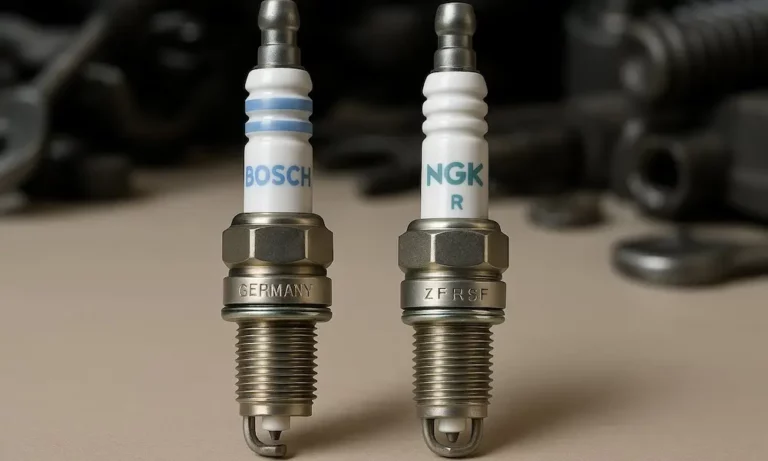
Pull a spark plug from your engine, and you’re holding a snapshot of everything happening inside your cylinders. The color, texture, and condition tell a story — and knowing how to read it can save you from a costly repair. Here’s exactly what to look for.
What a Good Spark Plug Looks Like
A healthy spark plug has a light tan, grayish-white, or fawn-brown insulator tip. That’s it. That’s the goal.
According to NGK’s spark plug reading guide, this coloring means the plug is hitting its self-cleaning temperature — somewhere between 450°C and 800°C. At that range, carbon deposits burn off naturally and exit through the exhaust.
Here’s what a good spark plug vs bad spark plug comparison looks like at baseline:
| Component | Healthy Appearance | What It Means |
|---|---|---|
| Insulator nose | Light tan, gray, or fawn brown | Correct heat range, balanced mixture |
| Electrodes | Sharp edges, uniform wear | Consistent voltage, no excess heat |
| Ground strap | Clear heat line at midpoint | Good timing and thermal management |
| Shell and threads | Dry, minimal soot, no oil | No mechanical leaks |
| Firing tip | Clean, no bridging | Spark jumps cleanly every time |
When the electrodes are sharp and the insulator is clean, the plug can keep doing its job indefinitely — until normal electrode erosion widens the gap enough to require replacement.
How a Spark Plug Fails (It Happens in Stages)
Spark plugs don’t just die suddenly. Failure happens in three clear stages:
Stage 1 — Performance drops: The gap widens from normal wear. Your ignition coil works harder to bridge it. Fuel economy dips slightly. You might not even notice yet.
Stage 2 — Intermittent misfires: The plug works fine under light loads but fails under stress — hard acceleration, cold mornings, high humidity. This is the stage most drivers dismiss as “just one of those things.”
Stage 3 — Complete failure: The plug misfires constantly. Raw fuel dumps into the exhaust. Your catalytic converter overheats. The check engine light flashes (not just glows — flashes). That flashing light means active damage is happening right now.
| Failure Stage | Plug Condition | What You’ll Feel |
|---|---|---|
| Performance-degraded | Widened gap, rounded electrodes | Slight MPG drop |
| Intermittent failure | Minor fouling, micro-cracks | Misfires under load |
| Complete failure | Bridged gap, heavy fouling | Constant misfire, flashing CEL |
Black and Sooty: Carbon Fouling
If your plug looks like it was dipped in dry, black velvet, you’re looking at carbon fouling.
This happens when the air-fuel mixture runs too rich — too much fuel, not enough air. The plug never gets hot enough to burn those deposits off. Bosch’s spark plug condition guide points to a few common culprits:
- Clogged air filter
- Malfunctioning oxygen sensor
- Stuck choke
- Too much idling or short-trip driving
Here’s the problem with carbon: it conducts electricity. Instead of the spark jumping across the electrode gap, current takes the easier route across the sooty insulator surface to the metal shell. The plug short-circuits itself.
You can sometimes clean a lightly fouled plug with a wire brush, but Firestone recommends replacing fouled plugs rather than cleaning them — and fixing the root cause. Otherwise, new plugs will foul just as fast.
| Visual Sign | Likely Cause | What You’ll Notice |
|---|---|---|
| Dull black dry soot | Rich fuel mixture | Rough idle, sluggish acceleration |
| Fluffy carbon buildup | Weak ignition voltage | Hard starting, misfires under load |
| Soot on shell and tip | Prolonged low-speed driving | Poor fuel economy |
Wet and Greasy: Oil Fouling
A wet, shiny, black, oily coating is a different animal entirely. This isn’t a tuning problem — it’s a mechanical one.
Oil is getting into your combustion chamber. The Champion Auto Parts diagnostic guide identifies the main entry points:
- Worn piston rings — oil gets pumped up from the crankcase on the intake stroke
- Degraded valve stem seals — oil migrates down from the cylinder head
- Faulty PCV system — crankcase pressure pushes oil mist into the intake
Oil coats the electrodes and insulator, blocking the spark entirely. Watch for blue or white smoke from your exhaust — that’s the burning oil telling on itself.
One useful diagnostic trick: check where the oil is. Oil on the threads and shell exterior often points to a leaking valve cover gasket. Oil saturating the electrodes means oil is being consumed inside the cylinder. Those are two very different repair bills.
| Feature | Carbon Fouling | Oil Fouling |
|---|---|---|
| Texture | Dry, matte, velvety | Wet, greasy, shiny |
| Root cause | Rich mixture or cold heat range | Worn rings, seals, or PCV |
| Exhaust smoke | Black | Blue or white |
| Fix | Tune-up or cleaning | Internal engine repair |
Bone White or Blistered: Overheating
White, blistered, or glazed insulator? Your plug is running dangerously hot.
A lean mixture — too much air, not enough fuel — drives combustion temperatures up fast. Foxwell’s spark plug reading guide outlines how this escalates:
- Deposits melt into a glossy glaze on the insulator nose
- Electrodes erode rapidly
- The insulator cracks or blisters
- The glowing electrode tip ignites fuel before the spark fires — that’s pre-ignition
The most alarming version of this is the “steam-cleaned” plug. If one plug looks spotlessly bright white while the others look normal, suspect coolant intrusion. A blown head gasket lets coolant leak into the cylinder, where it turns to steam and scrubs the plug clean. That plug is giving you a clear warning of a potentially catastrophic failure.
| Visual Sign | What It Indicates | Risk Level |
|---|---|---|
| Bone white insulator | Lean mixture or wrong heat range | Moderate — power loss |
| Glazed insulator | Melted deposits, high load | High — high-speed misfire |
| Blistered porcelain | Sustained thermal stress | Critical — pre-ignition risk |
| Steam-cleaned look | Coolant intrusion | Fatal — head gasket failure |
Detonation vs. Pre-Ignition: Two Killers, Two Clues
Both detonation and pre-ignition destroy engines. Both show up on your spark plug. But they’re not the same thing.
Detonation (engine knock) happens after the spark fires. The remaining fuel-air charge ignites spontaneously from heat and pressure. You’ll hear a metallic ping or rattle. On the plug, look for silver or dark speckling on the ceramic insulator. Those tiny specks are molten aluminum blasted off the piston crown and deposited on the plug.
Pre-ignition happens before the spark fires. A glowing hot spot — carbon deposit, sharp valve edge, overheated plug tip — ignites the mixture while the piston is still moving up. The forces involved are extreme. The plug shows melted electrodes, a soft or spongy-looking ceramic, and often a missing or destroyed ground strap.
| Attribute | Detonation | Pre-Ignition |
|---|---|---|
| When it happens | After spark fires | Before spark fires |
| Visual sign on plug | Silver peppering on ceramic | Melted electrodes, missing material |
| Sound | Metallic pinging or rattle | Harsh knock, immediate power loss |
| Damage pattern | Cumulative over time | Instant and catastrophic |
The Gap: Small Distance, Big Consequences
The spark plug gap — the space between the center and ground electrodes — controls how much voltage the spark needs and how strong the ignition event is.
Too narrow: weak spark, incomplete combustion, poor fuel economy.
Too wide: spark struggles to jump under load or in cold weather, causing misfires.
Modern iridium and platinum fine-wire plugs help here. Their smaller electrode tips focus energy more precisely and reduce the quenching effect — the way metal absorbs heat from the initial flame kernel and kills it before it spreads. Specialty ground electrode designs like U-groove cuts and cut-back ground straps give the flame more room to grow, producing a more complete burn.
Weird Deposits You Might Misread
Corona stain: A brownish or yellowish ring on the external ceramic near the metal shell. Looks suspicious but it’s harmless. High voltage attracts oil mist and dust that bake onto the ceramic. No performance effect.
Flashover: Vertical black track marks on the ceramic. This is not harmless. Voltage is traveling down the outside of the plug to the shell instead of jumping the electrode gap. Common causes: moisture, dirt, or a degraded ignition boot. Causes misfires and needs to be fixed.
Lead fouling: A yellowish or greenish glaze on the insulator. Common with racing or aviation fuels. At high temperatures, lead glaze turns conductive and kills the spark under load.
Ash deposits: Loose, cinder-like chunks on the firing end. Usually from oil additives burning in the combustion chamber. When ash deposits glow red-hot, pre-ignition follows.
One Quick Electrical Check
If you have a multimeter, check the resistance between the center electrode and the shell. NGK’s spark plug analysis guide gives a simple rule:
- Over 10 ohms: The plug is healthy enough to fire normally
- Near zero ohms: The plug is shorted — either wet or dry fouling has created a conductive bridge, and the plug won’t produce a reliable spark
That’s a 30-second test that removes all guesswork.
Your Spark Plug Is Talking — Are You Listening?
Every plug you pull tells you something. Tan and clean means everything’s working. Black and sooty means the mixture’s off. Wet and oily means mechanical wear. White and blistered means heat stress. Silver speckling means detonation.
The difference between a good spark plug vs bad spark plug isn’t just about the part itself — it’s about what the part reveals. Pull them at your next service interval, spend 60 seconds looking at each one, and you’ll know more about your engine’s health than most diagnostic codes will ever tell you.