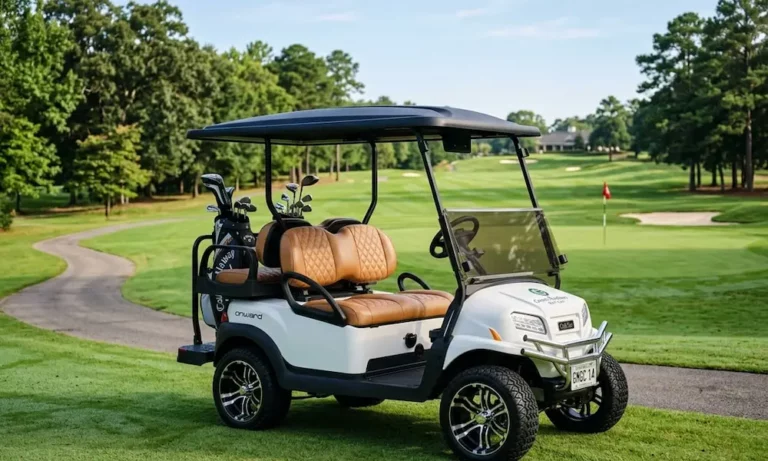
Trying to figure out how much a golf cart costs feels like asking “how long is a piece of string?” Prices range from under $2,000 to well past $20,000 — and that’s before dealer fees, insurance, and shipping enter the picture. This guide breaks down every cost you’ll face, so you can budget smart and avoid nasty surprises at the dealership.
The Real Price Range for Golf Carts in 2026
Ten years ago, the average golf cart cost around $5,000. Today, that number has doubled to roughly $10,000. Better technology, street-legal requirements, and lithium battery upgrades pushed prices up fast.
Here’s the honest overview:
- Brand new, basic models: $5,000 – $8,000
- New mid-range (4-passenger): $8,000 – $12,000
- New premium/street-legal LSV: $12,000 – $18,000+
- Used, budget models: $1,800 – $4,500
- Used, quality condition: $5,000 – $8,000
So, how much does a golf cart cost really? Expect to spend anywhere between $2,000 and $30,000 depending on what you need.
New Golf Cart Prices by Brand and Model
The Big Three: Club Car, E-Z-GO, and Yamaha
These brands dominate the premium end of the market. They offer strong resale value, nationwide dealer networks, and decades of reliability data.
Club Car builds its carts on rust-proof aluminum frames — a big deal if you live near saltwater. Their flagship Onward series starts just under $10,000 for a base 2-passenger model. A 4-passenger lifted lithium Onward jumps to $14,000 – $16,000, and the 6-passenger version can hit $21,000.
E-Z-GO wins on acceleration and has a massive aftermarket parts community. Their entry-level RXV electric model starts around $9,000. The multi-passenger Express and Liberty lines push up to $17,000 with factory lithium packages.
Yamaha is known for quiet gas engines and solid independent suspension. Their Drive2 series starts between $9,500 and $10,500. The luxury Concierge lines land between $13,000 and $16,000.
| Legacy Brand Model | Powertrain | Passengers | Price Range |
|---|---|---|---|
| Club Car Onward | Electric/Lithium | 2 | $9,700 – $14,100 |
| Club Car Onward | Gas/Lithium | 4 | $11,400 – $18,000 |
| E-Z-GO RXV | Electric/Gas | 2 | $8,900 – $12,500 |
| E-Z-GO Express | Gas/Lithium | 4–6 | $11,300 – $17,500 |
| Yamaha Drive2 | Gas/Electric | 2–4 | $9,400 – $13,500 |
| Yamaha Concierge | Gas/Electric | 4–6 | $12,100 – $16,000 |
Newer Brands That Bundle Everything In
Brands like ICON, Evolution, Denago, Dach, and Bintelli are shaking up the market with a smarter pricing model. Instead of selling you a bare-bones cart and charging extra for every upgrade, they include lithium batteries, disc brakes, lifted suspension, touchscreen displays, and street-legal lighting in the base price.
The result? You often save 20–30% compared to a similarly spec’d legacy cart. The ICON i40 and Denago EV Nomad XL both land around $9,000 – $10,000, fully loaded. The Evolution D5 Ranger fits 4–6 passengers for $11,400 – $15,500.
The trade-off? These brands don’t have the same long-term resale data or dealer density as the legacy names yet.
| Emerging Brand | Powertrain | Passengers | Price Range |
|---|---|---|---|
| ICON i20/i20X | Lithium | 2 | $9,100 – $12,300 |
| ICON i40/i40L | Lithium | 4 | $9,300 – $12,800 |
| Denago EV Nomad XL | Lithium | 4 | $9,995 |
| Dach Falcon Rider | Lithium | 4 | $10,985 |
| Evolution D5 Ranger | Lithium | 4–6 | $11,400 – $15,500 |
| Bintelli Beyond | Lithium | 4–6 | $12,700 – $21,500 |
How Much Does a Used Golf Cart Cost?
The used golf cart market offers real savings, but you need to know what you’re buying.
A well-maintained used cart typically runs $5,000 – $7,000. Depreciation follows a predictable pattern:
- Years 1–2: Retains 70–80% of original value
- Years 5–7: Drops to 35–45% of original value
That steep drop at the 5-year mark usually comes down to one thing — battery condition. A suspiciously cheap cart under $3,000 often has lead-acid batteries at the end of their life. Factor in $800 – $2,000 for an immediate replacement pack.
| Make and Model | Year | Powertrain | Average Price |
|---|---|---|---|
| Club Car DS | 2009 | Lead-Acid Electric | $1,800 |
| Yamaha G22 | 2003 | Lead-Acid Electric | $2,995 |
| ICON i40 | 2021 | Lead-Acid Electric | $4,500 |
| Club Car Tempo | 2022 | Lead-Acid Electric | $5,995 |
| E-Z-GO Lifted TXT | 2021 | Gas | $6,950 |
| Evolution Carrier 6 | 2022 | Lithium Electric | $7,999 |
| Atlas Gen-1 4-Passenger | 2023 | Lithium Electric | $10,000 |
Gas vs. Electric: Which Costs More to Own?
Gas Golf Carts
New gas carts run $6,000 – $14,000. They handle hills better, have unlimited range, and refuel in minutes. They also hold resale value well.
The downside? They’re noisy, produce exhaust, and need ongoing maintenance — oil changes, spark plugs, air filters, and fuel system checks all add up every year.
Electric Golf Carts
Electric models range from $5,000 – $15,000 new. Daily running costs are remarkably low — charging overnight typically costs less than $1. There’s no oil, no belts, and no exhaust system to maintain.
The catch is range. Most electric carts cover 25–50 miles per charge, then need several hours plugged in. Performance also drops as the battery drains.
Lead-Acid vs. Lithium Batteries: The Biggest Cost Decision
This choice will define your long-term costs more than almost anything else.
Lead-Acid Batteries
A full replacement set costs $600 – $1,500. Sounds affordable, right? The problem is they only last 3–5 years, require regular watering and terminal cleaning, and you can’t just replace one dead battery. Because the batteries run in series, mixing old and new cells causes overcharging and kills the new unit fast. You’ll replace the whole pack — multiple times over a decade.
Lithium Iron Phosphate Batteries
A factory or aftermarket lithium system costs $1,500 – $3,500 upfront. That’s a real sting. But a quality pack lasts 8–10 years through 3,000–5,000 charge cycles. No watering, no terminal corrosion, no maintenance. They’re also significantly lighter, which means faster acceleration and less wear on the cart’s motor and suspension.
The math favors lithium heavily over a 10-year ownership period.
| Battery Type | Replacement Cost | Lifespan | Maintenance | 10-Year Cost |
|---|---|---|---|---|
| Flooded Lead-Acid | $800 – $1,500 | 3–5 years | High | $2,500 – $3,500+ |
| AGM | $1,200 – $2,000 | 4–6 years | Medium | $2,400 – $4,000 |
| Lithium Iron Phosphate | $1,500 – $3,500 | 8–10+ years | Zero | $1,500 – $3,500 |
If you’re converting an older cart to lithium, brands like Eco Battery, Vatrer, and Bolt Energy offer drop-in kits. A 65Ah kit (good for ~25 miles) runs about $1,500. A 105Ah kit for ~50 miles costs $1,800 – $2,600. Add $200 – $600 for professional installation if you’re not doing it yourself.
Hidden Fees You Won’t See Coming
The sticker price is never the final price. Watch for these extras:
- Destination/freight charges: $300 – $1,000+ to move the cart from factory to dealer
- Dealer prep/setup fees: Technicians uncrate, assemble, and inspect the cart before delivery — you pay for that
- Documentation fees: Some dealers charge up to $1,000 just for title and registration paperwork
- Pre-installed accessories: Dealers sometimes bolt on custom wheels, soundbars, or tracking devices before the sale, adding $1,000 – $2,000 to the price with no opt-out
Always request a full line-item invoice before you sign anything.
Golf Cart Shipping Costs
Buying from out of state? Shipping a golf cart runs $300 – $1,200 for domestic transport. Open-trailer transport is cheaper but exposes the cart to weather and debris. Enclosed shipping costs 40–60% more and is worth it for high-value or custom builds.
| Shipping Route | Estimated Cost (Open) |
|---|---|
| San Francisco, CA to Las Vegas, NV | $426 |
| Philadelphia, PA to Jacksonville, FL | $634 |
| Fargo, ND to Austin, TX | $671 |
| Oklahoma City, OK to Seattle, WA | $1,012 |
| Chicago, IL to Los Angeles, CA | $1,174 |
Bigger, heavier carts cost more to ship. A lifted 6-passenger gas cart will run about $150 more than a compact lithium model on the same route.
Street-Legal Golf Carts: What It Costs to Make One Road-Legal
There’s a hard legal line between a standard golf cart and a street-legal Low-Speed Vehicle (LSV). An LSV must comply with Federal Motor Vehicle Safety Standard 500 and carry a 17-digit VIN. It must reach 20–25 mph and come equipped with:
- DOT-approved glass windshield
- Headlights, taillights, and brake lights
- Front and rear turn signals
- Rearview and side mirrors
- Lap or shoulder seatbelts for every passenger
- Parking brake, horn, and pedestrian alert system
Buying a factory-certified LSV costs $1,000 – $2,000 more than a comparable standard cart. Retrofitting a standard cart with the required aftermarket equipment runs $300 – $1,200 for parts alone, before labor. After that, you’ll pay annual state registration fees of roughly $15 – $40.
State rules vary wildly. Florida and Texas offer wide LSV access on public roads. New York and Massachusetts are much more restrictive.
Golf Cart Insurance: What You’ll Pay
Don’t skip insurance. A golf cart that rolls into a parked car can cause $3,000 – $5,000 in damage before you’ve had your morning coffee.
- Basic liability only: $75 – $100/year
- Added to homeowner’s policy (private property use): $50 – $200/year
- Full coverage (theft, collision, comprehensive) for a street-legal LSV: $200 – $500/year
Progressive and other major insurers offer policies that include up to $3,000 in accessory coverage for custom upgrades. You can lower your premium by bundling with your home or auto policy, raising your deductible, or paying annually instead of monthly.
| Risk Factor | Lower Premium | Higher Premium |
|---|---|---|
| Usage location | Private property | Public roads, urban areas |
| Vehicle type | Standard electric | Modified, lifted LSV |
| Storage | Locked garage | Open driveway |
| Driver history | Clean record | Prior accidents |
| Policy structure | Bundled, high deductible | Standalone, low deductible |
Tax Credits for Golf Carts in 2026: The Honest Answer
Here’s the part most people get wrong. The federal clean vehicle tax credit program has ended. Under the One, Big, Beautiful Bill Act (OBBBA), all federal EV tax credits — for new vehicles, used vehicles, and commercial vehicles — expired for purchases after September 30, 2025. There are no federal credits available in 2026.
Even before the credits expired, most golf carts never qualified anyway. The program required a minimum 7kWh battery (most carts fall short), North American final assembly, strict battery mineral sourcing, and buyer income limits under $150,000 (single) or $300,000 (joint). Imported carts were automatically disqualified.
Where to still look for savings:
- State-level rebates for registered street-legal LSVs (varies widely by state)
- Utility company rebates for home charging infrastructure ($250 – $1,000+)
- Local municipality programs targeting emissions reduction in planned communities
Check your state’s department of transportation and your electricity provider directly. These programs change frequently and funding runs out fast.
What’s the Right Budget for Your Situation?
Here’s a quick way to frame your decision:
Under $5,000: Buy used. Focus on battery condition first. A 2009 Club Car DS costs under $2,000 but budget for a fresh pack immediately.
$5,000 – $9,000: The sweet spot for quality used carts with good batteries, or entry-level new models from emerging brands.
$9,000 – $14,000: New carts from legacy or emerging brands. Most people buying a neighborhood cruiser or family cart land here.
$14,000 – $20,000+: Fully loaded premium 4–6 passenger models, lifted luxury builds, or factory-certified LSVs from Club Car, E-Z-GO, or Yamaha.
Whatever you spend at the dealership, add 10–15% for destination fees, setup costs, insurance for the first year, and registration. That’s your real budget number.