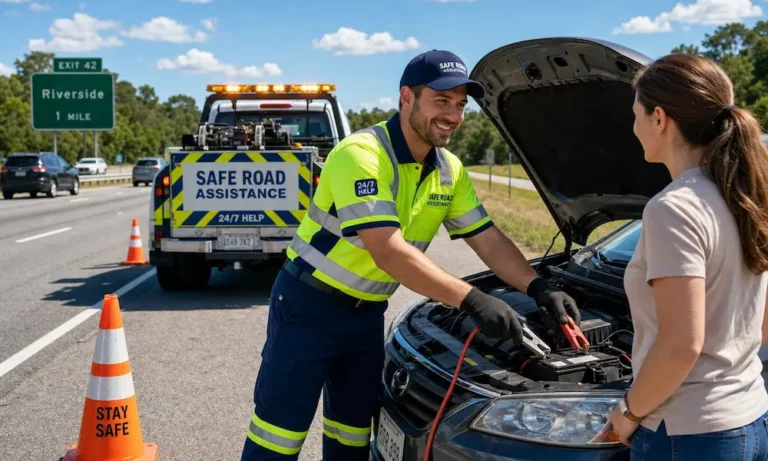
Thinking about joining Good Sam Roadside Assistance? Before you hand over your credit card, there’s some stuff you really need to know. This post cuts through the marketing fluff and gives you the real picture — the good, the bad, and the “why is no one coming to get me?” ugly. Read to the end before you decide.
What Is Good Sam Roadside Assistance?
Good Sam Roadside Assistance is a membership-based emergency service under the Camping World corporate umbrella. You pay an annual fee, and in theory, they’ll send help when your car or RV breaks down — towing, tire changes, battery jumps, fuel delivery, lockout help, and more.
It sounds like a solid deal on paper. Whether it holds up in real life is a very different story.
How Much Does Good Sam Roadside Assistance Cost?
Good Sam splits its plans into two buckets: auto plans and RV plans. Both use a sneaky pricing trick — heavily discounted intro rates that roughly double at renewal.
Auto Plan Pricing
| Plan | Intro Price | What’s Covered |
|---|---|---|
| Platinum Auto | $49.95/yr | Your owned car, truck, SUV, or van |
| Platinum+ Auto | $54.95/yr | Adds rentals, motorcycles, sports trailers |
| Platinum Complete Auto | $89.95/yr | Adds tire/wheel hazard and emergency medical help |
RV Plan Pricing
| Plan | Intro Price | Renewal Price |
|---|---|---|
| Standard RV | $64.95 | $129.95 |
| Platinum RV | $79.95 | $159.95 |
| Platinum Complete RV | $119.95 | $239.95 |
| Platinum+ RV | $219.95 | Varies |
That intro rate looks great. But the renewal price can hit double what you originally paid. And getting out of the membership? Consumers report billing headaches, unauthorized fees, and cancellation barriers that make the whole process more painful than it should be.
What Does Good Sam Roadside Assistance Actually Cover?
Here’s what Good Sam promises across its plans:
Towing: The flagship benefit. Good Sam markets “unlimited towing” with no mileage cap. Sounds incredible — until you read the fine print (more on that in a minute).
Flat tire help: A technician removes your damaged tire and installs your spare. Great for RV owners who don’t carry a floor jack that can lift 20,000 pounds. Note: if you need a new tire delivered, you pay for the tire itself.
Fuel and fluid delivery: Run out of gas? They’ll deliver up to five gallons free. Other fluids like coolant or diesel exhaust fluid are available, but you cover the fluid cost.
Battery jump-start: Standard jump service for dead batteries.
Lockout assistance: A tech comes to unlock your vehicle. They won’t cut or program new keys — that’s on you.
Winching and extrication: They’ll pull your vehicle out of mud, snow, or a ditch — but only if you’re within 100 feet of a maintained public road.
Mobile mechanic dispatch: A technician comes to you for minor repairs. Good Sam covers the dispatch fee. You pay labor and parts.
Travel interruption benefits (higher tiers): If you break down more than 100 miles from home, you can get reimbursed for lodging, meals, and rental cars — up to $1,000–$1,500 depending on your plan.
RV tech helpline: Priority access to certified technicians who can walk you through fixes by phone, potentially saving you a tow altogether.
Family coverage: Spouse, domestic partner, and dependents under 25 are all covered at no extra cost.
The “Unlimited Towing” Catch You Need to Know About
Here’s where things get uncomfortable.
Good Sam’s “unlimited towing” doesn’t mean what most people think. The unlimited distance only applies if you’re towed to the nearest qualified facility — not the shop you trust, not the dealer you prefer, not your driveway.
If you break down 50 miles from home, but a mechanic is 5 miles in the opposite direction, they’ll send you there. Want to go home instead? That’s out of pocket.
For RV owners, this gets worse. The “nearest qualified facility” might be a general mechanic with a 10-foot ceiling clearance and zero experience with a Class A diesel pusher. Consumers have documented being towed to facilities that couldn’t even fit their RV, were closed for the weekend, or refused the job entirely — and Good Sam offered no further assistance.
The only plan that gives you destination flexibility is the Platinum+ RV plan, which lets you choose where you’re towed — within a 100-mile radius — for $219.95 at intro pricing.
The “Excessive Use” Problem
This one’s genuinely alarming.
Good Sam sells plans with “unlimited” service. But members who use the service more than two or three times in a year have reported getting their policies cancelled — labeled as “excessive use.”
Think about what that means in practice. A flat tire in spring. A dead RV battery at a campground in summer. A short tow in fall. Three legitimate emergencies in one year — and Good Sam has been documented threatening cancellation or refusing service entirely.
The company uses an internal, undisclosed cost threshold to decide when a member costs too much. When you hit it, they cancel without a pro-rated refund.
That’s not a safety net. That’s a safety net with a trap door.
How Reliable Is Good Sam’s Dispatch?
This is where the data gets hard to ignore.
Good Sam holds a 1.2 out of 5 stars on Consumer Affairs, with over 92% of reviewers giving one star. That’s not a vocal minority — that’s a pattern.
Here’s what consumers report most:
- Wait times of 3 to 7+ hours for a tow truck to arrive
- Tracking apps showing “driver arriving soon” for hours while no one was actually dispatched
- Being stranded overnight because local tow operators rejected the job (Good Sam’s reimbursement rates are reportedly below market)
- Wrong equipment sent — a standard flatbed dispatched for a 20,000-pound fifth wheel
- Phone systems that crash or loop, blocking access to live agents
- Repeat callbacks from different agents asking the same questions without ever securing a truck
- BBB complaints documenting digital infrastructure failures and dispatch breakdowns
The core issue is structural. Good Sam doesn’t own a fleet. It operates through third-party dispatch brokers like Sonsio, which means it’s the middleman — not the rescuer. When local tow companies won’t accept the job at Good Sam’s rates, nobody comes.
What Happens When You Pay Out of Pocket?
Sometimes Good Sam’s network fails completely and you’re forced to hire a private tow truck. Good Sam technically requires pre-authorization before you do that. But when their system crashes and you can’t reach an agent, that authorization becomes impossible.
Then you submit for reimbursement and the claims department denies it.
Common reasons for denial include demanding photos of your blown tire that highway patrol already cleared, or using their own software failure as “proof” you never called. Instead of covering a $1,500 tow bill their network caused, some members have been offered a $100 gift card.
Good Sam vs. The Competition
Good Sam vs. AAA
| Feature | Good Sam | AAA (Plus/Premier) |
|---|---|---|
| Towing distance | Unlimited — but nearest facility only | Capped (100–200 miles) — but your choice of destination |
| Destination control | Denied unless paying extra | Full member choice within mileage cap |
| Network type | Third-party brokers | Proprietary contracted fleets |
| RV specialization | Marketed heavily, execution varies | Depends on regional club |
AAA’s mileage cap sounds worse until you realize you pick where you go. That flexibility is worth a lot when you’re broken down and stressed. RV forum users frequently report abandoning Good Sam mid-crisis and calling AAA, who arrived faster.
AAA isn’t perfect for RVs — not every regional club has heavy-duty equipment. But for standard vehicles, AAA wins on reliability and destination choice.
Good Sam vs. Coach-Net
| Feature | Good Sam Platinum Complete | Coach-Net (Motorized) |
|---|---|---|
| Annual cost | $119.95 intro / ~$239.95 renewal | $249 |
| Trip interruption | Up to $1,500 | Up to $2,000 |
| Heavy RV dispatch | Frequently sends wrong equipment | Deploys two trucks simultaneously for complex rigs |
| Tech support integration | Add-on helpline | Built into the dispatch model |
Coach-Net costs more, but it pays local towers at market rates — which means trucks actually show up. For full-timers or anyone towing a big rig, the RV community consistently recommends Coach-Net over Good Sam.
Good Sam vs. FMCA / SafeRide
| Feature | Good Sam | FMCA / SafeRide |
|---|---|---|
| Auto pricing | $49.95–$89.95 | $49.99/vehicle |
| Usage cap | “Unlimited” (cancellation risk) | Capped at 3 uses/$100 per incident |
| Transparency | Low | High |
| Trip interruption | $1,000–$1,500 | Up to $1,500 |
FMCA / SafeRide caps you at three uses per year — but tells you that upfront. No surprise cancellations. No hidden thresholds. For budget-conscious drivers who want honest terms, this is a more trustworthy option than Good Sam’s opaque “unlimited” promise.
So Is Good Sam Roadside Assistance Worth It?
Here’s the straight answer by driver type:
Standard car drivers and families: No. AAA’s larger proprietary network, faster response times, and destination flexibility make it the better choice — even at a slightly higher price. The peace of mind is real, not just a marketing claim.
Full-time RV travelers with heavy rigs: Absolutely not. The dispatch failures, equipment mismatches, and nearest-facility rule create real danger when you’re managing a 40-foot motorhome or a loaded fifth wheel. Coach-Net’s premium pricing reflects a service that actually executes — and that matters when you’re on the side of the highway.
Occasional travelers on a tight budget: Maybe — but only if you go in with open eyes. The intro pricing is genuinely low. But you should treat it as a discount club with inconsistent emergency support, not a reliable rescue service. Know that wait times may be long, destination control is limited, and using it more than twice might get your policy cancelled.
Good Sam’s marketing is polished. Its execution, based on real consumer data, frequently isn’t. The gap between what they promise and what they deliver is wide enough to leave you stranded on a hot interstate shoulder for eight hours — and that’s not a hypothetical. It’s in the reviews.