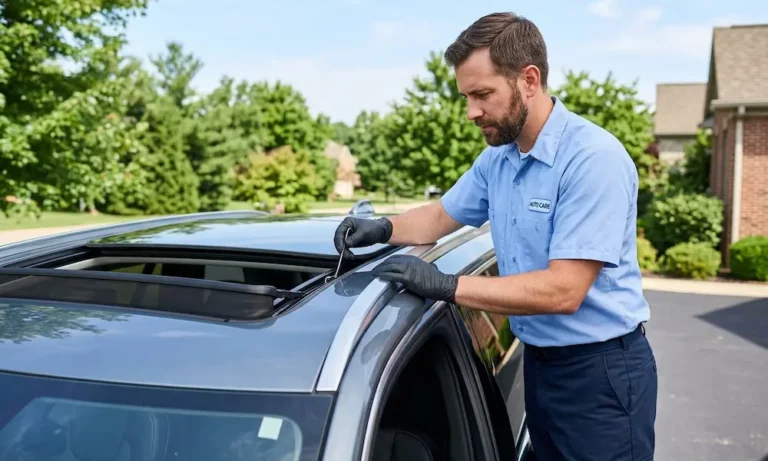
Got a musty smell in your car? Wet carpets after rain? Your sunroof drains are probably clogged. The good news — you can fix this yourself in about 30 minutes with tools you likely already own. Keep reading to learn exactly how to clean sunroof drains, what to avoid, and how to prevent a repeat of the soggy mess.
Why Your Sunroof Leaks (It’s Actually by Design)
Here’s something most car owners don’t know: your sunroof is designed to let water in.
Engineers call it a controlled leak system. The rubber seal around your glass slows water down, but it doesn’t stop it completely — especially as the car ages. UV exposure, heat cycles, and everyday use cause the seal to harden and develop tiny gaps.
So instead of trying to keep water out entirely, the sunroof frame acts like a catch basin. It collects water and routes it through four drain tubes hidden inside your car’s pillars, down and out to the ground beneath your wheel wells or bumper.
The system works great — until the tubes get clogged.
What’s Clogging Your Sunroof Drains?
Three main culprits are responsible for most blockages.
Organic sludge — Leaves, pine needles, and pollen wash into the trough when you open your sunroof. Inside the narrow tubes, this debris decomposes. In warm, humid climates, it turns into a thick, sludgy compost that grows mold and algae, forming a solid plug that water can’t push through.
Fine sediment — In dry or urban areas, dust and fine particles settle into low points in the tubing. Over time, they mineralize into a hard, scale-like blockage that’s tougher to break up.
Bugs and debris — Spiders love the dark, moist shelter of drain tubes. Their webs act like a net, catching dust and pollen at the entry or exit points. Exit valves can also seal shut from road grime and mud, trapping water inside even when the tubes themselves are clear.
Signs Your Sunroof Drains Are Blocked
Don’t wait for a flood to figure out something’s wrong. Here are the warning signs to watch for, from subtle to serious.
Smell before you see it — A persistent musty or moldy odor after the car sits closed for a few hours is usually the first clue. Trapped moisture in the carpet padding causes excessive window fogging too.
Visual clues by location:
- Headliner stains near the sun visors or roof corners → the trough is overflowing
- Wet A-pillar fabric or water dripping from grab handles → tube disconnected or bypassed
- Soaked front or rear footwells → water tracked down the pillar to the lowest point
- Water near the dashboard or kick panels → front drain circuit failing
Electrical gremlins — This is where things get expensive. Modern cars pack the Body Control Module, airbag controllers, and audio amplifiers under the seats and in the floor. Water finds them fast. If you’re seeing random warning lights, key fob failures, or total shutdowns — check those drains immediately.
Where Are the Sunroof Drains Located?
Every sunroof has four drains — one at each corner of the trough. They’re hidden inside your car’s structural pillars behind the headliner and trim.
| Drain Position | Routing Path | Exit Location |
|---|---|---|
| Front Left & Right | A-pillars (beside windshield) | Behind front fender liners or door hinge area |
| Rear Left & Right | C-pillars (sedan) or D-pillars (SUV/wagon) | Behind rear bumper or in rear wheel wells |
The front drains are usually easier to access and clean. The rear drains are longer, have more bends, and collect more sediment — which is why they clog more often.
What You’ll Need to Clean Sunroof Drains
Using the wrong tools causes more damage than the clog itself. Stiff wire can pierce aged tubing. Too much air pressure blows the tube right off its fitting — and now you need to drop the headliner to fix it.
Use these:
- 3–4mm weed trimmer line — flexible enough to navigate pillar bends, stiff enough to push through clogs. This is the go-to tool for DIY sunroof drain cleaning.
- Regulated air compressor — set to under 30 PSI, no exceptions. Aerosol “cans of air” are harder to control and not ideal here.
- Wet/dry vacuum with a narrow nozzle
- Enzyme-based cleaner or mild dish soap mixed with warm water — enzyme cleaners break down biological growth that plain soap can’t touch
- LED flashlight to find the drain ports
- Small soft brush or cloth
Never use:
- Chemical drain cleaners (sodium hydroxide, sulfuric acid) — they destroy the polymer tubes and can damage your paint
- Metal wire or stiff rods — they puncture old tubing easily
- High-pressure air above 30 PSI — it disconnects tubes from their fittings, turning a $20 fix into a $500 repair
How to Clean Sunroof Drains: Step-by-Step
Work through these five stages in order. Skipping steps leaves debris behind that’ll re-clog the system faster.
Step 1: Clear the Trough First
Open your sunroof all the way. Use your wet/dry vacuum to pull out every leaf, twig, and clump of debris from the trough. Then wipe the corners — especially around the drain ports — with a damp cloth and mild soap. If you skip this, you’ll push that debris straight into the tubes during cleaning.
Step 2: Snake the Drain Ports
Shine your flashlight into each corner to find the small drain holes. Feed the trimmer line into the port slowly, rotating it clockwise as you push. This rotation helps the tip navigate tight bends inside the pillar.
Push until you feel resistance — that’s your clog. Don’t force it. Instead, pull back halfway and push again repeatedly. This “flossing” motion breaks up the blockage mechanically. Keep going until the line moves freely through the full length of the tube. Wipe the line clean before moving to the next port.
Step 3: Blow Out the Debris
After snaking, hold your air nozzle slightly away from the port — don’t seal it tight. Send short 1–2 second bursts of compressed air (under 30 PSI) to blow out loosened debris. Keeping the nozzle loose lets excess pressure escape and protects the tube-to-frame connection.
Step 4: Flush and Verify Flow
Pour your enzyme cleaning solution slowly into the trough near each drain port. Watch where the water exits:
- Front drains → water appears near the front wheel wells or door hinges
- Rear drains → water exits near the rear bumper or rear wheel wells
A clear drain drains fast. You might hear a light gurgling sound at the port — that’s a good sign. If water pools in the trough or drains slowly, go back and repeat Steps 2 and 3.
Step 5: Clean the Exit Valves
Walk around the car and find the rubber exit valves — they look like small rubber flaps or “teats” near the bumpers and wheel wells. Squeeze and flex them by hand to free up any road grime or mud sealing them shut. For stubborn valves, you can snake upward from the exit point to clear blockages from the bottom.
Sunroof Drain Cleaning: Cost of Neglect
Still not sure this maintenance is worth your time? Here’s what ignored drains actually cost.
| Problem | Severity | Estimated Repair Cost |
|---|---|---|
| Clogged tube | Low | $0–$150 (DIY or shop) |
| Disconnected tube | Moderate | $250–$600 |
| Mold in carpet and padding | High | $500–$2,000 |
| Electrical module replacement | Critical | $1,500–$8,000+ |
Once water soaks into the open-cell foam under your carpet, professional extraction equipment is the only real solution. Mold colonies establish within 48–72 hours in that environment and create a permanent odor that even ozone treatment struggles to eliminate.
Electrical damage is worse. Water wicks through wire insulation to reach control modules far from the original leak. Replacing a central wiring harness can take 20–40 hours of labor — on top of parts costs.
Vehicle-Specific Tips
Some cars need a slightly different approach.
Volkswagen GTI / Passat and Audi B5 — VW models use a “sphincter valve” exit that clogs easily with fine sediment. Some owners trim the valve ends to improve flow. Audi Avant wagon owners often need to remove the interior wheel well liner to reach the rear exit points.
Subaru Forester / Outback — The front drain ports are easy to spot and great for DIY maintenance. Check behind the mud flaps — road compost buildup can block the exit from the outside.
Mazda 3 / Volvo C30 — These models sometimes have tubes secured with adhesive that degrades over time. If water runs down the inside of your windshield immediately when you pour water in the trough, the tube is disconnected — not clogged. Cleaning won’t fix it. You’ll need to drop part of the headliner and re-secure the tube with a clamp or zip-tie.
How Often Should You Clean Sunroof Drains?
Your environment determines your schedule.
Once a year works for most climates. Clean in late autumn after leaves have fallen.
Twice a year if you park under trees regularly, live in a high-pollen area like the Pacific Northwest or Southeast US, or drive in heavy rain frequently. Spring cleaning clears pollen sludge; autumn cleaning clears leaf debris.
After every storm or high-pressure car wash — do a quick check of your footwells and headliner for dampness. Catching it early is the difference between a 30-minute cleaning session and a multi-thousand-dollar repair.
A few other habits that help:
- Park away from trees with small leaves, needles, or heavy sap when you can
- Always close the sunroof completely — even a tilted position lets in significantly more debris
- Wipe the rubber seal periodically with a damp cloth and treat it with a silicone-based rubber protectant to slow down cracking from UV damage
A few feet of trimmer line costs less than a dollar. Thirty minutes of your time costs nothing. That’s genuinely one of the best investments you can make in your car’s long-term health.