You’re staring at two trim levels of the same truck. One’s got air suspension. The other doesn’t. The price gap? Around $1,500. Your brain’s doing the math while the salesperson hovers.
Here’s the deal: air suspension isn’t a simple yes or no decision. It’s a bet on how you’ll use your vehicle—and whether you’re cool with the maintenance that comes later. Let’s break down what you’re actually paying for.
What Air Suspension Actually Does (And Why It Matters)
Think of traditional steel springs like a fixed-rate mortgage. They’re set at one stiffness level, period. Air suspension? That’s variable-rate. It adjusts on the fly.
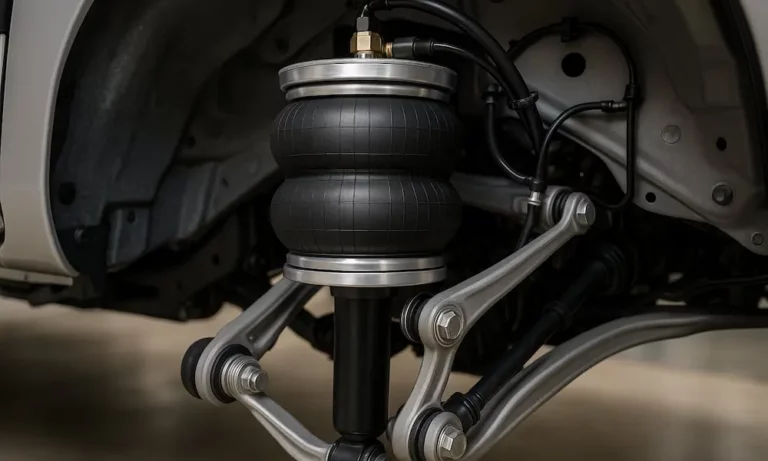
Instead of metal coils, you’ve got rubber bags filled with compressed air. The system pumps them up or lets air out based on what you’re doing—towing a trailer, cruising empty, or hitting highway speeds.
The magic’s in the physics. Steel springs follow a linear path: compress them an inch, they push back with X force. Compress them two inches, they push back with 2X force. Predictable, but dumb.
Air springs work differently. Light bumps? The air compresses gently. Big hits? The pressure spikes exponentially, giving you a progressive spring rate that feels plush over railroad tracks but won’t bottom out when you hit a pothole at speed.
The Real-World Translation
You’ll notice this most when your truck goes from empty to loaded. A half-ton pickup with steel springs rides like a buckboard when there’s no weight in the bed. The springs are calibrated for hauling, so they’re too stiff for daily driving.
Air suspension fixes this. It drops pressure when you’re solo, softening the ride. Load up 1,500 pounds of mulch? The system inflates to keep the truck level without turning into a pogo stick.
Where Air Suspension Actually Wins
Let’s cut through the marketing fluff. There are three scenarios where air suspension isn’t just nice—it’s legitimately better than steel.
Towing Heavy, Often
If you’re pulling a camper or equipment trailer regularly, air suspension improves safety in ways helper bags can’t match.
When you hitch up a heavy trailer, tongue weight squats the rear. This lifts the front end, unloading the steering tires. Your headlights now point at the sky instead of the road. Braking gets sketchy because weight’s shifted off the front axle.
Factory air suspension detects this squat through height sensors. It automatically inflates the rear bags until the truck’s level again. Your steering grip comes back. Headlights aim where they should. The brake system works within its designed geometry.
Can you get this with aftermarket helper bags? Sort of. But those require manual adjustment before every trip. Factory systems do it seamlessly while you’re driving down the on-ramp.
The Luxury Ride You Actually Feel
There’s a reason Mercedes and Range Rover make air suspension standard on their top models. The difference is real.
Air is a natural vibration damper. Steel springs are metal-on-metal connections that transmit road noise straight to the cabin. Air bags act as insulators, absorbing the micro-vibrations that create highway drone.
Pair this with adaptive dampers (which almost always come with air suspension), and you’ve got a system that can be plush on the commute and firm on a twisty road. One vehicle, two personalities.
Aerodynamics That Save Money
This one’s sneaky but significant for highway drivers. Trucks like the Ram 1500 and EVs like the Audi e-tron use air suspension for active aero.
At speeds above 60 mph, the suspension automatically lowers the vehicle by about an inch. This reduces drag by smoothing airflow under the chassis. The fuel savings per tank are small—maybe a mile per gallon—but over 100,000 miles? You’re looking at real money.
For electric vehicles, this isn’t about fuel—it’s about range anxiety. Lowering the car at highway speeds can add 5-10 miles of range, which matters when you’re watching the battery meter tick down.
The Reliability Problem Nobody Mentions at the Dealership
Here’s where the conversation gets uncomfortable. Air suspension is mechanically complex. When it works, it’s fantastic. When it fails—and it will—you’ll understand why so many truck forums have “air delete” threads.
The Domino Effect of Failures
Air suspension doesn’t fail gracefully. It cascades.
A small leak in one air bag (maybe $400 to replace) causes the compressor to run constantly, trying to maintain height. The compressor overheats and burns out ($800). Before you catch it, moisture from all that cycling saturates the air dryer ($200) and corrodes the valve block ($600).
What started as a $400 bag replacement is now a $2,000 system overhaul. This isn’t hypothetical—it’s the most common failure pattern across all manufacturers.
Cold Weather Is the Enemy
If you live where it freezes, pay attention. Most air systems (especially Ram trucks) use an “open-loop” design. They pull air from the atmosphere, compress it, and try to dry it with a desiccant filter.
Problem: humid air contains water vapor. When temperatures drop, that moisture freezes inside the valve block and air lines. Your truck drops to the bump stops overnight, stuck in “Aero Mode” until the ice melts.
Owners in Canada and northern states have gotten creative—adding air brake antifreeze, parking in heated garages, even converting to coil springs to escape the headache.
Jeep and Land Rover use “closed-loop” systems filled with nitrogen, which eliminates freezing. But if you get a leak, you can’t just refill it at a gas station. You need a nitrogen recharge at a dealer or specialty shop.
Warranties Won’t Save You
Read the fine print on extended warranties. Most classify air suspension components as “wear items,” like brake pads. They’re often excluded from coverage.
You might buy a bumper-to-bumper warranty assuming it covers your $3,000 air strut failure at 65,000 miles. Then you read the exclusions list and see “adaptive suspension systems” in tiny print. You’re on your own.
The Real Cost of Ownership
Let’s model this out for someone buying a truck they plan to keep 10 years.
Steel Springs: Boring and Cheap
- Upfront cost: $0 (it’s standard)
- Maintenance over 10 years: Maybe $800 for shocks at 100k miles
- Total: $800
Factory Air Suspension: The Premium Bet
- Upfront cost: $1,500 option price
- First major repair (7-9 years): $2,500 (air bags and compressor)
- Preventative maintenance: $400 (dryer service, tank drain)
- Total: $4,400
That’s the math. Air suspension costs about $3,600 more over a decade, assuming you get lucky and don’t have early failures.
The Aftermarket Middle Ground
Don’t want factory air but need load-leveling? Helper bags (Firestone Ride-Rite, Air Lift LoadLifter) are the compromise.
They bolt onto your existing steel springs. Keep them at 5 psi when empty. Inflate to 80 psi when towing. You get 80% of the leveling benefit for $500 installed.
The ride won’t be as refined as factory air. You’ll manually adjust pressure with a compressor or wireless controller. But if a bag fails, your steel springs keep working. No tow truck needed.
Where Air Suspension Is a Bad Bet
Not everyone should buy this tech. Here’s where it’s objectively the wrong choice.
Serious Off-Roading
Overlanders and rock crawlers avoid air suspension for one reason: articulation.
When you lift a truck into “Off-Road 2” mode for clearance, you’re inflating the bags to max pressure. That makes them stiff. When the suspension hits a rock, it bounces instead of absorbing. Tires lose contact with the ground.
Steel coils flex. Air bags at high pressure don’t. You’ll lift a wheel in situations where a well-tuned coil setup would keep all four tires planted.
Worse, if a bag punctures 100 miles into the backcountry, you’re stuck. The vehicle drops to the frame. Driving on bump stops over rough terrain will destroy your chassis. A broken coil spring? You limp home with a sag.
Daily Commuters Who Keep Cars Forever
If you’re buying a Camry-equivalent and planning to drive it 200,000 miles, air suspension is a liability you don’t need.
The ride quality difference on smooth roads is marginal. You’re not towing. You don’t need height adjustment. What you do need is simplicity.
Steel springs last the life of the vehicle. Air bags need replacement every 60,000-100,000 miles. The compressor will eventually fail. Sensors corrode. You’re signing up for maintenance that serves no functional purpose for your use case.
Budget-Conscious Used Car Buyers
Buying a 7-year-old luxury SUV with air suspension is playing Russian roulette.
The previous owner might’ve deferred maintenance. The system might be on borrowed time. When it fails, you’re looking at a $3,000+ repair bill on a car you paid $18,000 for.
This is why conversion kits exist. Owners swap to steel coils to escape the repair cycle. The ride quality suffers, but the car becomes reliable again.
Maintenance Tricks That Actually Work
If you’ve already got air suspension—or you’re buying it anyway—here’s how to stretch its lifespan.
Manage Moisture Like Your Wallet Depends On It
The air dryer is the system’s weak point. It uses desiccant beads to remove moisture from compressed air. Over time, those beads turn to powder and stop working.
Replace the dryer every 3-4 years, even if it seems fine. This $150 part prevents $2,000 in downstream damage. In humid or coastal climates, do it every 2 years.
For open-loop systems in cold regions, add air brake antifreeze to the reservoir. It’s methanol-based and prevents ice formation in the lines. Truckers have done this for decades.
The Overnight Drop Test
Park on level ground. Measure the distance from the top of each wheel to the fender. Check it again 12 hours later.
If one corner’s dropped more than a half-inch, you’ve got a leak. Fix it now—before the compressor starts overworking. This simple test can save you thousands by catching failures early.
Clean the Bags
Road salt, mud, and sand get trapped in the folds of the air springs. As the suspension cycles, this grit acts like sandpaper, wearing through the rubber.
Every few months, spray out your wheel wells with a hose. Wipe down the visible portions of the bags. It takes 10 minutes and can double the lifespan of the bags.
The Verdict by Driver Type
So, is air suspension worth it? Depends entirely on who you are.
You Should Buy It If:
- You tow heavy trailers (over 5,000 lbs) more than a few times a year
- You haul max payload regularly and want a decent unladen ride
- You’re buying a luxury vehicle and plan to sell before 80k miles
- You live in a warm climate and value ride comfort over simplicity
Skip It If:
- You rarely tow or haul heavy loads
- You off-road seriously or overland in remote areas
- You keep vehicles past 100,000 miles and hate repair bills
- You’re buying used and the air suspension is already 6+ years old
- You live in a cold climate and park outside
The Aftermarket Compromise:
Buy the truck with steel springs. Add helper bags if you tow. You’ll spend $500 instead of $4,400 over 10 years, and you’ll still get 80% of the utility.
The Bottom Line: It’s a Trade, Not a Win
Air suspension isn’t “better” than steel springs. It’s different. You’re trading simplicity and longevity for versatility and comfort.
If those benefits align with how you actually use your vehicle—and you’re prepared for the maintenance reality—it’s a smart investment. The self-leveling for towing is genuinely safer. The ride quality is noticeably better. The aero gains add up.
But if you’re buying it because it sounds cool, or because the dealer pushed the option, you’re paying $3,000+ for a feature you’ll resent the first time it fails.
The folks who love air suspension? They tow boats every weekend. They bought the Range Rover knowing it’s high-maintenance. They budget for repairs like they budget for premium fuel.
The folks who hate it? They bought the fancy truck, ignored the “Service Suspension” light for a month, and got hit with a $4,500 invoice at 75,000 miles.
Know which camp you’re in before you check that option box.