Spending $1,000–$2,000+ on a ceramic coating is a big call. So before you hand over your keys, you deserve a straight answer. This post breaks down exactly what Gtechniq delivers, what it doesn’t, and whether it’s actually worth your money — no fluff, no hype.
What Gtechniq Ceramic Coating Actually Does
Gtechniq coatings don’t just sit on top of your paint like a wax. The nano-particles penetrate the microscopic pores of your factory clear coat and cross-link into a hardened, glass-like barrier. That barrier becomes the new functional surface of your car.
Here’s what you actually get from that:
- Chemical resistance — bird droppings, tree sap, alkaline car wash detergents, and road grime all struggle to bite through it
- UV protection — the coating absorbs ultraviolet radiation that would otherwise slowly oxidize and fade your paint
- Hydrophobicity — water beads up tight and rolls off the panel, pulling surface dirt with it
- Reduced wash frequency — the self-cleaning effect is real, especially on a properly maintained coating
What it won’t do is stop rock chips, key scratches, or heavy impact damage. If you want that, you need paint protection film on high-impact panels, with the ceramic coating applied on top. That combination is the gold standard.
Crystal Serum Light vs. Crystal Serum Ultra: Which One’s Right for You?
Gtechniq splits its paint protection lineup into two distinct tiers. Knowing the difference saves you money and prevents costly mistakes.
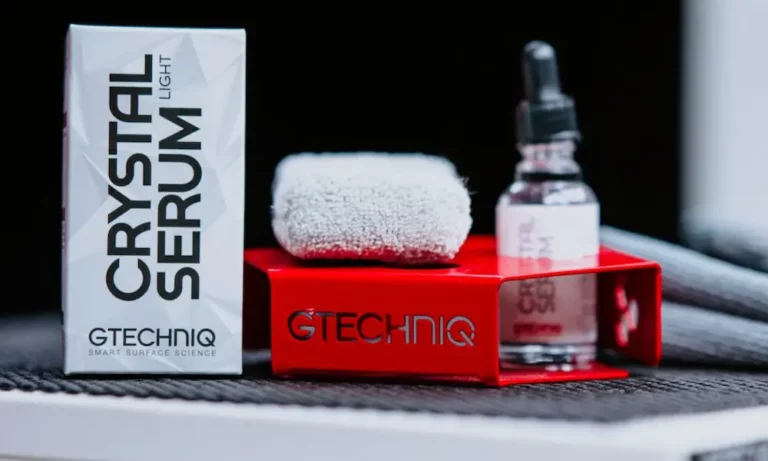
Crystal Serum Light (CSL) — The DIY-Friendly Option
Crystal Serum Light is widely regarded as the industry benchmark for enthusiast-level coatings. It’s available to hobbyists, mobile detailers, and anyone willing to do the prep work properly.
Key specs:
- Rated at maximum pencil hardness
- Realistic durability of 3–5 years depending on your climate and maintenance
- Thermal stability from –40°F to over 400°F — handles a hot engine hood in a Texas summer without breaking down
- Broad chemical resistance against acids and alkalis
The biggest selling point? If you mess up the application and get a high spot, you can remove it with machine polishing. That forgiveness makes CSL the smart choice if you’re not working in a perfectly controlled environment.
Crystal Serum Ultra (CSU) — Pro-Only, Maximum Protection
Crystal Serum Ultra is locked behind a strict accreditation process. Gtechniq only sells it to vetted professional installers with climate-controlled facilities and demonstrated paint correction skills. That restriction isn’t snobbery — it’s risk management.
Here’s why: CSU uses a dual-layer composite structure. As it cures, the liquid chemically separates into two distinct layers:
- A slightly flexible base layer that absorbs the thermal expansion and contraction of metal and plastic panels
- An ultra-hard outer layer that resists chemical damage, oxidation, and wash-induced micro-marring
That combination is what single-layer coatings can’t easily replicate. But the bond is practically permanent. If a high spot cures fully, standard machine polishing won’t touch it — you’re looking at aggressive wet-sanding, which shaves down your factory clear coat. One error can cost a panel respray. That’s why professionals only.
Quick Comparison Table
| Feature | Crystal Serum Light | Crystal Serum Ultra |
|---|---|---|
| Who can buy it | Enthusiasts and mobile detailers | Accredited professionals only |
| Structure | Single layer | Dual-layer composite |
| Realistic durability | 3–5 years | 5+ years (marketed up to 9) |
| Error correction | Machine polish | Wet-sanding required |
| Best for | High performance with a safety margin | Maximum long-term asset preservation |
The Real Cost Breakdown — And Why Labor Is Everything
People often think the price of a professional ceramic coating install ($1,000–$2,000+) is mostly for that small glass vial of liquid. It’s not. The liquid is a fraction of the bill.
Most of the cost is labor — specifically, paint correction.
Ceramic coatings are optically clear and highly permanent. They don’t fill or hide existing swirl marks, scratches, or oxidation. Apply a coating over neglected paint and you’ve just permanently locked those defects under a glass shield. They’ll look worse under direct sunlight, and removal becomes extremely difficult.
Proper prep involves:
| Preparation Phase | What Happens | Why It Matters |
|---|---|---|
| Chemical decontamination | Iron removers and alkaline pre-washes | Dissolves embedded metals and heavy traffic film |
| Mechanical decontamination | Detailing clay | Removes bonded surface contaminants |
| Paint correction | Machine polishing with abrasive compounds | Levels the clear coat and removes swirl marks |
| Surface stripping | Panel prep solvent (Gtechniq recommends their Panel Wipe) | Removes polishing oils so the coating bonds properly |
That paint correction stage alone can take 10–20+ hours of skilled labor depending on the paint’s condition. That’s where your money goes — and it’s worth every cent if you want a flawless result.
EXO v5: Why This Topcoat Changes the Hydrophobic Game
The foundational ceramic coating gives you protection. The EXO topcoat gives you the visual drama — the tight water beads, the extreme slickness, the gloss that makes people stop and stare.
Gtechniq EXO v5 is applied directly over cured Crystal Serum coatings. The engineering jump from v4 to v5 solved a specific, real-world problem: surface clogging.
Earlier topcoats had a slightly porous structure under electron microscope analysis. Over time, water minerals, traffic film, and greasy fallout embedded in those pores. Water stopped beading. Owners assumed their expensive coating had failed. Usually, it hadn’t.
The v5 formula cures into a significantly denser, less porous surface. That means:
- Contact angle of 115 degrees — water forms incredibly tight, spherical beads
- Draining angle of just 13 degrees — water evacuates panels at minimal incline, slashing hard water spot risk
- Single layer application — v4 required two layers; v5 achieves superior results in one pass, cutting installer time significantly
- 18–24 month durability as a standalone topcoat
For anyone in the American Midwest or Southwest dealing with hard municipal water, that 13-degree draining angle is particularly important. Mineral deposits from evaporating water are a serious threat to both coatings and bare clear coat.
C2v3 Liquid Crystal: Your Ongoing Maintenance MVP
A ceramic coating isn’t a one-and-done investment. It needs maintenance. C2v3 Liquid Crystal is how you keep your coating performing properly between professional visits.
It serves three functions:
- Standalone sealant — 4–8 months of protection on bare, prepared paint
- Coating booster — applied every few months over a cured ceramic layer, it replenishes the sacrificial hydrophobic surface
- Drying aid — diluted heavily with distilled water, mist it onto a wet car after washing. It lubricates your microfiber drying towel, prevents marring, and deposits a thin protective layer in one step
One critical note: always dilute with distilled water, not tap. Dissolved minerals in tap water will spoil the mixture within weeks. Distilled water preserves it for months.
Wheels and Glass: Don’t Ignore the Rest of Your Car
C5 Wheel Armour — Brake Dust’s Worst Enemy
Wheels operate in brutal conditions — road salt, tar, and superheated iron brake dust, millimeters from the road surface. Traditional waxes evaporate almost immediately in that environment.
Gtechniq C5 Wheel Armour maintains its structure at temperatures approaching 1,100°F. It bonds to alloy, chrome, stainless steel, and painted wheel finishes and physically prevents hot brake dust from penetrating the wheel surface.
The practical payoff: uncoated wheels often need aggressive acid-based cleaners and stiff brushes. Coated wheels typically come clean with just car shampoo and a rinse. Durability runs 1–2 years depending on your driving habits and climate.
One installation note worth knowing: the coating makes wheels so slick that adhesive wheel weights won’t stick. Either coat the wheels after mounting and balancing your tires, or tell your tire shop to lightly scuff the weight placement area with solvent before applying.
G1 ClearVision Smart Glass — Safer Driving in Wet Weather
G1 ClearVision Smart Glass changes how your windshield handles rain. Once cured, rainwater instantly beads and evacuates at highway speeds — often without needing your wipers at all.
The application requires three layers on the front windshield for wiper durability, and one layer on side and rear glass. Durability runs 1–2 years, surviving harsh winters and ice scraping in northern states.
One known quirk: some users report wiper chatter — the blades skip across the low-friction glass rather than gliding smoothly. Fix it by applying a thin layer of G1 to the wiper blades themselves. In most cases, even if minor chatter occurs, it resolves on its own within a few weeks as the blades adapt.
Note: G1 bonds to true glass only. Don’t apply it to polycarbonate headlight lenses or plastic motorcycle screens.
“My Coating Stopped Beading” — Failure vs. Clogging
This is the most misunderstood issue in ceramic coating ownership. A significant number of vehicle owners watching their coating go flat after one year assume the product has completely failed. Expert analysis says otherwise.
True coating failure — where the ceramic bond fully delaminates from the clear coat — is rare within the first two years on a properly applied coating. What’s far more common is clogging.
Here’s what happens: as you drive daily, a microscopic layer of traffic film, airborne pollutants, iron fallout, and mineral deposits builds up on the coating’s surface. Water stops interacting with the hydrophobic ceramic — it’s interacting with the layer of grime on top of it. The result looks identical to failure.
The test is simple: run a chemical decontamination sequence:
- Alkaline degreaser — strips organic film and traffic residue without leaving artificial wax behind
- Iron remover — spray on, watch it turn purple as it dissolves embedded ferrous particles
- Acidic descaler — tackles baked-on mineral deposits from hard water and road salt
If the coating snaps back to aggressive beading after that process, it was clogged — not dead. Your investment is still sound. If it stays flat after a thorough acid and iron decontamination, then you’re dealing with a structural failure, likely from poor prep, lack of maintenance, or extended exposure to harsh conditions without washing.
Is Gtechniq Ceramic Coating Worth It? The Straight Answer
Yes — with realistic expectations.
If you’re willing to do the prep work (or pay a professional to do it properly), maintain the coating consistently, use the right wash products, and avoid automated brush washes, Gtechniq products genuinely outperform waxes and basic polymer sealants by a significant margin.
The 9-year warranty on Crystal Serum Ultra gets thrown around a lot in marketing. Realistically, that claim depends entirely on annual professional maintenance visits and strict wash protocols. Skip those, and you’ll see the coating’s functional properties degrade far sooner.
Think of it this way: Gtechniq ceramic coatings are highly advanced sacrificial layers, not invincible force fields. They work best when you treat them like a premium asset — because that’s exactly what they are.