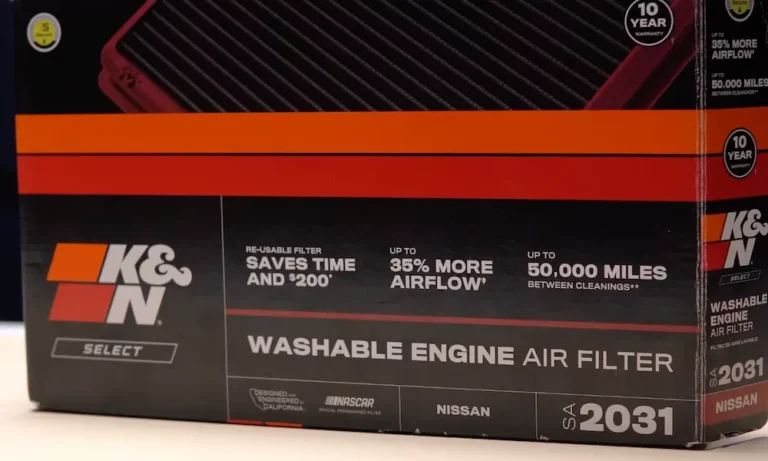
You’re standing in the auto parts store, staring at that orange K&N box with its bold promises of more power and lifetime use. It costs five times more than a regular paper filter, but is it actually worth it? Let’s cut through the marketing hype and look at what the data really shows about these controversial filters.
What Makes K&N Filters Different
K&N filters don’t work like the paper filter that came with your car. Instead of compressed paper fibers, they use multiple layers of oiled cotton fabric sandwiched between pleated aluminum screens. Think of it like a window screen coated with sticky oil—air passes through easily, but particles get caught in the tackiness.
Paper filters trap dirt by forcing air through tiny holes in compressed fibers. K&N’s approach creates larger pores that allow more airflow while relying on oil to grab contaminants. It’s a completely different filtration philosophy, and that difference matters more than you might think.
The cotton gauze construction also makes these filters washable and reusable. K&N markets them as “lifetime” products—you clean and re-oil them instead of throwing them away. Sounds great in theory, but the reality gets complicated fast.
The Performance Claims: What’s Real and What’s Marketing
Airflow Improvements You Can Actually Measure
K&N filters genuinely do flow more air than paper alternatives. Independent testing showed K&N achieving airflow speeds of 57.3 mph compared to 52-55 mph for paper filters, with the lowest static pressure (1.72) among all tested brands.
That’s not marketing fluff—it’s measurable physics. The oiled cotton design creates less restriction than paper fibers, allowing your engine to breathe easier. In acceleration testing, K&N filters enabled 9.2-second 0-60 runs compared to 9.3-9.5 seconds for other brands.
Why You Probably Won’t Notice the Difference
Here’s the catch: your throttle body creates way more restriction than any modern air filter. Unless you’re running wide-open throttle—like full-throttle acceleration or track driving—the airflow difference means absolutely nothing.
Think about your daily driving. How much time do you spend with the gas pedal buried to the floor? Maybe a few seconds when merging onto the highway? The rest of the time, you’re partially closing the throttle body anyway, which creates far more restriction than any filter ever could.
That 0.1-0.3 second improvement in 0-60 times? You’ll never feel it on the street. It’s real, but it’s buried under normal driving variations like traffic, road conditions, and whether you’ve got a full tank of gas.
The Filtration Problem Nobody Talks About
How Much Dirt Actually Gets Through
This is where things get ugly for K&N. Particle counting tests revealed K&N filters allowing 421 large particles through compared to just 18 for Wix filters. For smaller particles (1-5 microns), K&N permitted 3,604 particles versus 401 for Wix.
Let that sink in. We’re talking about nearly ten times more contamination reaching your engine. K&N achieves about 97% filtration efficiency while quality paper filters exceed 99%. That 2% difference sounds small until you realize it means three times more dirt entering your engine.
Your engine doesn’t care about horsepower gains if it’s grinding itself to death with dirt particles. Independent ISO 5011 testing consistently shows K&N’s inferior filtration performance across multiple particle sizes.
What Oil Analysis Reveals
Oil analysis data tells a damning story. Multiple studies document elevated silicon levels—the marker for dirt infiltration—in engines using K&N filters. One oil analysis expert noted that “90% of the analysis I review using a K&N result in elevated silicon (dirt) and associated high wear metals.”
Real-world case studies back this up. Chevrolet Avalanche forum users documented switching back to paper filters after oil analysis showed excess silicon and wear metal levels, with contamination returning to normal after ditching K&N.
Testing on heavy equipment showed K&N filters allowing so much dirt that secondary filters clogged within hours, forcing early test termination. That’s not a minor performance trade-off—it’s a fundamental filtration failure.
The MAF Sensor Nightmare
Why Your Check Engine Light Might Come On
Modern engines use mass air flow (MAF) sensors to measure incoming air and adjust fuel delivery. These sensors are incredibly sensitive, and K&N’s oiled cotton construction can transfer oil particles onto them, causing erratic readings and triggering check engine lights.
BMW M5 owners report repair costs exceeding $1,800 due to K&N-related MAF sensor failures. Symptoms include lean fuel mixture codes, rough idling, and restricted engine operation. Your car literally goes into limp mode because filter oil gunked up a $300 sensor.
The contamination happens when filters arrive over-oiled from the factory or when you apply too much oil during cleaning. Excess oil gets sucked through the filter media and deposits on the MAF sensor’s delicate elements. Even a tiny film disrupts airflow measurement.
The Over-Oiling Problem
K&N provides cleaning instructions and claims proper maintenance prevents MAF issues. But here’s the reality: most people over-oil their filters because the application method isn’t precise. You spray or squeeze oil onto cotton fabric and hope you got it right.
Too little oil and filtration efficiency drops even further. Too much and you’re contaminating sensors. It’s a narrow margin that’s tough to hit consistently, especially when you can’t see how much oil the fabric actually absorbed.
Dealerships increasingly recognize K&N-related MAF problems, and they’re not shy about denying warranty coverage for sensor failures caused by aftermarket filter oil. That $50 you saved on air filters over three years just cost you $500 in sensor repairs.
The Real Cost of “Lifetime” Filters
Breaking Down the Numbers
K&N filters cost $44-70 compared to $8-12 for quality paper filters. You’ll also need cleaning kits at $15-25 plus your time for proper maintenance. Paper filters get replaced every 12,000-15,000 miles—you just swap them in two minutes and you’re done.
Let’s do the math for 100,000 miles:
| Filter Type | Initial Cost | Maintenance Cost | Total Cost | Time Investment |
|---|---|---|---|---|
| K&N | $60 | $75 (3 cleaning kits) | $135 | ~3 hours cleaning |
| Paper (Premium) | $12 × 7 | $0 | $84 | ~15 minutes total |
| Paper (Budget) | $8 × 7 | $0 | $56 | ~15 minutes total |
That “lifetime” filter actually costs more than premium paper filters when you factor in cleaning supplies. And this doesn’t include potential MAF sensor repairs ($300-500) or increased engine wear from worse filtration.
The Maintenance Reality Check
Proper K&N maintenance requires washing with specialized cleaner, thorough drying (24 hours minimum), and precise re-oiling. Skip any step or rush the process and you’ll either reduce filtration efficiency or contaminate sensors.
Compare that to paper filters: pop the hood, undo some clips, swap the filter, close everything up. Five minutes max. No special cleaners, no drying time, no guessing about oil application. You can’t mess it up.
Most people underestimate how annoying regular K&N maintenance becomes. That filter sitting in your garage waiting to dry for 24 hours while you can’t drive your car? Yeah, you’ll do that exactly once before you start cutting corners.
When K&N Filters Make Sense
High-Performance Applications
K&N filters actually shine in specific scenarios. Track cars, drag racing builds, and heavily modified engines benefit from maximum airflow during sustained wide-open throttle operation. When you’re rebuilding your engine every season anyway, the filtration trade-off becomes acceptable.
Race applications where you’re running full throttle for extended periods actually use that extra airflow. The performance gains that disappear in normal driving become real advantages when you’re constantly demanding maximum power.
Dyno testing on modified turbocharged engines sometimes shows measurable power gains with K&N filters as part of a complete intake system. But we’re talking built motors making serious power, not your stock daily driver.
Clean Environment, Highway Driving
If you exclusively drive on clean highways with minimal dust, K&N’s filtration weaknesses matter less. Low contamination environments mean less dirt trying to get through that less-efficient filter media.
But even under ideal conditions, you’re still allowing more engine wear than necessary. Paper filters provide better protection in clean environments too—they just provide way better protection in dirty ones.
Better Alternatives Worth Considering
High-Performance Dry Filters
Want better airflow without oil-related headaches? High-performance dry filters like AEM DryFlow offer improved flow over stock paper while maintaining better filtration than K&N. They eliminate MAF sensor contamination risks entirely.
These filters use advanced synthetic materials that flow well without requiring oil. You get enhanced intake sound and airflow characteristics without the maintenance complexity or sensor problems. They’re the middle ground that makes sense for enthusiasts who want some performance edge.
Premium Paper Filters
For maximum engine protection, quality paper filters from Wix, Purolator, and AC Delco provide excellent filtration with reasonable airflow. Modern paper filter technology has improved dramatically—they’re not the restrictive choke points from decades ago.
These filters represent the optimal choice for daily drivers, warranty-covered vehicles, and anyone prioritizing long-term engine durability. You’re not giving up meaningful performance, and you’re gaining significantly better protection.
Testing shows premium paper filters catching 99%+ of particles while maintaining airflow that’s only marginally less than K&N. For street driving where you’re not at wide-open throttle, that tiny airflow difference is completely invisible.
Special Considerations for Your Vehicle
Turbocharged Engines Need Better Filtration
If you’re running a turbo, superior filtration becomes even more critical. Turbocharger components are extremely sensitive to contamination—abrasive particles that slip past your air filter get accelerated to insane speeds inside the turbo housing.
That contamination wears turbine wheels and damages bearings. Replacing a turbo costs thousands. The microscopic performance gain from a K&N filter isn’t worth the risk of increased turbo wear.
Modern turbocharged engines make excellent power with stock filtration. The factory engineers already optimized airflow for the power levels they’re targeting. You’re not finding hidden horsepower with a different air filter.
Dusty Environments Are K&N Kryptonite
Off-road enthusiasts and people in dusty climates frequently report switching back to paper filters after experiencing accelerated filter clogging and engine contamination. K&N’s open construction gets overwhelmed quickly in challenging environments.
The oiled media becomes saturated with fine particles, reducing both filtration efficiency and airflow benefits. You end up with a filter that doesn’t flow well and doesn’t filter well—the worst of both worlds.
If you drive on dirt roads, live in the desert, or do any off-roading, paper filters are your only sensible choice. They handle contamination loads way better and protect your engine from the harsh conditions.
Warranty Considerations
Got a newer vehicle still under factory warranty? Installing a K&N filter creates potential warranty complications. If you develop engine problems or MAF sensor failures, dealerships may deny coverage by attributing damage to your aftermarket filter.
Even if the filter didn’t cause the problem, you’ve given them an easy excuse to deny your claim. Is that worth saving $40 over the life of your warranty period? Probably not.
Stick with OEM or equivalent paper filters during the warranty period. You can experiment with aftermarket options once you’re paying for repairs out of pocket anyway.
Is K&N Air Filter Worth It? The Bottom Line
For 95% of drivers, K&N filters aren’t worth it. The performance gains are real but meaningless in normal driving, while the filtration compromises create genuine long-term risks. You’re paying more money for worse engine protection and complicated maintenance.
The math doesn’t work unless you’re in specific high-performance scenarios where maximum airflow actually matters. Track cars, race builds, and heavily modified engines can justify the trade-offs. Your daily-driven Camry, Civic, or F-150? Absolutely not.
Quality paper filters from Wix, Purolator, or even your dealer provide better engine protection, simpler maintenance, and lower total cost. Modern paper filters flow plenty of air for stock and mildly modified street engines. You’re not leaving power on the table.
The performance differences that matter happen under wide-open throttle conditions you rarely experience. The filtration differences that matter happen every second your engine is running. Better filtration protects your investment—those few tenths of a second in acceleration don’t.
If you want enhanced intake sound and slightly better airflow without the headaches, consider high-performance dry filters instead. They split the difference without the oil-related complications that plague K&N products.
Save your money, protect your engine, and spend that $50 difference on something that actually improves your driving experience—like better tires, which matter infinitely more than air filters ever will.