
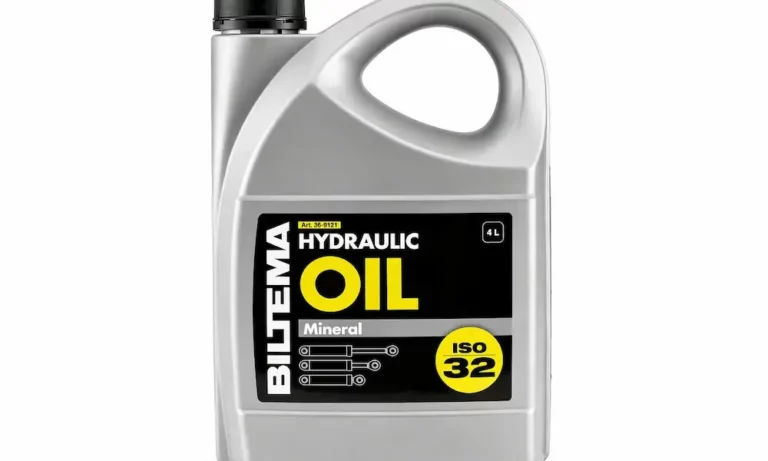
Trying to find the right ISO 32 hydraulic oil equivalent without breaking your equipment — or your budget — can feel like a guessing game. The good news? It doesn’t have to be. This guide breaks down every major brand equivalent, what the specs actually mean, and how to pick the right one for your specific application. Stick around to the end — the cross-reference table alone will save you hours of research.
What ISO 32 Hydraulic Oil Actually Means
The “32” in ISO 32 isn’t random. It refers to a kinematic viscosity of 32 square millimeters per second at 40°C, measured under the ISO 3448 standardization system.
Here’s the allowable range:
| Viscosity Parameter | ISO 32 Specification |
|---|---|
| Mid-Point at 40°C | 32.0 mm²/s |
| Minimum at 40°C | 28.8 mm²/s |
| Maximum at 40°C | 35.2 mm²/s |
| Typical at 100°C | 5.2 – 5.5 mm²/s |
This range means two different brands can both qualify as ISO 32 while still flowing slightly differently. As long as both fall within that window, your pump won’t know the difference — at least not viscosity-wise.
ISO 32 is a thinner grade than ISO 46 or ISO 68. That lower resistance translates to faster valve response, better cold-weather flow, and less energy consumed at startup.
Why the Viscosity Index Matters as Much as the Grade
Here’s something many people miss: the ISO grade only tells you how thick the oil is at one temperature. It says nothing about what happens when things heat up or cool down.
That’s where the Viscosity Index (VI) comes in. The higher the VI number, the more stable the oil stays across a temperature range.
- Standard mineral ISO 32 oils: VI of 95–110
- High Viscosity Index (HVI) fluids: VI of 140–164+
If your equipment sits in an unheated building in Minnesota or runs outdoors in summer heat, a standard VI oil will either be too thick to start in the morning or too thin to protect by afternoon. A high VI equivalent handles both extremes without breaking a sweat.
Performance Designations: HM, HLP, HV, HVLP
Before you swap one ISO 32 oil for another, you need to match the performance classification — not just the viscosity number.
Standard Anti-Wear Fluids (HM / HLP)
These are your go-to for indoor industrial equipment like injection molding machines, metal presses, and assembly lines. They carry ISO 11158 HM or DIN 51524 Part 2 HLP ratings. Zinc-based additives form a protective barrier on metal surfaces under high pressure.
High Viscosity Index Fluids (HV / HVLP)
Mobile equipment, outdoor power units, and construction machinery need more. ISO 11158 HV or DIN 51524 Part 3 HVLP fluids share the same 40°C viscosity but include shear-stable polymers that maintain protection across a wider temperature range.
| Standard | Anti-Wear (AW) Grade | High VI Grade |
|---|---|---|
| ISO 11158 | Type HM | Type HV |
| DIN 51524 | Part 2 (HLP) | Part 3 (HVLP) |
| ASTM D6158 | Type HM | Type HV |
| Eaton Vickers | I-286-S (Stationary) | M-2950-S (Mobile) |
Using the wrong designation is a real problem. Drop a standard HM fluid into a mobile system designed for HVLP, and you’re looking at accelerated pump wear the moment temperatures swing hard.
ISO 32 Hydraulic Oil Equivalent by Brand
Here’s the section most people actually need. Each major brand has a direct equivalent — but not all equivalents are equal in terms of service life, base oil quality, or additive chemistry.
ExxonMobil ISO 32 Equivalents
Mobil’s hydraulic line covers every application tier:
- Mobil DTE 24 Ultra — Standard industrial AW (HLP). Extended drain intervals and strong keep-clean performance. The go-to equivalent for most indoor systems.
- Mobil Univis N 32 — Multi-grade HVI fluid for mobile and outdoor equipment.
- Mobil DTE 10 Excel 32 — Zinc-free, high-efficiency fluid. Laboratory testing shows up to 6% better pump efficiency compared to standard DTE 20 series equivalents. In a large facility, that percentage becomes serious annual savings.
- Mobil SHC 524 — Fully synthetic ISO 32 for extreme conditions.
Shell ISO 32 Equivalents
Shell’s Tellus range is one of the most widely used in North America:
- Shell Tellus S2 MX 32 — Successor to the S2 M series. Premium oxidation resistance for standard industrial use.
- Shell Tellus S2 VX 32 — Multi-grade equivalent for mobile and outdoor applications. Shear-resistant VI improvers maintain performance through long drain intervals.
- Shell Tellus S4 ME 32 — High-efficiency synthetic for heavy-duty industrial use. Targets energy savings and extended maintenance windows.
Chevron ISO 32 Equivalents
Chevron’s hydraulic lineup leans heavily on base stock quality:
- Chevron Rando HD 32 — Zinc-based AW fluid for high-pressure industrial and mobile service. Meets most vane, gear, and piston pump specs.
- Chevron Rando HDZ 32 — High VI multi-grade equivalent. Oxidation life reportedly up to three times longer than standard industry fluids in lab testing.
- Chevron Clarity Hydraulic Oil AW 32 — Zinc-free option for systems sensitive to standard additives or in environmentally monitored areas.
Castrol ISO 32 Equivalents
Castrol’s Hyspin range is frequently specified by international OEMs:
- Castrol Hyspin AWS 32 — Premium mineral AW fluid with excellent thermal stability and sludge resistance.
- Castrol Hyspin AWH-M 32 — Multi-grade equivalent that holds viscosity under high shear and heat.
- Castrol Dual Range HV 32 — Built specifically for mobile equipment. Handles cold starts without hesitation and holds up under full load.
Phillips 66 and Kendall ISO 32 Equivalents
These brands are heavily used in agriculture and industrial sectors across the U.S.:
- Phillips 66 Megaflow AW 32 — Strong water separation and oxidation resistance for standard industrial use.
- Phillips 66 Megaflow AW HVI 32 — Multi-grade cold climate fluid. Certified for high dielectric strength — required for bucket trucks and aerial lifts working near power lines.
- Kendall Four Seasons Hydraulic AW 32 — Versatile equivalent covering both stationary and mobile applications.
Valvoline ISO 32 Equivalents
Valvoline’s anti-wear hydraulic line offers a solid range at competitive price points:
- Valvoline AW ISO 32 — Standard industrial equivalent with VI of 109 and a pour point of -42°C — excellent cold-weather performance.
- Valvoline Ultramax HVLP 32 — Multi-grade for extreme temperature environments.
- Valvoline Ultramax AF 32 — Ashless (zinc-free) formulation for sensitive systems.
Full ISO 32 Hydraulic Oil Cross-Reference Table
This is the quick-reference breakdown every maintenance professional needs:
| Manufacturer | Standard AW (HM/HLP) | High VI (HV/HVLP) | Zinc-Free / Specialized |
|---|---|---|---|
| Mobil | DTE 24 Ultra | Univis N 32 | DTE 10 Excel 32 |
| Shell | Tellus S2 MX 32 | Tellus S2 VX 32 | Tellus S4 ME 32 |
| Chevron | Rando HD 32 | Rando HDZ 32 | Clarity AW 32 |
| Castrol | Hyspin AWS 32 | Hyspin AWH-M 32 | Hyspin ZZ 32 |
| Phillips 66 | Megaflow AW 32 | Megaflow AW HVI 32 | Ecoterra 32 |
| Valvoline | AW ISO 32 | Ultramax HVLP 32 | Ultramax AF 32 |
| Texaco | Rando HD 32 | Rando HDZ 32 | Rando HD Ashless 32 |
| Mystik | AW Hydraulic Oil 32 | JT-9 LeakShield HVI 32 | — |
| Sinopec | L-HM 32 | L-HV 32 | — |
| Kendall | Four Seasons AW 32 | — | Hyken 052 (Ag-specific) |
Technical Performance Comparison Across Major Brands
Not all ISO 32 equivalents perform the same over time. Here’s how top products stack up on the specs that matter most:
| Product | VI | Pour Point | Flash Point | Oxidation Life |
|---|---|---|---|---|
| Mobil DTE 24 Ultra | 100 | -30°C | 225°C | 6,000+ hrs |
| Shell Tellus S2 MX 32 | 105 | -30°C | 210°C | 5,000+ hrs |
| Chevron Rando HD 32 | 100 | -33°C | 210°C | 2,000+ hrs |
| Phillips 66 Megaflow AW 32 | 102 | -37°C | 216°C | 5,000+ hrs |
| Valvoline AW ISO 32 | 109 | -42°C | 200°C | 6,000+ hrs |
| Castrol Hyspin AWS 32 | 95+ | -27°C | 210°C | 2,500+ hrs |
| Mystik JT-9 LeakShield 32 | 108 | -30°C | 224°C | 6,000 hrs |
| Mobil DTE 10 Excel 32 | 164 | -54°C | 250°C | 10,000+ hrs |
The Mobil DTE 10 Excel 32 is in a different class entirely — it’s the premium synthetic pick when maximum efficiency and longevity matter most.
When ISO 32 Is the Right Choice (And When It’s Not)
Use ISO 32 When:
- Cold temperatures are common. ISO 32 flows freely in unheated facilities or outdoor environments where temps drop below 50°F. It prevents pump cavitation during cold starts — the condition where thick oil can’t fill the pump inlet fast enough, causing rapid internal damage.
- System pressure stays below 1,500 PSI. At lower pressures, flow efficiency beats film strength. ISO 32 prioritizes fast signal transmission through control circuits.
- Precision control matters. Plastic injection molding, automated assembly, and high-speed machining benefit from ISO 32’s low resistance, which allows control valves to respond faster and more accurately.
Consider a Heavier Grade When:
- System pressure regularly exceeds 3,000–4,000 PSI.
- The equipment runs at sustained high temperatures in direct sunlight.
- The OEM specifically calls for ISO 46 or ISO 68.
Specialized Applications That Need More Than a Standard Equivalent
Agricultural Equipment
Tractors and utility equipment often use a single fluid for hydraulics, transmission, and wet brakes. Standard ISO 32 won’t work here. You need a Universal Tractor Transmission Oil (UTTO) with specific friction modifiers. Products like Mobilfluid 424 and Shell Spirax S4 TXM fill this role. Using a standard hydraulic fluid in a wet brake system causes brake chatter — or worse, brake failure.
Utility Aerial Lifts
Phillips 66 Megaflow AW HVI 32 and specific Valvoline variants are tested to withstand 30 kV or more — a requirement for aerial lift trucks working near high-voltage lines. This property disappears the moment the oil picks up moisture, so keeping these systems clean and dry isn’t optional.
Food Processing
NSF H1 registered fluids like Mobil SHC Cibus 32 are formulated for incidental food contact. They deliver full anti-wear protection without the risk of contaminating product lines.
Environmentally Sensitive Areas
Forestry, marine, and coastal operations often require biodegradable equivalents made from synthetic esters or vegetable base oils. These break down naturally if a leak occurs, reducing environmental liability.
| Application | Required Property | Equivalent Type |
|---|---|---|
| Utility Aerial Lifts | High Dielectric Strength | HVI with Dielectric Certification |
| Food Processing | Incidental Contact Safety | NSF H1 Registered |
| Agriculture | Wet Brake Compatibility | UTTO / J20C Compliant |
| Precision Manufacturing | Energy Efficiency | High-Efficiency / Ashless |
| Environmentally Sensitive | Biodegradability | Synthetic Ester / Vegetable Base |
What to Check Before Switching Brands
Swapping ISO 32 equivalents isn’t as simple as pouring a new jug in. Here’s what to verify first:
Check additive compatibility. Most mineral-based AW oils are physically compatible, but zinc-based and zinc-free (ashless) formulations can react badly when mixed. The reaction can form precipitates that clog filters fast.
Drain and flush properly. If the old oil was oxidized or contaminated, don’t just top off with the new product. Drain fully, flush the system, and replace all filters before refilling.
Watch the seals. Mineral ISO 32 fluids are generally compatible with nitrile and fluoropolymer seals. But switching to a synthetic or biodegradable equivalent? Verify seal compatibility first. Some older systems respond to seal-swelling agents like those in Mystik JT-9 LeakShield, which can actually stop minor leaks in aging equipment.
Monitor the first 500 hours. After a fluid change, pull an oil sample around the 500-hour mark. Check for unusual wear metals or signs of additive depletion. Catching problems early prevents expensive pump failures.
The Real Cost of Getting It Wrong
Choosing the cheapest ISO 32 equivalent rarely saves money long-term.
- A properly matched premium fluid can reduce pump wear and mechanical failure by up to 40%.
- Extended drain interval fluids like Chevron Rando HDZ cut oil change frequency by up to 3x compared to standard products — that’s real labor savings.
- High-efficiency fluids like Mobil DTE 10 Excel deliver up to 6% energy savings — in a facility running dozens of hydraulic machines, that adds up quickly year over year.
- Preventing control valve sticking from sludge buildup avoids unplanned downtime — which always costs more than the oil itself.
The right ISO 32 hydraulic oil equivalent isn’t just about matching a number. It’s about matching the additive chemistry, performance classification, and operating conditions to your specific equipment — and then sticking to a consistent maintenance schedule that protects your investment.


