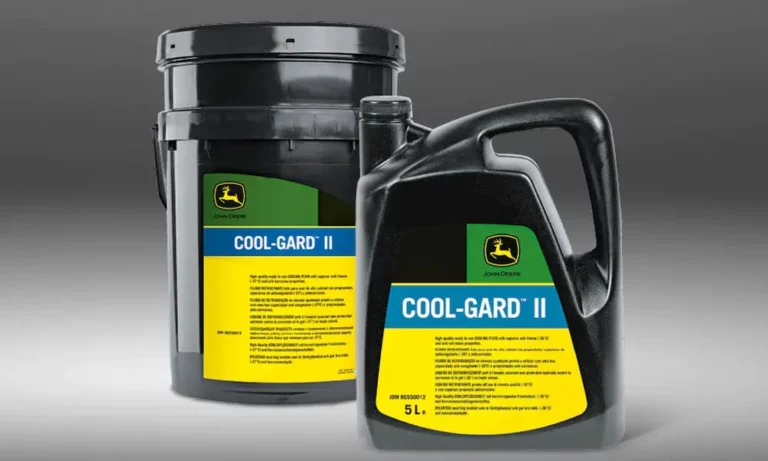
Cool-Gard II isn’t cheap, and it’s not always on the shelf when you need it. If you’re running John Deere equipment and need a reliable substitute, the wrong choice can wreck your cooling system fast. This guide breaks down exactly what makes Cool-Gard II tick, which products match it, and what to watch out for when you swap it out.
What Makes Cool-Gard II Different From Regular Coolant
John Deere Cool-Gard II isn’t just antifreeze with a green label. It’s a fully formulated, nitrite-free extended life coolant built specifically for modern diesel engines running hotter and harder than ever.
Here’s what sets it apart:
- OAT chemistry (Organic Acid Technology) — uses carboxylate acids instead of old-school inorganic salts
- Nitrite-free — safe for aluminum-heavy cooling systems
- 2-EHA free — won’t degrade rubber gaskets and seals
- 6-year or 6,000-hour service life under heavy-duty conditions
- No SCA top-ups needed at the initial fill
The shift from conventional coolants to OAT matters because traditional silicate-based coolants deplete fast, create scale, and can’t handle the thermal load of Final Tier 4 engines. Cool-Gard II’s carboxylate inhibitors only activate where corrosion is actually starting — which means they last far longer.
The Physical Properties You Need to Match
Any John Deere Cool-Gard 2 equivalent needs to hit these benchmarks. If a product doesn’t match up here, move on.
| Property | Cool-Gard II (50/50 Premix) | Standard |
|---|---|---|
| pH | 7.9 | ASTM D1287 |
| Freeze Point | -37°C (-34°F) | ASTM D1177 |
| Boiling Point | 108°C (226°F) | Visual |
| Density @ 15°C | 1.080 g/cm³ | DIN 51757 |
| Chloride Content | < 13 ppm | Visual |
| Reserve Alkalinity | 7.0 | ASTM D1121 |
| Color | Gold / Yellowish | Visual |
One thing worth repeating: don’t use color as a compatibility guide. Color is just a dye — different brands use different shades for the same chemistry. A red OAT coolant can be perfectly compatible with a gold one.
Why Nitrite-Free Is Non-Negotiable
This is the hill you need to die on. Using a nitrited coolant in a John Deere machine with aluminum radiators and heat exchangers is a fast track to serious damage.
Here’s what happens: nitrites react with aluminum surfaces under high heat and flow, forming aluminum hydroxide deposits that can block radiator tubes in fewer than 75 hours of operation. That’s not a slow problem — that’s a “your machine is down in a week” problem.
Any equivalent you choose must be nitrite-free. No exceptions.
The JDQ-1522 Test: Why It Matters for Equivalents
John Deere doesn’t just rely on standard ASTM testing. They run their own JDQ-1522 Thermal Oxidative Stability Test, which exposes coolant and metal samples to 148°C (300°F) for seven days straight.
Here’s how Cool-Gard II stacks up against generic alternatives:
| Metal Type | Cool-Gard II Mass Loss (mg) | Competitive Universal ELC (mg) | Automotive Coolant (mg) |
|---|---|---|---|
| Aluminum | 0 | 371 | 342 |
| Cast Iron | 5 | 386 | 160 |
| Steel | 6 | 86 | 29 |
| Copper | 28 | 269 | 205 |
| Brass | 17 | 68 | 123 |
| Solder | 5 | 24 | 32 |
The aluminum and cast iron numbers are the ones that should grab your attention. Cool-Gard II causes zero measurable aluminum loss. Generic ELCs? 371 mg. That’s not a minor difference — that’s your cooling system eating itself.
When shopping for a John Deere Cool-Gard 2 equivalent, look for products that specifically test to ASTM D6210, which covers heavy-duty diesel engine coolant performance.
The Best John Deere Cool-Gard 2 Equivalents Right Now
Shell Rotella® ELC Nitrite Free
Shell Rotella® ELC NF is probably the most widely available direct match for Cool-Gard II in North America. It’s nitrite-free, 2-EHA free, and rated for up to 24,000 hours in some commercial applications — well beyond John Deere’s 6,000-hour requirement.
It meets ASTM D6210, ASTM D3306, and Cummins CES 14439, which aligns closely with what John Deere demands internally.
Chevron Delo® ELC Nitrite Free
Chevron Delo® ELC NF uses carboxylate OAT chemistry and is rated for 12,000 hours of off-highway service. It protects all six common cooling system metals, stabilizes pH across long service intervals, and meets Detroit Diesel 93K217 and ASTM D6210.
One practical advantage: Delo® doesn’t form a thick insulating layer on metal surfaces the way silicate-based coolants do, which means better heat transfer throughout the service life.
Valvoline Zerex™ HD Nitrite Free
Zerex™ HD Nitrite Free ELC is directly recommended for John Deere equipment by Valvoline. It’s rated for up to 10 years or 1,000,000 miles, registered to Cummins CES 14603, and conforms to ASTM D6210.
It’s also backward-compatible with older OAT systems, which makes it a solid pick for mixed fleets running machines of different ages.
Peak Final Charge® Global Extended Life
Peak Final Charge® Global is nitrite-free, phosphate-free, silicate-free, and borate-free. It’s rated for 20,000 hours of off-road use and explicitly meets John Deere H24A1/C1 — which is the OEM specification Cool-Gard II is built around.
Its “Contamination Tolerant Additives” let it maintain protection even when mixed with up to 25% of a different coolant technology, though a clean flush is always the better move.
Mobil Delvac™ Extended Life Coolant/Antifreeze
Mobil Delvac™ ELC is specifically recommended for John Deere H24A1 and H24C1 specifications. It’s free of nitrates, phosphates, borates, and silicates, and is rated for 20,000 hours of off-highway use. A clean, reliable option for fleet operators who already use Mobil products across their equipment.
Side-by-Side Comparison
| Product | Technology | Nitrite-Free | 2-EHA Free | Off-Road Service Life |
|---|---|---|---|---|
| John Deere Cool-Gard II | OAT | ✅ | ✅ | 6,000 Hours |
| Shell Rotella® ELC NF | OAT | ✅ | ✅ | 12,000–24,000 Hours |
| Chevron Delo® ELC NF | OAT | ✅ | — | 12,000 Hours |
| Zerex™ HD Nitrite Free | OAT | ✅ | — | 20,000 Hours |
| Peak Final Charge® Global | OAT | ✅ | ✅ | 20,000 Hours |
| Mobil Delvac™ ELC | OAT | ✅ | — | 20,000 Hours |
All five meet ASTM D6210. All five are nitrite-free. Any of them will work as a John Deere Cool-Gard 2 equivalent when you follow the right mixing and compatibility steps.
Getting the Mix Right: Water Quality Matters More Than You Think
If you’re using concentrate rather than premix, your water quality directly affects how well any coolant performs. Hard water introduces calcium and magnesium, which form scale on heat transfer surfaces and cause hot spots, warped heads, and liner failure.
Use distilled, deionized, or demineralized water and make sure it meets these specs before mixing:
| Impurity | Maximum Allowed |
|---|---|
| Chlorides | < 40 mg/L |
| Sulfates | < 100 mg/L |
| Total Dissolved Solids | < 340 mg/L |
| Total Hardness | < 170 mg/L |
| pH | 5.5 to 9.0 |
Tap water might look clean, but it can quietly kill your inhibitor package within the first few hundred hours.
Glycol Concentration and Freeze Protection
Stick to a glycol concentration between 40% and 60%. Going above 60% doesn’t give you more protection — it actually causes the coolant to gel and lose heat transfer ability. Below 40% and you’re not getting enough corrosion protection.
| Glycol Concentration | Freeze Point (EG) | Freeze Point (PG) |
|---|---|---|
| 40% | -24°C (-12°F) | -21°C (-6°F) |
| 50% | -37°C (-34°F) | -33°C (-27°F) |
| 60% | -52°C (-62°F) | -49°C (-56°F) |
Most operators in temperate climates are fine at 50/50. If you’re running equipment in northern winters, bump to 60% — but don’t go beyond that.
Mixing Coolants: What You Absolutely Can’t Do
A few hard rules when swapping coolants:
- Don’t mix ethylene glycol (EG) and propylene glycol (PG). They have different physical properties, and your refractometer won’t give you an accurate freeze point reading on the blend.
- Don’t mix OAT with nitrited coolants. If contamination exceeds 25% of the system volume, you’ve lost the extended-life benefit. Treat it as a conventional 2,000-hour system or flush it.
- Don’t skip the flush when switching from conventional coolant to an OAT equivalent. Drain, flush with clean water or a dedicated cooling system cleaner, refill, and purge air pockets.
Keeping an Eye on Coolant Health Between Services
Even with a 6,000-hour fluid, you can’t just set it and forget it. Build a simple monitoring habit:
- Visual check — Look for cloudiness, floating debris, or oil contamination
- Freeze point — Test with a refractometer matched to your glycol type (EG and PG read differently)
- pH — A drop below 7.0 is a warning sign. It means the glycol is degrading and acids are forming
- Nitrite test strips — If you run a mixed fleet, confirm no nitrites have snuck in
And if you’re going the full 6,000 hours, consider adding a coolant extender at the halfway mark to replenish the organic inhibitors. Most ELC manufacturers recommend it, and it’s cheap insurance compared to a cooling system rebuild.
A Note on Propylene Glycol Systems
If your machine uses Cool-Gard II PG — the propylene glycol version for environmentally sensitive areas — make sure any equivalent you choose is also PG-based and nitrite-free. PG is less toxic to wildlife and safer in spill situations, but you can’t substitute EG into a PG system and expect accurate testing results.
Finding a PG-based nitrite-free ELC is harder than finding an EG equivalent, but they do exist. Check manufacturer specs carefully before ordering.
Used Coolant Disposal
Don’t pour used coolant down the drain or into the soil. Once it’s been through an engine, it accumulates heavy metals like copper and lead. It’s classified as hazardous waste once contaminated, regardless of how eco-friendly the unused formula was. Check your local regulations and use an approved disposal service or recycling facility.