Lost your VW key? Need a spare? You’re about to discover why Volkswagen key programming isn’t as simple as cutting a new blade at the hardware store — and exactly what it costs, who can do it, and where things go wrong. Stick around, because the answer changes completely depending on your car’s year.
Why Volkswagen Key Programming Is More Complex Than Most Cars
VW doesn’t use a single key security system. They use five generations of immobilizer technology, each more complex than the last.
The immobilizer is the system that tells your engine, “Yes, this is the right key — go ahead and start.” Without a properly matched key, your engine cranks for two seconds and dies. Every time.
Here’s the core issue: the older your VW, the more options you have. The newer it is, the fewer people can actually help you — and the more it costs.
What’s an Immobilizer, Exactly?
Your VW’s immobilizer communicates between several components:
- The instrument cluster (dashboard)
- The engine control unit (ECU)
- The transmission control unit (TCU)
- The electronic steering column lock (ELV)
All of these need to agree that your key is legitimate. If one module gets replaced without proper programming, your car won’t start. Understanding which immobilizer generation your car uses is the first — and most critical — step in any key programming job.
The Five Generations of VW Immobilizer Systems
This table sums up what Ross-Tech’s VCDS documentation calls one of the most diverse security ecosystems in the automotive industry:
| Generation | Years (Approx.) | Key Type | PIN Format | VCDS Readable? |
|---|---|---|---|---|
| Gen 1 | Early 1990s (RoW) | Fixed Code (Festcode) | 4-digit | Yes |
| Gen 2 | 2000–2001 (NAR) | Crypto (ID48) | 4-digit | Yes (with PIN) |
| Gen 3 | 2002–2005 | Crypto (Locked) | 4–5 digit | Yes (with PIN) |
| Gen 4 | 2005–2012 | AES / Hitag | 7-digit / Token | Limited |
| Gen 5 (MQB) | 2012–Present | Megamos AES / Hitag-Pro | Online Token | No |
Generations 1, 2, and 3: The “Good Old Days”
For Gen 1 vehicles, programming a new key needs a 4-digit PIN. VW originally put this on a scratch-off tag in your owner’s kit. These older keys used a fixed code — meaning the transponder chip sent the same signal every time, which made them easier to copy (and easier to program).
Gen 2 introduced “Crypto” transponders that use a variable handshake, blocking simple replay attacks. Gen 3 went further — once you matched a key to a vehicle, the chip locked permanently. You couldn’t reuse that key in another car.
Generation 4: The Challenge-Response Wall
Gen 4 ditched the static PIN model entirely. Instead of entering a code, the immobilizer generates a revolving “Challenge” value that changes every ignition cycle. Standard enthusiast tools can’t keep up. According to Lock Medic’s technical breakdown, Gen 4 also introduced “Component Security” (CS) bytes — 16 bytes of data, with one byte requiring up to 256 attempts to guess correctly.
Generation 5 / MQB: Distributed Security Across the Whole Car
The MQB platform (launched 2012) spreads security information across every major module on the vehicle’s CAN network. There’s no single “master” module anymore. Abrites’ MQB programming guide identifies three sub-variants:
- IMMO 5A: Renesas V850 processor, uses ID88 transponders
- IMMO 5B: Renesas RH850 processor, similar data structure
- IMMO 5C: RH850 with a “crypto core” that blocks standard diagnostic port reads — introduced around 2020 in the Golf 8, Polo, and Tiguan
All-Keys-Lost on an MQB vehicle? You’re looking at bench-reading the instrument cluster chip directly. One mistake can permanently brick the cluster — costing thousands to replace.
The Secret Key Code (SKC) and the GeKo System
For older VWs, Volkswagen key programming required a Secret Key Code (SKC). Early systems used a 4-digit static PIN. Newer systems moved to a 7-digit SKC that Ross-Tech describes as tied to a specific date, workshop code, and importer number.
By April 2005, VW eliminated visible PIN delivery entirely. The GeKo system (Geheimzahl- und Komponentenschutz) sends the code directly from VW’s German servers to the dealer’s scan tool — without ever showing it on screen. The technician never sees the actual code. This shift started a trend that’s only gotten more extreme with today’s vehicles.
SFD and SFD2: The Modern Security Wall
If you drive a 2024 or newer VW, Audi, Škoda, or SEAT, welcome to SFD2 territory.
SFD (Schutz Fahrzeug Diagnose) was introduced in 2020 to comply with UNECE R155 and R156 cybersecurity regulations, which require connected vehicles to be protected against unauthorized software changes.
SFD1 was relatively manageable — it logged access and required a token to unlock write functions, but tools could sometimes automate around it.
SFD2 is a different beast. As Carista explains in their SFD2 breakdown, it’s not a single gateway lock. Each write command or data change requires its own manufacturer-signed token, generated through a challenge-response handshake with VW’s servers. You can’t just “unlock the car for 90 minutes.” Every individual change needs its own authorization.
Which Cars Does SFD2 Affect?
| Brand | Affected Models (2024+) | Protected Units |
|---|---|---|
| Volkswagen | ID.4, ID.Buzz, Golf 8, Atlas | Engine, Cluster, Central Electrics |
| Audi | A3 (8Y), Q4 e-tron, Q8 e-tron | Gateway, Multimedia, Steering |
| Škoda | Octavia IV, Enyaq, Kodiaq II | Airbag, Brakes, Power Liftgate |
| SEAT/Cupra | Leon IV, Born, Formentor | Transmission, Parking Assist |
Immobilizer vs. Component Protection: Don’t Confuse Them
These are two separate systems, and mixing them up causes real headaches.
The immobilizer stops your engine from running without a valid key. It targets the ECU, TCU, cluster, and ELV.
Component Protection (CP) is a secondary layer that stops stolen parts from being reused in other cars. It targets infotainment units, climate control modules, gateways, and seat adjusters. When CP activates on a used part, you might see a “Component Protection Active” message with no audio, or a climate system stuck at basic defrost mode.
CP removal requires an online session through ODIS, where VW’s servers check the module’s serial number against a global stolen parts database. If it’s clear, the server “remarries” it to your VIN. Component Protection has expanded dramatically from covering just radios in 2003 to covering nearly every module by 2022.
Choosing the Right Key Hardware: Don’t Get This Wrong
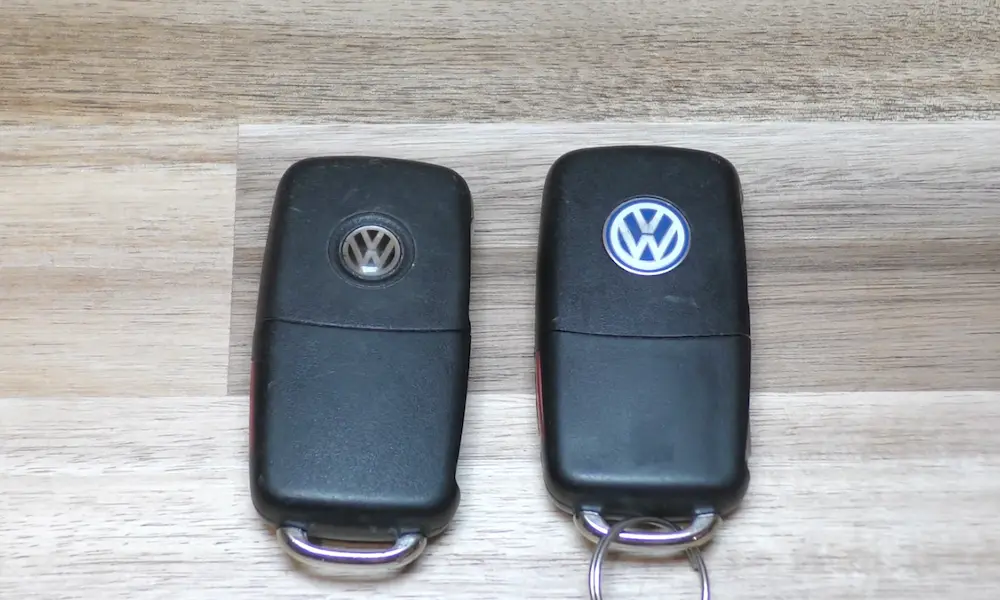
315 MHz vs. 433 MHz Key Fobs
Buy the wrong frequency and your key will start the car but won’t lock or unlock the doors. These two frequency bands divide sharply by region:
- 315 MHz — North America and Japan
- 433.92 MHz — Europe, Middle East, China
The transponder chip (which handles starting the engine) operates on a near-field frequency that’s separate from the remote locking function. So a mismatched fob can pass the immobilizer check but still fail on the remote. Analog Devices’ overview of remote keyless entry systems explains why these regional standards exist and why they’re strictly enforced.
Reading VW Part Numbers
VW uses a 9-digit part number format. Just Kampers’ guide to reading VW part numbers breaks down what each digit tells you about the component — from vehicle type to specific revision. Matching both the part number and the FCC ID on the back of the fob is the most reliable way to confirm you’re buying the right key. Two fobs can share an FCC ID but contain different transponder chips internally (ID48 Crypto vs. ID48 CAN, for example). Keyless City’s guide to FCC IDs, part numbers, and VINs is worth bookmarking before you buy anything online.
Tools Used for Volkswagen Key Programming
ODIS — The Dealer’s Weapon
ODIS (Offboard Diagnostic Information System) is the only software with full native support for SFD2 and Component Protection removal. Its power comes from direct integration with VW’s GeKo servers. ODIS vs. VCDS comparisons consistently show ODIS winning on coverage but losing hard on cost and complexity — independent shops pay over $1,000/year for licenses, plus hardware.
VCDS — The Enthusiast Standard
Ross-Tech’s VCDS handles Generations 1, 2, and 3 well — as long as you already have the PIN. It can’t touch Gen 4 Challenge-based systems or MQB platforms, because it has no pathway to VW’s security servers. Great for diagnostics and basic coding on older cars. Not the tool for key matching on anything post-2012.
Autel MaxiIM and Xhorse VVDI
These are the workhorses for professional automotive locksmiths. Tools like the Autel IM608 Pro II and the Xhorse VVDI Key Tool Plus work by:
- Reading EEPROM chips directly from the circuit board (bypassing OBDII security)
- Sending security data to cloud servers to calculate CS or sync data
- Automatically unlocking SFD1 gateways through third-party token services
For MQB All-Keys-Lost jobs, the Autel XP400 Pro adapter reads key slot data directly, allowing the tool to generate a functional “Dealer Key” from extracted synchronization bytes.
VAG Tacho and Xtool VAG409
For MK4-era vehicles (Gen 2 and 3), these inexpensive tools still work well. They extract the 4-digit SKC/PIN directly from the instrument cluster memory. A modern $2,000 scan tool often can’t do this without a server connection — so for older VWs, the $20 tool sometimes wins.
What Does Volkswagen Key Programming Actually Cost?
The price gap between your three options is significant. Here’s a realistic breakdown:
| Service Component | Dealer | Locksmith | DIY |
|---|---|---|---|
| Fob Hardware | $200–$350 | $100–$200 | $15–$80 |
| Key Blade Cutting | $80–$120 | $30–$60 | $10–$30 |
| IMMO Programming | $150–$250 | $100–$150 | $20–$50 |
| Mobile Service Fee | N/A | $50–$100 | N/A |
| Total | $430–$720 | $280–$510 | $45–$160 |
Reddit discussions in the VW community consistently show locksmiths beating dealer prices by 30–50% on pre-2024 vehicles. Miramar Locksmith’s breakdown confirms this pricing pattern, with on-site service eliminating the towing cost that’s often the dealership’s hidden expense.
For 2024+ SFD2 vehicles: Almost no independent locksmiths can help you right now. The official ODIS connection required costs more than the profit on a single job. The dealer is essentially your only real option. West Broad Volkswagen’s explainer on key replacement costs spells out exactly why modern key replacement is priced the way it is.
Adding a Spare Key vs. All-Keys-Lost: Two Very Different Jobs
Adding a spare key is relatively straightforward. The working key contains the security seeds a programmer needs. Tools like the Autel XP400 Pro read the CS bytes from the existing key, prepare a Dealer Key, then register both keys through an OBDII session.
All-Keys-Lost on an MQB vehicle is a completely different situation:
- Physically open the locked door (alarm triggers, potentially blocking diagnostics)
- Remove the instrument cluster for bench reading
- Extract 16 bytes of Component Security data and 32 bytes of sync data
- Cross-reference dashboard data with ECU and TCU data
- Write the calculated sync data to a blank transponder
- Complete final learning via OBDII
One wrong step during bench reading can brick the cluster permanently. That’s a potential $1,500–$3,000 mistake. MQB all-keys-lost jobs are documented in detail by Abrites, and the workflow makes clear why very few shops tackle them confidently.
Where VW Key Programming Is Headed
The 2026 trajectory points toward asymmetric encryption — meaning even if a technician reads the chip data, the private key stays on VW’s German servers. Offline key programming for new models becomes technically impossible. Newer MEB electric vehicle platforms also use CAN FD protocols, requiring faster diagnostic hardware like the Autel JVCI+ or VAS 6154A.
For independent locksmiths, the role is shifting from cracking local electronics to facilitating official remote connections — borrowing dealer-level server access through “Remote Expert” platforms. The standalone VW, fully manageable by an independent shop, is becoming a thing of the past.
The bottom line: if your VW predates 2012, your options are wide open and your costs are manageable. From 2012 to 2023, you need a professional locksmith with MQB capability or a dealership. From 2024 onward, budget for the dealer — and verify they have SFD2 access before you book the appointment.