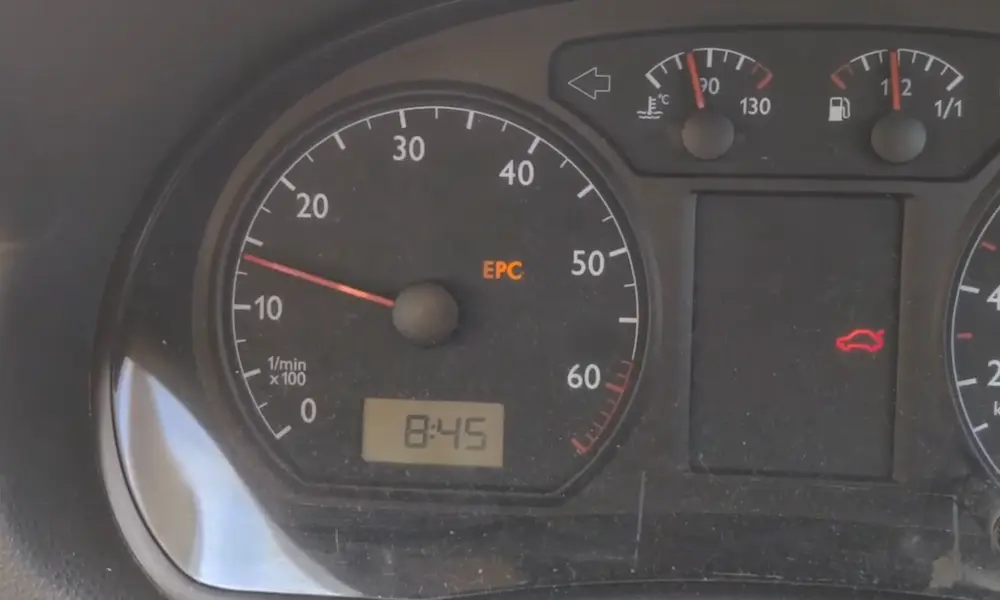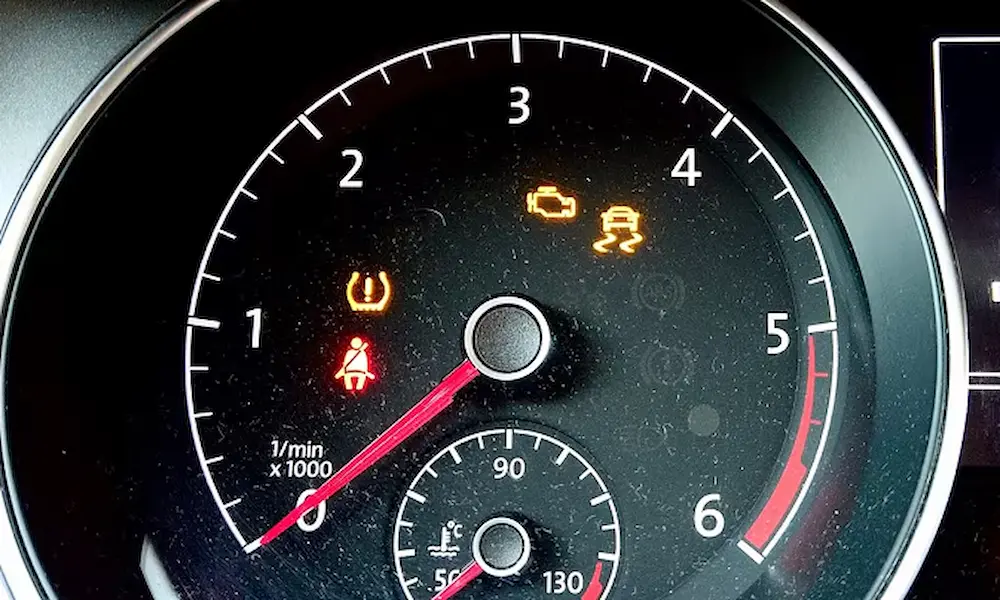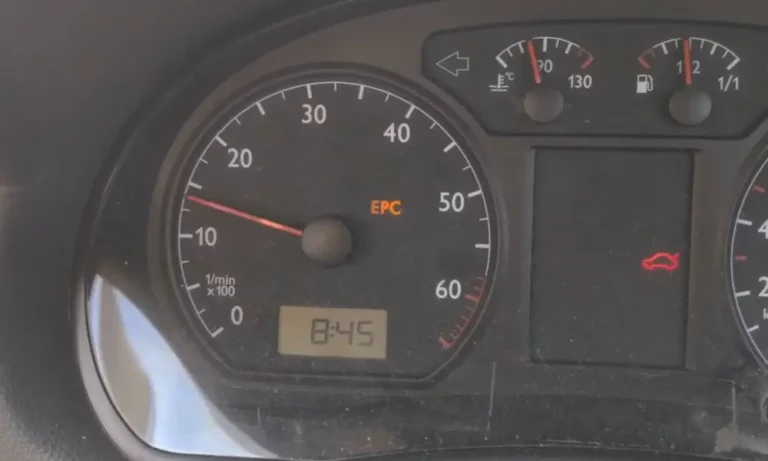
That little “EPC” light just popped up on your VW’s dashboard, and now you’re wondering if you can still drive or if your car is about to self-destruct. Good news — it’s probably not that dramatic. But you shouldn’t ignore it either. This guide breaks down exactly what’s happening, what causes it, and what it’ll cost you to fix.
What Does the VW EPC Light Actually Mean?
EPC stands for Electronic Power Control. It’s your VW’s way of saying, “Hey, something in the throttle or engine management system isn’t right.”
Unlike the standard Check Engine Light (which mainly tracks emissions), the VW EPC light covers a much wider range of systems — throttle body, accelerator pedal, traction control, and even the brakes. Think of it as a more serious, more comprehensive warning.
Your car runs on a “drive-by-wire” system. There’s no physical cable connecting your foot to the engine anymore. Instead, sensors read your pedal position and send electronic signals to the Engine Control Unit (ECU). When those signals don’t line up, the EPC light comes on.
What Happens When the EPC Light Comes On?
Two scenarios play out when the VW EPC light turns on:
Scenario 1: The light comes on but the car drives normally. You likely have a soft fault — something intermittent that the ECU logged but isn’t critical yet. Still get it scanned soon.
Scenario 2: The light comes on and the car feels sluggish or limited. You’re in limp home mode. The ECU has intentionally capped your power to protect the engine. Expect:
- A top speed around 40 mph
- No revs above 3,000–4,000 RPM
- Reduced throttle response
Limp mode isn’t a punishment — it’s the ECU keeping your car drivable while preventing further damage. Don’t push it. Head to a shop.
The 7 Most Common Causes of the VW EPC Light
1. Dirty or Failing Throttle Body
This is the number one cause of the EPC light across the entire VW lineup. Direct-injection engines like the 1.8T and 2.0T TSI accumulate carbon buildup on the throttle plate over time. That buildup creates resistance, the throttle can’t reach the angle the ECU commands, and — EPC light.
In more serious cases, the resistance burns out the throttle body’s internal motor. At that point, cleaning won’t cut it. You’ll need a replacement plus a “throttle body alignment” using a diagnostic tool.
2. Faulty Accelerator Pedal Position Sensor
Your accelerator pedal has two sensors that send matching voltage signals to the ECU. It’s a built-in redundancy system to prevent unintended acceleration. If those two signals disagree, the ECU flags it immediately and lights up the EPC warning.
3. Bad Brake Light Switch
Here’s one that surprises people. Your brake light switch does two jobs — it powers your rear brake lights AND sends a safety signal to the ECU. If the second circuit fails, you get an EPC light even if your brake lights look perfectly fine from outside the car.
This was such a widespread problem that VW issued a recall affecting approximately 790,000 vehicles in the US. Models included the 1999–2005 Golf and Jetta and the 1998–2007 New Beetle. If you own one of these, check if your car was covered. The NHTSA recall documentation confirms the brake light switch replacement campaign in detail.
4. Weak or Failing Battery
Your EPC sensors need stable voltage to send accurate readings. A battery that’s more than 3–4 years old can drop voltage just enough to produce “ghost” EPC codes — especially during cold starts. Always test the battery’s cold cranking amps (CCA) before replacing expensive sensors.
5. Turbocharger Wastegate Actuator (MQB Platform)
If you drive a newer VW — a Mark 7 Golf GTI, 2018–2023 Tiguan, or similar MQB-platform vehicle — watch for the turbocharger wastegate actuator. High heat cycles cause the actuator arm to seize, which triggers a P00AF code and the EPC light.
Important: dealerships sometimes quote $3,600–$4,000 for a full turbo replacement when the actual problem is just a $200 actuator. Push for a proper diagnosis before approving any large repair.
6. Ignition Coils and Spark Plugs
When a coil fails on your 2.0T TSI engine, you get a cylinder misfire. The crankshaft position sensor picks up the irregular engine rhythm, reports it to the ECU, and the system can trigger both the Check Engine Light and the EPC light simultaneously. Rough idle + EPC = check your coils first.
7. PCV Valve Failure
The Positive Crankcase Ventilation valve on the 2.0T is a plastic assembly at the top of the cylinder head. When its internal diaphragm tears, it creates an air leak that bypasses the MAF sensor entirely. The ECU can’t calculate the correct air-fuel mix, resulting in a P0171 “system too lean” code and an EPC warning. Clues: loud whistling noise and rough idle.
Common EPC-Related Fault Codes
| DTC Code | What It Means | Likely Cause |
|---|---|---|
| P0121 | Throttle position sensor “A” — range/performance | Carbon buildup or wiring fault |
| P0221 | Throttle position sensor “B” — range/performance | Internal throttle body failure |
| P0507 | Idle RPM too high | Vacuum leak or bad PCV valve |
| P0300 | Random/multiple cylinder misfire | Worn coils or spark plugs |
| P2015 | Intake manifold runner sensor — range/performance | Worn plastic linkage in manifold |
| P00AF | Turbo boost control “A” performance | Seized wastegate actuator |
How to Diagnose the EPC Light Step by Step
Don’t just swap parts and hope for the best. Here’s the right diagnostic process:
- Check for limp mode — Is the car limited in power? This tells you how urgent the situation is.
- Scan for codes — Use an OBD-II scanner or, better yet, a VCDS tool from Ross-Tech, which shows VW-specific data including fault frequency and reset counters.
- Check the basics first — Test battery voltage (should be above 12.2V at rest). Check that brake lights work. Look for loose intake hose clamps.
- Visual inspection — Open the hood and look for carbon on the throttle plate, torn vacuum lines, or oil leaks near the coils.
- Component testing — Use a multimeter on sensors or run VCDS output tests to command the throttle motor directly.
- Fix and adapt — After replacing a part, clear the codes and run any required adaptations like throttle body alignment. Skipping this step means the ECU won’t recognize the new hardware.
Professional diagnostics typically cost $131–$209 but can save you hundreds by identifying the actual problem rather than guessing. As this breakdown of how diagnostics save money on repairs explains, a proper scan pays for itself quickly.
VW EPC Light Repair Costs
| Repair | Estimated Cost |
|---|---|
| Diagnostic scan | $50 – $150 |
| Throttle body cleaning | $100 – $250 |
| Brake light switch replacement | $100 – $200 |
| Battery replacement | $150 – $350 |
| Ignition coils + spark plugs | $200 – $550 |
| Throttle body replacement | $400 – $800 |
| Intake manifold replacement | $600 – $1,200 |
| Turbo wastegate / actuator repair | $1,500 – $4,000 |
For older VW models, an independent European specialist often offers better value than a dealership. They’re more likely to clean and test components rather than push for full assembly replacements.
Model-Specific EPC Issues Worth Knowing
VW Jetta and Golf (1.8T / 2.0T TSI)
Carbon buildup on the throttle body is the biggest repeat offender here. Direct injection means fuel doesn’t wash the intake valves, so soot accumulates fast. Regular throttle body cleanings at every 40,000–60,000 miles can delay or prevent full replacements.
VW New Beetle, Golf, Jetta (Pre-2006)
These are the models covered by the brake light switch recall. If you bought one used and it’s throwing an EPC light, verify the recall was completed using your VIN at the NHTSA website.
VW Golf GTI and Tiguan (2018–2023 MQB)
Wastegate actuator corrosion is the repeat problem here. Catch it early — a seized actuator can eventually break the linkage pin, turning a $200 fix into a potential $4,000 turbo replacement.
VW 2.0T Across Multiple Models (2008–2019)
A class-action lawsuit (Rieger v. Volkswagen Group of America) alleged defective piston rings and timing chains in these engines. Defective piston rings cause excessive oil consumption and cylinder compression loss — which eventually triggers EPC faults through misfires and torque loss. If your EPC light comes with high oil consumption, that’s a red flag worth investigating seriously.
Preventative Maintenance That Keeps the EPC Light Off
A few simple habits can dramatically reduce your EPC warning odds:
- Test your battery every 2–3 years. Voltage instability causes more ghost EPC codes than most people realize.
- Use Top Tier gasoline. The detergent additives slow carbon buildup on the throttle plate — not a complete solution for direct-injection engines, but it helps.
- Check your intake ducting regularly. A loose clamp or cracked hose creates an unmetered air leak that throws the ECU into confusion and triggers limp mode.
- Don’t skip ignition service. Replacing coils and plugs on schedule (roughly every 40,000 miles on most TSI engines) prevents misfires that escalate to EPC events.
- Address oil consumption early. Burning through more than a quart per 1,000 miles on a 2.0T deserves immediate attention — not just a top-up.
The VW EPC light is one of the more informative warning lights your car can show you. It’s specific, it’s urgent, and it’s telling you something real. The worst thing you can do is clear the code without diagnosing it, drive on, and let a $150 brake switch turn into a $1,500 repair. Get it scanned, get it fixed, and keep driving.