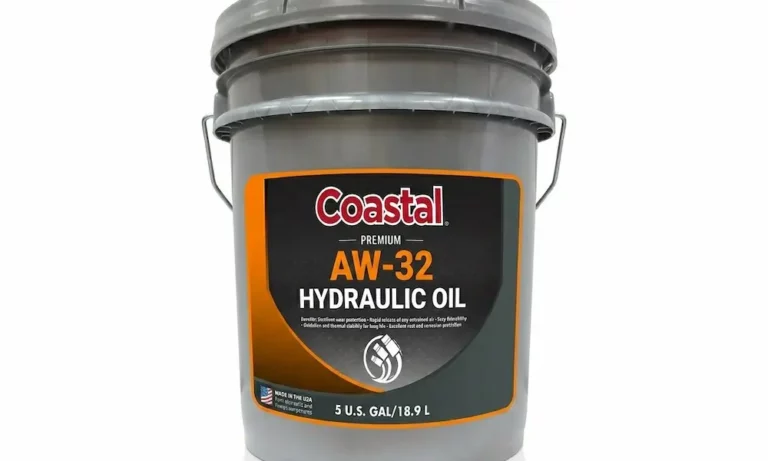
Finding the right AW 32 hydraulic fluid equivalent doesn’t have to be a guessing game. Whether your usual brand is out of stock or you’re just shopping smarter, this guide breaks down every major equivalent, what makes them interchangeable, and what to avoid. Stick around — the mixing section alone could save your pump.
What Is AW 32 Hydraulic Fluid, Exactly?
AW 32 is an anti-wear hydraulic oil built around the ISO VG 32 viscosity grade. The “32” means it flows at roughly 32 centistokes when measured at 40°C. Think of it as a 10-weight oil — thin enough to flow fast, thick enough to protect.
The “AW” part matters just as much. It signals a chemical additive package that forms a sacrificial film on metal surfaces when the load gets heavy. Without it, vane pumps, piston pumps, and gear pumps wear fast.
Here’s a quick snapshot of what AW 32 looks like on paper:
| Specification | Typical Value | Test Method |
|---|---|---|
| Kinematic Viscosity at 40°C | 28.8 – 35.2 cSt | ASTM D445 |
| Kinematic Viscosity at 100°C | 5.3 – 6.9 cSt | ASTM D445 |
| Viscosity Index (Standard) | 95 – 115 | ASTM D2270 |
| Flash Point | 210°C – 220°C | ASTM D92 |
| Pour Point | -27°C to -34°C | ASTM D97 |
| Specific Gravity at 15.6°C | 0.865 – 0.882 | ASTM D1298 |
AW 32 works best in systems operating between 0°F and 120°F. Its low pour point makes it a solid pick for cold-climate startups and indoor manufacturing alike.
The Standards That Define a True Equivalent
Before you grab any bottle labeled “AW 32,” check that it meets one of these two benchmarks:
- ISO 11158 HM — the global standard for anti-wear hydraulic oils
- DIN 51524-2 (HLP) — the European benchmark, widely referenced by Bosch Rexroth and Eaton Vickers
These ISO and DIN classifications confirm the fluid passed real-world tests — not just viscosity checks. Any fluid that meets both qualifies as a genuine AW 32 hydraulic fluid equivalent.
If you need wide-temperature performance, look for the HV / HVLP tier instead:
| Standard | Type | What It Means |
|---|---|---|
| ISO-L-HM | AW-grade mineral oil | Standard anti-wear; most common |
| ISO-L-HV | High Viscosity Index AW | Stable across temperature swings |
| DIN 51524-2 (HLP) | European AW benchmark | Required by most pump OEMs |
| DIN 51524-3 (HVLP) | High VI European AW | Mobile and outdoor equipment |
Major Brand AW 32 Hydraulic Fluid Equivalents
Most Tier 1 manufacturers produce a fluid that matches ISO HM and DIN HLP specs. That makes them interchangeable in most standard systems. Here’s the full breakdown:
Mobil AW 32 Equivalents
Mobil’s flagship AW 32 product is the Mobil DTE 24. It’s been the industry benchmark for decades. Mobil also offers the DTE 24 Ultra and the DTE 10 Excel 32, the latter being a high-viscosity-index option designed to cut energy consumption by staying more stable across temperature changes.
Shell AW 32 Equivalents
Shell’s go-to is the Shell Tellus S2 MX 32, the successor to the older Tellus 32 name. For machines dealing with big temperature swings, the Tellus S2 VX 32 steps up to the HV/HVLP tier.
Chevron and Texaco AW 32 Equivalents
Chevron sells its AW 32 as Rando HD 32 — a zinc-based fluid designed for heavy-duty industrial and mobile use. It meets Denison HF-0 and Eaton Vickers requirements. Texaco’s Rando HD 32 is practically the same product under a different label, common in marine and international markets.
Castrol AW 32 Equivalent
Castrol rebranded its line not long ago. Castrol Hyspin AWS 32 replaced the older Castrol Paradene AW 32. Same zinc-based mineral oil formula, same anti-wear protection — just a new name on the drum.
Full Tier 1 Cross-Reference Table
| Manufacturer | Standard AW 32 Product | High-VI Version |
|---|---|---|
| Mobil | DTE 24 / DTE 24 Ultra | DTE 10 Excel 32 / Univis N 32 |
| Shell | Tellus S2 MX 32 | Tellus S2 VX 32 |
| Chevron | Rando HD 32 | Rando HDZ 32 |
| Castrol | Hyspin AWS 32 | Hyspin AWH-M 32 |
| Total | Azolla ZS 32 | Equivis ZS 32 |
| Valvoline | Valvoline HLP 32 | Ultramax MG 32 |
| Fuchs | Renolin B 10 VG 32 | Renolin HVI 32 |
| Gulf | Harmony AW 32 | Harmony HVI 32 |
| Phillips 66 | Megaflow AW 32 | Ecoterra HVI 32 |
| Sinopec | Sinopec AW 32 | Sinopec High VI AW 32 |
Retail AW 32 Equivalents You Can Grab Today
Not everyone orders in 55-gallon drums. Sometimes you just need a gallon to top off a log splitter or a vehicle lift. These retail options cover that need without sacrificing quality for everyday applications.
Walmart Super Tech AW 32
Walmart’s Super Tech Anti-Wear Hydraulic Oil ISO 32 meets ASTM D6158 and Parker Denison HF-0. It’s a smart budget pick for light-duty systems — log splitters, vehicle lifts, and small workshop hydraulics. Don’t expect it to shine in extreme-pressure industrial pumps running around the clock.
Tractor Supply Traveller AW 32
The Traveller ISO 32 Premium Anti-Wear Hydraulic Fluid is a staple at farm supply stores. It handles general agricultural machinery well. Just don’t confuse it with the Traveller Premium Universal Tractor Trans/Hydraulic Fluid — that’s a totally different product for shared reservoirs, and mixing them up can damage your equipment.
AutoZone and O’Reilly Options
AutoZone carries STP AW-32 Hydraulic Fluid in one-gallon bottles — fine for moderate service like RV hydraulics, dump trailers, and basic lifts. O’Reilly’s house-brand AW-32 comes in a five-gallon pail, which works well for small fleet maintenance when you need it fast.
| Retailer | Product | Size | Best For |
|---|---|---|---|
| Walmart | Super Tech Anti-Wear ISO 32 | 1-gal, 5-gal, 18.9L | Log splitters, light duty |
| Tractor Supply | Traveller ISO 32 Premium | 1-gal, 2-gal, 5-gal | Agricultural equipment |
| AutoZone | STP AW-32 | 1-gal | RV hydraulics, dump trailers |
| O’Reilly | O’Reilly AW-32 | 5-gal | Small fleet maintenance |
| Home Depot | Powercare AW ISO 32 | 1-gal | Outdoor power equipment |
AW 32 vs. Universal Tractor Fluid — Don’t Mix These Up
This is the mistake that kills hydraulic systems and transmissions. AW 32 and Universal Tractor Fluid (UTF) are not interchangeable — even if both end up in a hydraulic circuit.
AW 32 does one job well: power transmission. Its formula focuses on water separation and fast air release to prevent pump cavitation. It contains no friction modifiers, no extreme pressure gear additives, and no detergents.
Universal Tractor Fluid — typically meeting John Deere J20C — must lubricate the transmission, differential, wet brakes, and hydraulics from a single reservoir. To do that, it needs:
- Friction modifiers for smooth wet-brake engagement
- Extreme pressure additives for high-torque transmission gears
- Detergents to suspend particles in the fluid
Put AW 32 in a system that needs J20C fluid and the wet brakes will chatter, then fail. Put UTF in a high-pressure industrial pump and it foams, loses efficiency, and clogs filters.
| Feature | AW 32 Hydraulic Oil | Universal Tractor Fluid (J20C) |
|---|---|---|
| Power Transmission | Excellent — low foaming | Good — may foam in fast pumps |
| Gear Protection | Basic lubrication only | High — EP additives included |
| Wet Brake Operation | Not suitable — causes chatter | Required — friction modifiers included |
| Water Separation | Superior demulsibility | Moderate — detergents interfere |
| Typical Viscosity | ISO 32 / Single grade (10W) | Multi-grade (~10W-30) |
Can You Mix Different Brands of AW 32?
Short answer: it’s not ideal, even when the grade matches.
The issue is additive chemistry. One brand might use a zinc dialkyldithiophosphate system, another might use an ashless phosphorus-based package. In rare cases, these react and form solid precipitates that plug fine hydraulic filters fast. Even if nothing dramatic happens, you’re diluting the additive concentration in both fluids.
The right way to switch brands is to drain while the oil is warm, replace all filters, clean the reservoir, and refill with the new product.
The one exception: mixing within the same brand’s product line. Lucas Oil, for example, uses identical additive packages across its AW 32, AW 46, and AW 68 grades. In that case, mixing grades is safe and can even be useful — blending AW 32 with AW 46 gives you an intermediate viscosity that helps compensate for worn seals or shifting climate conditions.
| Scenario | What Happens | What to Do |
|---|---|---|
| Brand A AW 32 + Brand B AW 32 | Possible additive drop-out | Avoid — flush first |
| Lucas AW 32 + Lucas AW 46 | Intermediate viscosity achieved | Safe and useful |
| AW 32 + Universal Tractor Fluid | Water separation fails; lubrication compromised | Never mix — drain and flush |
| AW 32 + Motor Oil | Foaming; possible seal damage | Never mix |
Choosing the Right AW 32 Equivalent for Your Situation
Not all AW 32 applications are the same. Here’s how to match the fluid to the job:
Indoor manufacturing or injection molding? A standard AW 32 from Mobil, Shell, or Castrol covers you well. The temperature stays controlled and loads stay consistent.
Cold-climate mobile equipment like snow plows? Standard AW 32 is still the right call. Its pour point of -30°C to -34°C means cold starts don’t starve the pump.
All-weather construction equipment like excavators? Go for an HVI 32 or step up to AW 46. You need a fluid that stays stable from a freezing morning to a hot afternoon job site.
Food processing or environmentally sensitive areas? Choose an ashless, zinc-free AW 32. These use phosphorus and sulfur-based organics instead of zinc compounds, which reduces contamination risk and avoids reactions with yellow metals.
How Long Does AW 32 Last — and How Do You Know When It’s Done?
Most systems call for an oil change every 1,000 to 2,000 hours, or once a year — whichever hits first. But that’s a general rule, not gospel.
Three things degrade AW 32 faster than anything else:
- Heat — excessive temperatures oxidize the base oil, producing sludge and varnish that gunk up valves and filters
- Water — condensation through worn seals creates a milky emulsion that promotes rust and can seize a pump; high-quality fluids from brands like Total Azolla ZS 32 handle this better than budget options
- Particulates — metal wear particles and external dust act as abrasives, grinding away precision pump surfaces
The best approach for high-value equipment is oil analysis. Send a small sample to a lab and get actual data on wear metals, additive depletion, and moisture levels. It tells you exactly when to change the oil — not just when the calendar says to. That alone can extend component life significantly and catch mechanical problems before they become expensive.