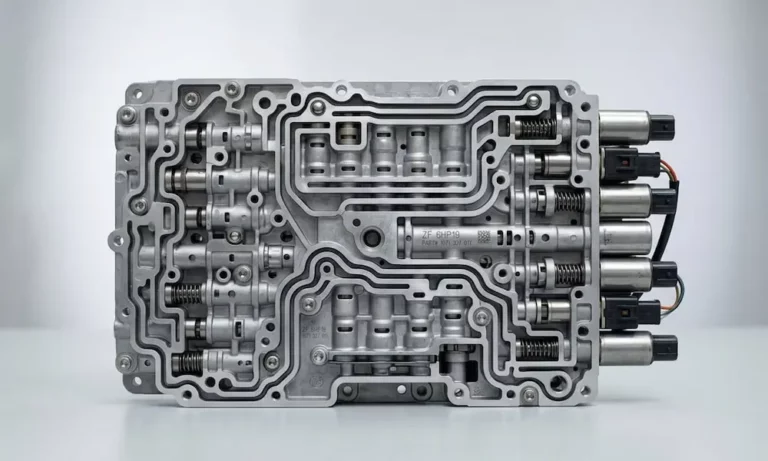
Your car slams into gear. Or hesitates. Or just locks itself into third and refuses to budge. Sound familiar? A failing valve body could be the culprit — and transmission valve body replacement might be exactly what your car needs. This guide breaks down everything: symptoms, repair options, real costs, and the step-by-step process.
What Does a Transmission Valve Body Actually Do?
Think of the valve body as the brain of your automatic transmission. It’s a hydraulic control center that routes pressurized fluid to the right clutches at the right time — which is what makes your gears shift smoothly.
Inside, it’s a maze of precision-machined passages, spring-loaded valves, check balls, and solenoids. In older transmissions, mechanical pressure handled everything. In modern vehicles, solenoids controlled by a transmission control module (TCM) do the heavy lifting.
Here’s a quick breakdown of what’s inside:
| Component | What It Does |
|---|---|
| Main Housing | Routes fluid through machined channels |
| Control Valves | Opens and closes fluid passages |
| Solenoids | Converts electrical signals into hydraulic movement |
| Check Balls | Prevents fluid backflow |
| Separator Plate | Divides valve body sections and controls flow |
The more gears your transmission has, the more complex this system gets. Today’s 8- and 10-speed transmissions make the valve body far more intricate than older 3-speed units.
Why Valve Bodies Fail
Valve body failure is almost never sudden. It builds up gradually — and usually comes down to one of three causes.
Contaminated Fluid
Dirty transmission fluid is the most common villain. As clutch plates wear inside your transmission, they release fine metallic debris into the fluid. That debris enters the valve body and scores the walls of the valve bores, creating tiny leaks that bleed off hydraulic pressure. Less pressure means gears slip. Slipping gears burn up friction material. It snowballs fast.
Solenoid Wear
Modern solenoids cycle hundreds of times per minute to manage shift quality. Over time, the internal coils short out, or the plunger sticks from fluid varnish buildup. In popular platforms like the Ford 6R80 and GM 6L80, solenoid failure is a leading cause of hard shifts and missing gears.
Heat Damage
Excessive heat breaks down fluid viscosity, turns it into varnish, and can even warp aluminum valve body castings. Rubber check balls shrink or seat too deeply. Valves bind. Shift timing goes erratic.
Symptoms That Point to Valve Body Trouble
These are the signs your valve body is struggling:
- Harsh or jarring shifts — the car bangs into gear instead of gliding
- Delayed engagement — a pause when shifting from Park to Drive or Reverse (called a “delayed garage shift”)
- Shift flares — RPMs spike between gears during acceleration
- TCC shudder — feels like driving over rumble strips at highway speeds
- Limp home mode — transmission locks into one gear, check engine light comes on
That last one is your TCM throwing up a red flag. It’s saying: something is seriously wrong, and I’m protecting the transmission from destroying itself.
| Symptom | What’s Likely Happening |
|---|---|
| Delayed Park-to-Drive engagement | Low line pressure or leaking manual valve |
| Jarring gear changes | Faulty pressure control solenoid |
| RPM spikes between gears | Internal pressure leak or worn valve bores |
| Locked in 3rd gear | Solenoid circuit failure or electronic fault |
| Highway shudder | TCC solenoid malfunction |
Reading the Trouble Codes
When your check engine light comes on alongside shifting issues, a scan tool will pull Powertrain Diagnostic Trouble Codes (DTCs) from the 0700 series. Here are the ones most commonly tied to valve body problems:
| Code | What It Means |
|---|---|
| P0700 | General TCM fault — dig deeper |
| P0730 | Incorrect gear ratio — pressure or slippage issue |
| P0740 | Torque converter clutch circuit malfunction |
| P0750 | Shift solenoid A failure |
| P2707 | Shift solenoid F stuck — common in 6+ speed units |
One important caveat: a solenoid code doesn’t always mean the solenoid itself is dead. It could be a wiring harness fault, a bad connector, or a blocked hydraulic passage. That’s why technicians cross-reference live data — comparing commanded line pressure vs. actual pressure — before ordering parts. A big gap between those two numbers points directly to a mechanical hydraulic blockage inside the valve body.
Your Repair Options: Rebuild, Remanufacture, or Replace
When it’s confirmed — you need transmission valve body replacement. You’ve got three realistic paths.
Remanufactured (Best Overall Value)
A remanufactured valve body isn’t just a cleaned-up used part. It’s completely disassembled, cleaned in heated high-pressure tanks, and re-engineered. Known design flaws get corrected — worn bores get hardened sleeves, all solenoids are replaced, and the finished unit gets tested on a dynamometer to verify real-world pressure and shift timing. It’s the closest thing to a factory-fresh unit.
Rebuilt (Budget-Friendly, Higher Risk)
A rebuild targets the specific failed part — usually one solenoid or a sticking valve. It’s cheaper and faster, but it doesn’t address hidden wear elsewhere. Rebuilds work best on lower-mileage vehicles where the rest of the valve body is still healthy.
Used (Avoid If Possible)
Salvage yard valve bodies are a gamble. You don’t know its history, its internal condition, or its mileage. And since labor costs are high, paying twice for the same job wipes out any savings on the part.
| Option | Warranty | Best For |
|---|---|---|
| New OEM | 1 year / 12,000 miles | Vehicles under warranty |
| Remanufactured | 2–3 years / nationwide | Working trucks, high-mileage commuters |
| Rebuilt | 1 year / local shop | Tight budget, minor solenoid issues |
| Used | 30–90 days | Emergency repair only |
How Transmission Valve Body Replacement Works
This is a precise job. Here’s what a professional replacement looks like from start to finish.
Draining and Disassembly
The transmission needs to be cool before work starts — hot aluminum warps. The pan comes off, the fluid drains, and the filter is pulled and discarded. Technicians inspect the pan magnets carefully. Large metal chunks or heavy metallic “glitter” in the pan signals internal mechanical damage that a new valve body won’t fix.
Removing the Old Unit
The wiring harness disconnects from the solenoids first — those plastic connectors get brittle from heat cycles. Then the mounting bolts come out. Because many transmissions use bolts of different lengths, technicians often press each bolt into a cardboard template so nothing gets mixed up. The valve body lowers slowly — loose check balls and springs can fall out during this step, so slow and careful wins here.
Installing the New Valve Body
The mating surface on the transmission case gets wiped clean with lint-free rags. Then comes the most critical step: indexing the manual valve. This valve must align precisely with the shifter linkage pin. Miss it, and the car won’t engage any gear — and could damage the linkage internally.
Bolts go in finger-tight first, then torqued in a criss-cross pattern to a very low spec — typically 8–10 Newton-meters. Over-tightening even one bolt can distort the casting and cause the new valves to stick. A new filter and pan gasket go on, and the transmission gets filled with the correct fluid — using the wrong brand-specific fluid (Dexron, Mercon, or CVT-specific) is not an option.
The TCM Reset and Relearn Cycle
Here’s something most people don’t know: after transmission valve body replacement, the job isn’t done when the last bolt is tightened.
Your TCM has been adapting its shift tables to compensate for the old worn valve body. If you don’t clear that memory, the computer runs the new unit like it’s already worn out. Shifts feel off. Pressure targets are wrong.
A scan tool wipes the adaptive tables and resets the TCM to factory defaults. Then comes the relearn drive cycle:
| Phase | What You Do | Why |
|---|---|---|
| Warm-up | Drive gently to 170°F fluid temp | Stabilizes viscosity for accurate measurements |
| Garage shifts | N to D and N to R, hold 5 seconds, repeat 10 times | Teaches clutch engagement timing |
| Upshift sequence | Light throttle from 0–50 mph through all gears | Calibrates gear-to-gear transition timing |
| Coast-downs | 60 mph to a stop without heavy braking | Sets downshift and engine braking timing |
For some Ford and GM vehicles, the full adaptation can take up to 100 miles. Slightly firm or hesitant shifts during this period are completely normal — the computer is still learning.
What Does Transmission Valve Body Replacement Cost?
Costs depend on your vehicle, your region, and which repair path you choose.
Parts:
- Domestic brands (Chevy, Ford, Dodge): $300–$600 for a remanufactured unit
- European imports (BMW, Mercedes): $1,200+ — especially if the unit includes an integrated Mechatronic module
Labor: 3–6 hours depending on transmission access
Regional labor rates also shift the final bill significantly:
| US Region | Typical Shop Rate |
|---|---|
| West (CA, WA, AK) | $140–$200+ per hour |
| Northeast (NY, NJ, PA) | $135–$180 per hour |
| Midwest (IL, OH, NE) | $120–$150 per hour |
| South (FL, GA, TX) | $100–$160 per hour |
| Rural South (MS, AR, NC) | $85–$140 per hour |
In high-cost markets like California or New York, the total bill including diagnostics, fluid, and software programming can reach $2,500–$3,500. In rural areas, an independent transmission specialist might complete the same repair for under $1,200.
How to Avoid Valve Body Failure in the First Place
The single best thing you can do? Change your transmission fluid regularly. Despite manufacturer claims about “lifetime” fluid, real-world transmission specialists recommend fluid and filter changes every 40,000 to 60,000 miles. Clean fluid keeps contamination out of the valve bores, maintains proper viscosity under heat, and dramatically extends the life of your solenoids.
Don’t ignore early symptoms either. A slight shift hesitation caught early is a $400 solenoid replacement. Left alone, it becomes a $2,500 valve body job — or a full transmission rebuild.
The valve body is precision hydraulic engineering packed into a small aluminum housing. Treat the fluid well, and it’ll keep your shifts smooth for a long time.